MatC – 13
An author's collection of thoughts and stories

I actually have a hard time knowing how to classify my writing. Oh sure, there’s the big picture ‘fantasy/sci fi’ tag, but I get a little lost in the subgenres.
For example, my concept story “THEM” is my idea for a time traveling romance. Only, it features a nebulous alien invasion versus sorcerers, and the main love interest travels back in time to coach the main character (who was brought forward in time after her original was killed by the aliens) on how to seduce his contemporary counterpart, except she’s a reluctant introvert with social anxiety. All while she’s nannying a 4-year-old prince. Cue gothic overtones.
Maybe I’m just not well read enough, but I haven’t seen any hints of other books that are remotely like that.
Am I my own niche?
Which is one of the reasons why it’s so easy for me to put off that whole “marketing” thing (not to mention, I don’t want to mentally drain myself so I can’t spend time writing every day, ’cause it’s the writing part that I love the most).
I also have a malfunction.
But sometimes I feel lost in the noise. There are a lot of danged writers these days, and sometimes I think it’s harder to convince people to read something for free than it is to get them to buy it. Like, da hek ppl?
Am I going to find more readers by demanding money? Is that what you want out of me?
Anyway
My husband thinks I’m better at writing sci fi than fantasy. It is true that I was exposed to fantasy first, and there is a possibility that I might have stuck with it out of habit, despite the fact that I don’t actually like “sword and sorcery” type stuff all that much; hence why my Order of the Magi all use the internet and conduct their business with electronic tablets. I also prefer to explore human nature, instead of ‘world building’ or any of the typical fantasy tropes, but I also don’t like Star Trek type stories, or “technology is the magic” sorts of things either. I guess that I’ve got a nerdy enough bent to me that I like a solid foundation in reality. I’ve probably just illustrated that I’m actually a very picky reader.
So … the sequel to The Black Magus will very likely have a more sci fi atmosphere instead of fantasy. Heck, I established that magic is mostly just learning how to muck around with reality’s programming code anyway.
The hilarious part is, I have zero intuitive understanding of today’s trendy technology. Smart devices and I don’t get along. At all.


Quick recap: I wrote The Scion Suit in 2019 as a response to a writing prompt on Reddit that ended up being popular.
SO
While Carol and Lambert did develop some chemistry between the two of them during the course of the story, there simply wasn’t enough time for either of them to realize it consciously. Since this story was ‘unplanned,’ and was written while I was in the middle of working on The Black Magus, I kept it short and to the point, with the idea of returning to expand it into a full-length novel someday.
I’m a hopeless romantic. Honestly, sometimes it feels a little embarrassing to say, “I write love stories,” when so many people start groaning at those words, and I can easily imagine lurkers from Reddit reading this post and thinking to themselves, “She’s going to ruin TSS by adding sex!” (You know it! *wink wink*) But what can I say? It’s just who I am. A pervert.
Let’s be frank: Reddit was fun, but it wasn’t enough to keep me there. Ultimately, I found more joy in pursuing my own projects, even though they don’t get as much attention (admittedly, I don’t advertise). If you, as a reader, dislike things like romance, sex, and babies, then I’m not the author for you. I have five kids IRL, meaning there’s a huge amount of living out my fantasies and writing what I know going on, so naturally it’s going to permeate through my fiction.
I’m going to write my story arc where Carol and Lambert do everything right to end up [in bed] together, it’s going to be emotional and hot, and I’m going to love every second of it. So there. Deal with it.
Besides, there’s no point in trying to deny it.
I’m not exactly vanilla.
And the dynamic between those two is too kinky to ignore.




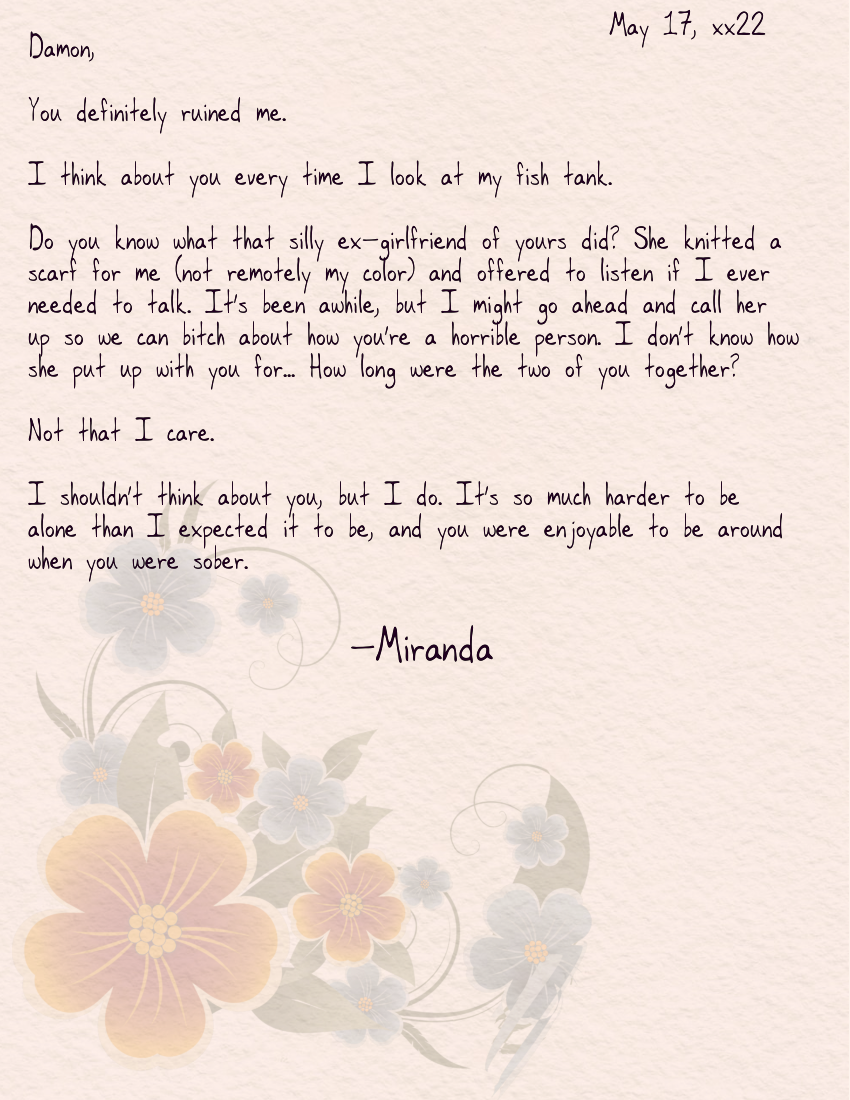


I wrote about 10,000 words of additional content for The Scion Suit in a week, which is *fast* for me. And, since the original was only 15,000 words, means that the VN is going to be *substantially* bigger (I’ve only added one alternate ending so far).
I definitely should have kept exercising over the winter, instead of letting myself get bogged down. But now I know just how important it is to my health (my blood clot resolved a few days ago, in case you were wondering).
Rules of living:
1. Stay hydrated
2. Keep moving
3. Magnesium
Anyway
I decided to write in my normal 3rd-person narration style since that’s what I’m most comfortable with, to be converted into a script later. And, in lieu of numbering each section, I titled them instead.
Highlights include:
Learning to Cuss
Kinky
My Girlfriend is an Alien
Actions Have Consequences
That Didn’t Go Well
Have I Gone Mad?
I’m probably going to eventually publish this stuff as a choose-your-own-adventure novel, since it includes events from Lambert’s perspective that aren’t going to be part of the VN … I got a little caught up in the story, lol.
I’m more than likely not going to be able to keep up that pace (I promised my kids a banana cream pie today), but dang it sure is nice to know that I’ve got it in me. But who knows, maybe I’ll be able to get this out faster than I originally thought.


The Rules:
Thank you Kat, from The Lily Cafe for the nomination!
The story:
I’m currently in writing binge mode, which (true to the stereotype) is making me ditzy about everything else. So, forgive me for the weird things that I’m inevitably going to say.
I created my blog during the summer of 2012, while my husband and I were living off-grid with our first newborn. I was in an alternate world back then — talking to trees to predict the future sort of stuff — so I can’t for the life of me remember why I did it; I just know that “Autumn Rain” was intended to be highly symbolic and infused with magic for my lifelong desire to be a writer. I sure wish I knew what was going through my mind, but I trust that I set myself up with the right thing.
Ultimately, I traded psychic ability for a laundry machine, because my body couldn’t keep up with the amount of physical labor that was required with the resources that were available. Consequently, I now eat too much junk food, exercise too little, and rarely have a clue what the breeze is trying to say. I’m always telling myself that I know better.
I didn’t post at all until 2017. By that point I had three babies, and I realized that the planets were never going to align and give me space to focus on writing — I had to carve some out for myself. So I started Light Eternal, and published occasional posts to my blog. In 2019, I decided that it was time to become serious about it all, and started updating regularly. It’s amazing how many superfluous activities I was able to cut out of my day in order to find the time, and now I’ve got a good routine going.
Hey, I told you it was going to be weird.
My advice:
Life is never going to be perfect, and the work is never going to be done, but don’t ever let that stop you.
2. Blog about what you love, because you love it.
The goal shouldn’t be monetization, because then you’re setting yourself up for burnout. This is something that I say about fiction writing as well: you are your most important audience, and your main focus should be on keeping yourself entertained. Basically, have fun.
I’m going to skip out on nominating anyone. I have a neurotic character named Carol who needs to have some adventures in a mechanical Suit from outer space, and quiet time only lasts for so long.