I’ve spent the last month or so probing around, and I’m starting to suspect that I’m going to have to let go of my little malfunction.
So that’s it, I guess. It’s probably time for me to get with the program.
Though honestly, with the way everything is going, charging $3 for a book might as well be giving it away for free.
And we did spend 2020 together.
Anyway, I’m not going to make any moves this week. Still processing ‘n stuff.
And the nice thing about books is that they don’t have expiration dates. I could spend the next five years sulking if I wanted.
The thing is, I will write in a vacuum. I will write for one other person. But there’s still a part of me that wants to know what my full potential is, and that’s not going to happen without making some changes. This isn’t 2010 anymore.
Vague griping, lawl.
I guess I can’t help but feel a little bitter about pulling myself together too late to achieve what I wanted. Ten years ago, sure. But not today.
I actually have a hard time knowing how to classify my writing. Oh sure, there’s the big picture ‘fantasy/sci fi’ tag, but I get a little lost in the subgenres.
For example, my concept story “THEM” is my idea for a time traveling romance. Only, it features a nebulous alien invasion versus sorcerers, and the main love interest travels back in time to coach the main character (who was brought forward in time after her original was killed by the aliens) on how to seduce his contemporary counterpart, except she’s a reluctant introvert with social anxiety. All while she’s nannying a 4-year-old prince. Cue gothic overtones.
Maybe I’m just not well read enough, but I haven’t seen any hints of other books that are remotely like that.
Am I my own niche?
Which is one of the reasons why it’s so easy for me to put off that whole “marketing” thing (not to mention, I don’t want to mentally drain myself so I can’t spend time writing every day, ’cause it’s the writing part that I love the most).
But sometimes I feel lost in the noise. There are a lot of danged writers these days, and sometimes I think it’s harder to convince people to read something for free than it is to get them to buy it. Like, da hek ppl?
Am I going to find more readers by demanding money? Is that what you want out of me?
Anyway
My husband thinks I’m better at writing sci fi than fantasy. It is true that I was exposed to fantasy first, and there is a possibility that I might have stuck with it out of habit, despite the fact that I don’t actually like “sword and sorcery” type stuff all that much; hence why my Order of the Magi all use the internet and conduct their business with electronic tablets. I also prefer to explore human nature, instead of ‘world building’ or any of the typical fantasy tropes, but I also don’t like Star Trek type stories, or “technology is the magic” sorts of things either. I guess that I’ve got a nerdy enough bent to me that I like a solid foundation in reality. I’ve probably just illustrated that I’m actually a very picky reader.
So … the sequel to The Black Magus will very likely have a more sci fi atmosphere instead of fantasy. Heck, I established that magic is mostly just learning how to muck around with reality’s programming code anyway.
The hilarious part is, I have zero intuitive understanding of today’s trendy technology. Smart devices and I don’t get along. At all.
I wrote about 10,000 words of additional content for The Scion Suit in a week, which is *fast* for me. And, since the original was only 15,000 words, means that the VN is going to be *substantially* bigger (I’ve only added one alternate ending so far).
I definitely should have kept exercising over the winter, instead of letting myself get bogged down. But now I know just how important it is to my health (my blood clot resolved a few days ago, in case you were wondering).
I decided to write in my normal 3rd-person narration style since that’s what I’m most comfortable with, to be converted into a script later. And, in lieu of numbering each section, I titled them instead.
Highlights include:
Learning to Cuss Kinky My Girlfriend is an Alien Actions Have Consequences That Didn’t Go Well Have I Gone Mad?
I’m probably going to eventually publish this stuff as a choose-your-own-adventure novel, since it includes events from Lambert’s perspective that aren’t going to be part of the VN … I got a little caught up in the story, lol.
I’m more than likely not going to be able to keep up that pace (I promised my kids a banana cream pie today), but dang it sure is nice to know that I’ve got it in me. But who knows, maybe I’ll be able to get this out faster than I originally thought.
This is probably pretty weird of me, but I love it when the white space between words lines up organically while I’m writing, and I always notice it instantly.
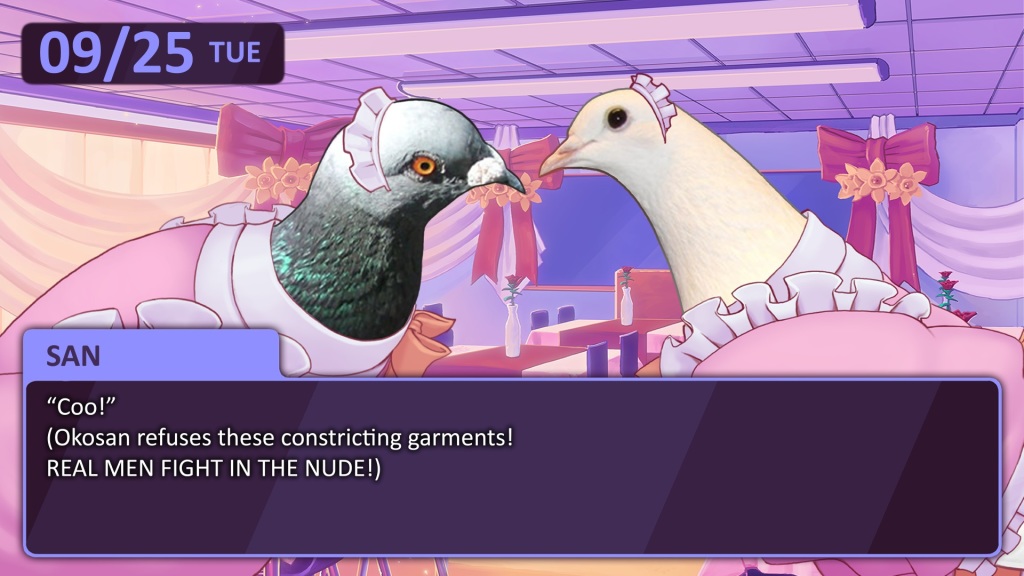
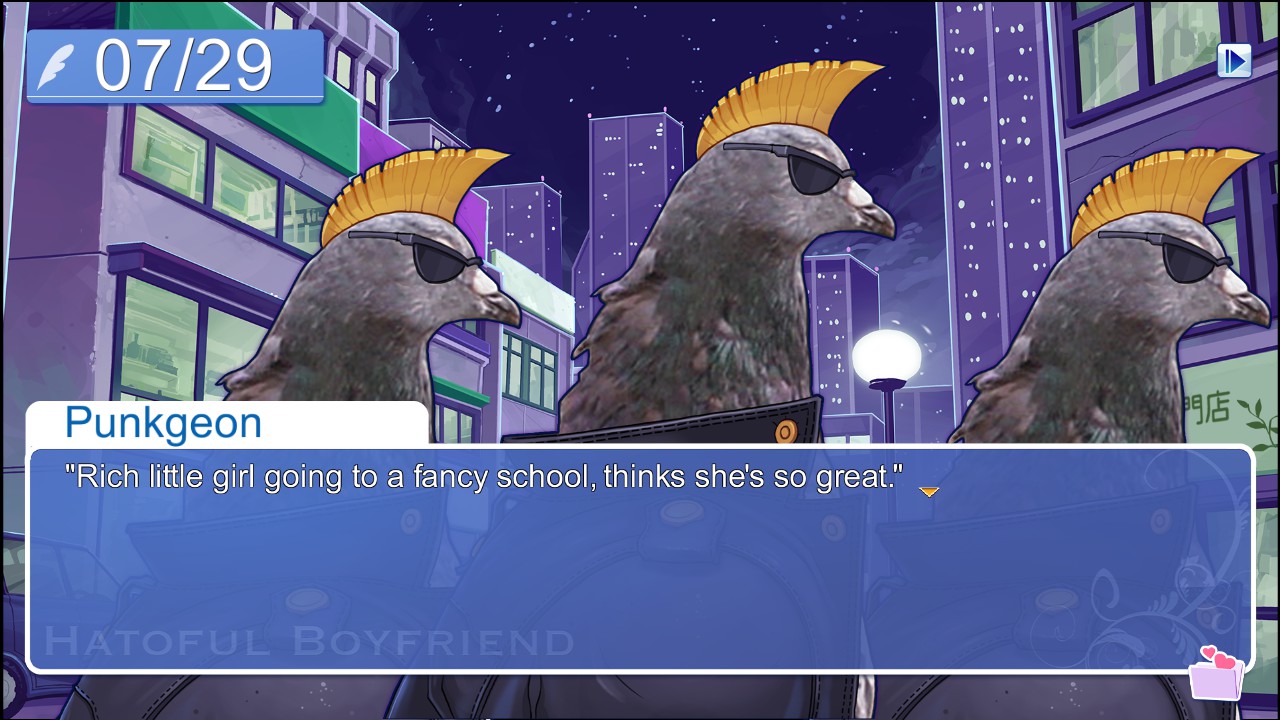
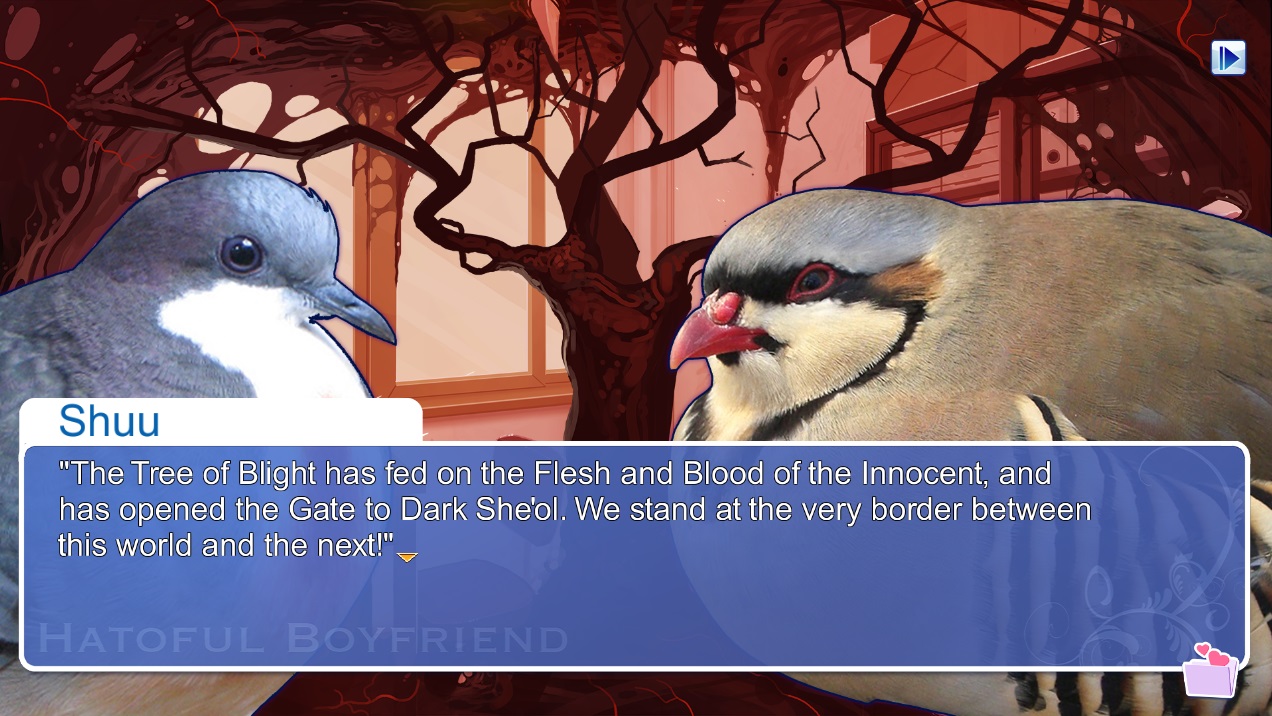
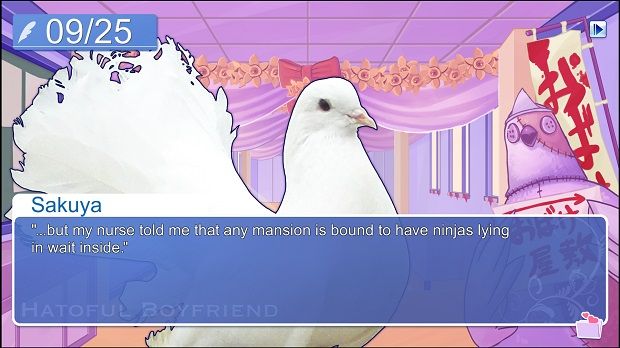
One of my most favoritest video games of all time is Hatoful Boyfriend, which is a categorized as a ‘dating simulator.’
Plot twist: You play as a human girl in a post-apocalyptic world that is dominated by hyper-intelligent birds. The puns are egregious.
And it gets weirder from there.
I know, I’m a strange person for loving the heck out of this game.
Which reminds me that I wanted to make a “Hatoful Boyfriend” shirt for myself…
Anyway, this game is what got me thinking that it would be a lot of fun to write a visual novel, especially because decent portions of it are spent reading events as they happen, rather than any per se ‘playing.’
I’m getting pretty excited over the idea of turning The Scion Suit into an interactive visual novel. I’m not planning on doing any art, at the moment, but exploring all of the ‘what ifs’ is … AWESOME.
And honestly, it’s a relief to be back in the realm of fantasy/sci fi writing. I missed it.
I also need to give Hatoful Boyfriend another play through, lol.
I often think to myself that I ought to treat writing more like a part-time job than a hobby, and make some adjustments to our routine so I can write in the mornings when my mind is sharper. The benefit is that I’ll be able to work much faster than I currently do.
I’ve given myself the goal of publishing a new novel every year, which is a perfectly respectable pace all told, and in that regard I think that I’m doing just fine. But I’m also interested in exploring creative writing in different formats, and that’s going to take up more time. A lot more.
Which means that I need to manage my time more efficiently.
Which is a bit of a trick with a 10-month-old crawling all over me. >.<
So, in addition to writing novels, I’ve decided that I want to turn The Scion Suit into a text-based game. i dunno why im such a nerd. That means writing a multi-pronged script, and learning basic programming (which has my husband tickled). You’d think that I have enough going on, but writing the script for a video game is one of my bucket-list items, and there’s no time like the present. We’re probably not going to be spending every weekend at the pool this summer anyway.
Besides, as long as I stick to the adage that “Progress is progress,” even just an hour a week will eventually add up. I’m pretty certain I do everything in 10-20 minute increments.
So I plan on starting off with a “choose your own adventure” format, but I want to get stats worked in as well.
I’m also looking forward to when the New Pokemon Snap comes out at the end of the month, so I’m probably going to have to quit watching movies and youtube. Frank James will just have to continue on without me. XD
The rule, “Show, don’t tell,” originated with the theater. Instead of having a narrator standing on the side of the stage loudly announcing that Aunt Martha is a mean #$%&, it’s far better to portray her with aggressive body language and a sour face.
However, somewhere along the way, the rule was applied to written fiction as well. Fact is, it’s pretty stupid as a rule for writing.
When your medium is words, you are literally telling everything.
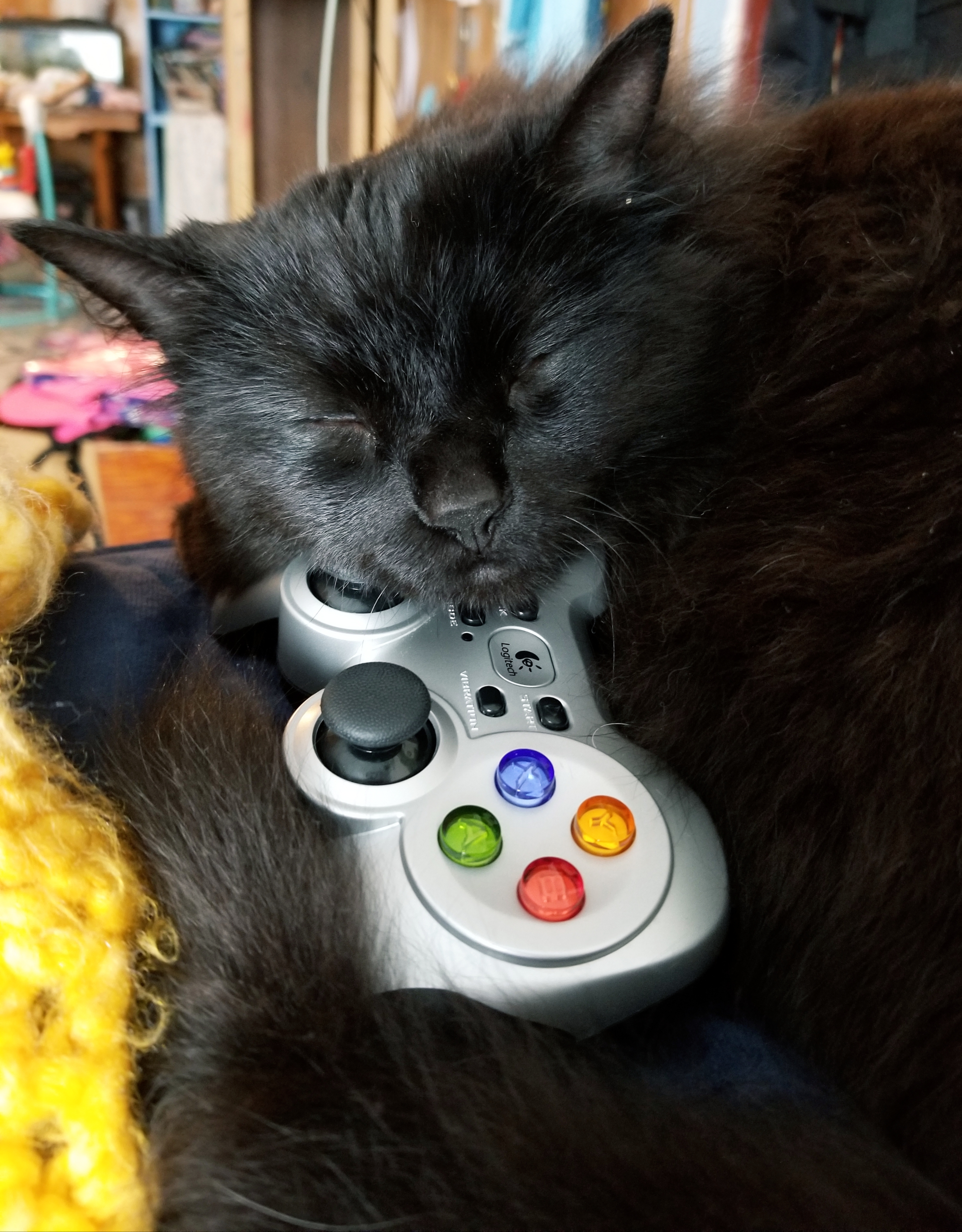
To illustrate my point, I’m going to show you a picture:
Yep. Pretty awesome.
…
The visual part of your brain interprets that the picture is a photograph of a black fluffy cat sleeping on a game controller. There’s something knitted with bright yellow yarn on the bottom left, and the background has child-clutter, bookshelves, and even a fish tank. How ’bout that.
That’s show.
It works with theater, because the audience is watching actors, costumes, and props in front of them. The appropriate parts of their brains are lighting up to make all the correct interpretations of what’s going on.
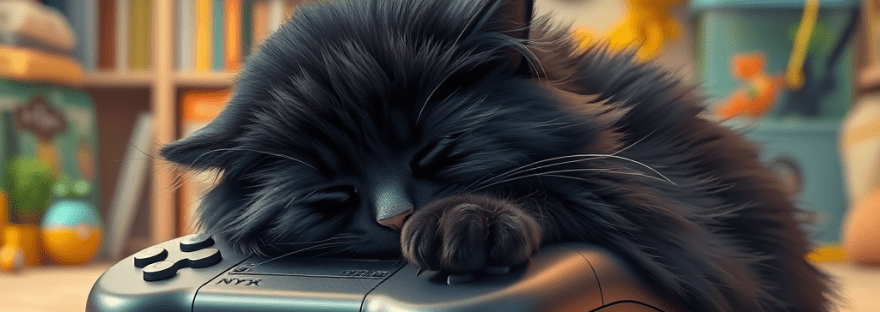
Reading activates a different part of your brain, and to put it bluntly, not everyone has a good visual imagination to properly construct a scene that’s described to them with words. When I say, “fluffy black cat,” instead of picturing anything like the photograph above, their imagination is going to construct something more like this:
Stick legs
Or maybe their visual imagination is REALLY bad, and this is the best they can manage:
Instead of imagining a vivid scene with a real cat that’s doin’ stuff, they’re going to find themselves bored with the descriptions. It doesn’t matter how detailed you get, or how poetic you wax, it just isn’t going to do it for someone who can’t visualize that well. Chances are, they are far better at hearing the words, than seeing the scene.
Now, I’m going to tell you about that cat:
His name is Nyx, and yes, he was named after the goddess even though he's male. We rescued him and his sister when they were six weeks old, both very undersized and malnourished at the time because of untreated intestinal worms. We got them the necessary veterinary care, fed them lots and lots of kitten formula, and generally loved them into being healthy, energetic kitties. Nyx isn't fond of anyone other than me (which my husband considers to be a great betrayal), and he's got one of the whiniest meows that I've ever heard, but he likes to snuggle up with me and suck on my blanket when I'm lounging on the couch after the children have all gone to bed. He's the one I consider to be my animal familiar.
Now it doesn’t matter if your visual imagination can’t construct a vividly detailed picture, because you can piece together the information that I told you about his history and personality to construct an idea of what sort of cat he is. You get a lot more abstract information than the photograph gave you, and the irrelevant stuff is completely filtered out (I know, you were just dying to learn about that yellow yarn).
Here’s what I’ve discovered: People who have powerful visual imaginations are going to ‘see’ a scene or a character even if you don’t describe very many physical details. It does a pretty good job even without the purple prose.
But those who are better at hearing are often left in the dark, so to speak. Writers don’t play with things like alliteration or rhymes in fiction anymore, as they are far too busy trying to “show” everything to someone who may or may not be able to appreciate it. They don’t pay attention to the way the story sounds.
Because your audience is reading a book and NOT watching a movie, pay attention to the way the syllables and consonants flow. Read your story out loud to give yourself a chance to hear it.
Go ahead and tell your audience that Aunt Martha is a mean #$%&. Have that be the first sentence of the story, and spend the next few paragraphs telling everyone why. Imagine Morgan Freeman is narrating, or Vincent Price. Don’t be afraid to have a strong voice as an author.
I plan on keeping it up for awhile, and I’ve also tried to make it easy to navigate through the chapters for anyone who wishes to read it in the future. Yah, I know, doing this isn’t going to earn me any money, but we could all use a distraction every now and then.
So
I’ve got “Miranda and the Convict” coming up (which I’ve been referring to as fan fiction) and I’ve decided to do something fun with it. I’m actually pretty excited about this, and you don’t want to know how much time I’ve put into setting up this little side project.
It’s kind of a big deal for me that I managed to maintain updating AatW for over a year. I’m the sort that’s prone to forgetting which dimension I’m in, so I’m proud of myself for sticking with it, even when I had a baby during last summer. To celebrate, I’m going to be posting even more fiction!
Maybe I’ll convince someone to stop being a lazy bum, and to read a book instead of watching Netflix.
An ambitious and spunky woman hits a low point in her career, so she leaves the big city to visit her small hometown, where she rekindles an old flame and learns a lesson about what’s really important in life. *cue heartfelt music*
Which basically means that once you’ve read one such story, you’ve read them all. *yawn* Yet a lot of writers keep sticking rigidly to the “basic plot” for whatever their chosen genre is, which ultimately makes them uninteresting to read.
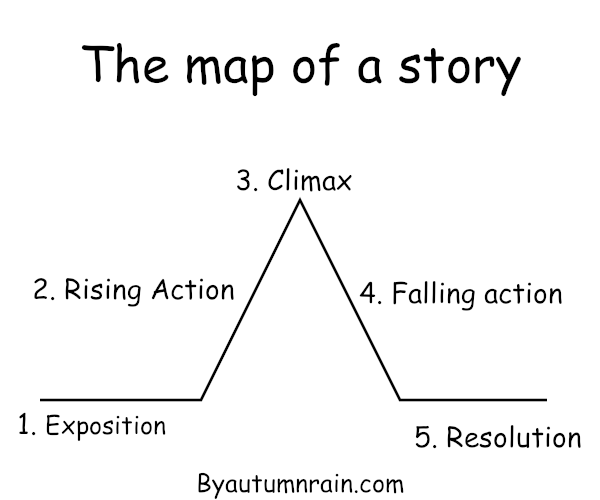
I’ve decided to go ahead and break it down farther, to give you the analysis of the framework, so you know how to write a story without relying on imitating a plot that’s already been done.
I give you, the bare bones:
1.Exposition – Tell us who the story is about, the setting, and anything else that’s relevant to understand the rising action.
From our example above, this would be the description of ambitious and spunky woman, her chosen career, why she’s in a slump, why she chooses to return to her hometown.
To mix it up: An introverted yet successful cake decorator is given the challenge of a lifetime — making a cake to welcome the alien invasion. Describe how she’s successful, and why she was chosen.
2. Rising Action – This is usually the bulk of the story. The conflict has been introduced, and now it’s up to the characters to play it out.
From the example: The spunky woman meets her old flame, swoons over how gorgeous he is, then gets upset that he’s a jerk. Meanwhile, she has several deep conversations with her mom and/or best friend.
To mix it up: The cake decorator is teamed up with some important guy from the government, and together they work out the alien symbology to avoid accidentally offending the invaders. Meanwhile, they discover the aliens are allergic to buttercream, and need to come up with a substitute.
3. Climax – This is the culmination of events, and often the turning point in the story. It’s usually exciting.
From the example: Spunky woman and her old flame are stuck together somehow. They reveal their feelings and begin their relationship.
To mix it up: The cake decorator and government man realize that they were set up as scapegoats, and decide to hijack an alien cruiser to flee to the stars. Earth is doomed.
4. Falling action – This is where the characters work through the consequences of the climax.
From the example: The spunky woman is offered a new job, and she must choose between returning to the big city, or staying in her hometown with her old flame.
To mix it up: The cake decorator and government man discover an established colony of humans on Mars. Turns out, the aliens have been kidnapping people to populate it for years. They settle down together to live inside a dome city.
5. Resolution – The conflict is resolved, and the loose ends are tied up. Basically, it’s the author’s job to bid us a proper farewell so we feel satisfied that the story is over.
From the example: The spunky woman learns an important lesson about life and love, and decides to spend a little less time working, and a little more time living.
To mix it up: The cake decorator opens a new business on Mars, because frosting is her passion in life. Thanks to her knowledge that the aliens are allergic to buttercream, the colony can live in peace as long as they eat cake regularly. She is much happier than she ever was on Earth. She and government man have an unbreakable bond because of their shared experiences.
It’s essential that every story have all five parts. The climax doesn’t necessarily have to be big and dramatic, but there does need to be some pivotal event. Also, if you just end abruptly without a resolution, the story is going to feel unfinished.
If you use the story map as a guide for the events in your fiction, you can come up with new and exciting plots that don’t repeat the same old tropes over and over and over. Branch out, do something new, and still leave your readers feeling satisfied in the end.
I took my first creative writing class 18 years ago.
Technically, I guess I did three years of creative writing as a teenager, then majored in the subject for two years in University before dropping out.
Anywho
It rather leaves me speechless at how creative writing has “modernized” since then. Absolutely no one talks about literary devices, story organization, or how to utilize punctuation. Instead you get an onslaught of articles promising to teach you, “How to write an emotionally manipulative villain”, or, “The best way to avoid burnout” — not to mention, the standard attacks on adjectives, and the word, “said.”
(That’s like painting a picture without using any shades of green and blue. Yes, it can be done, but it’s pointlessly limiting. If the words exist, don’t be afraid to use them.)
The other day it occurred to me that I’ve developed my own style of writing to the point that I could publish a how-to book on it. Then you, too, could be a famous author like me!
Except not really.
Because if there’s one thing I’m really bad at, it’s marketing — which has more to do with popularity than quality does.
And, well, it’s my writing style. Even if I listed everything I do out with bullet points and detailed explanations, you would still never write like I do. Could I even reduce it down succinctly? Is it possible to teach others how to talk to people who aren’t real?
Not to mention, some of my most poignant lessons happened while my husband and I were living out of a car, and that has been a major influence on what I write. You can’t teach that through a book.
I’d much rather encourage people to develop their own process that makes them happy. Ultimately, that’s what writing should be about.
But I’m really starting to think that literary devices need to make a comeback, and someone ought to give that push.