The Scion Suit

The Scions – 5

Hartmann waited for Carol out on the running track, smiling slightly when she came through the doors and squinted at him through the sunlight. The corporal was still with her, so the first thing that Hartmann did was dismiss the soldier, to ensure that they would be alone. She was nervous as the corporal left, so she bit her lip as her eyes locked onto the ground, and the action made her look younger and more girlish.

He had to find his tongue before he could say, โ€œWeโ€™re going to run a mile to start.โ€ It was hard to describe the effect that Carol was having on him. She wasnโ€™t feisty like the women in the military, nor did she try to act sexy like the women at the bar. She was something else โ€ฆ something unfamiliar.

Carol nodded and murmured, โ€œYes, sir,โ€ with her eyes still pointed downwards. Her hands tightened into fists.

โ€œRelax, Iโ€™m under orders to be nice to you.โ€ Hartmann smirked as he added, โ€œAnd remember to call me master sergeant. Iโ€™ll let you off this time because youโ€™re a civilian.โ€

โ€œYes, sir โ€ฆ master sergeant.โ€ She glanced up, met his eyes for a split second, then looked away.

โ€œGo on, get moving. Itโ€™s four laps around the track.โ€

Hartmann was silent as they jogged the first lap, giving Carol time to get used to his presence and feel more at ease. He watched her out of the corner of his eye, noting that it didnโ€™t take long for her to begin breathing heavily, and compensated by slowing down the pace. When they started around the curve again, he said, โ€œIโ€™m sorry for being a dick.โ€

Carol didnโ€™t reply, but he had expected that.

โ€œEveryone knows Iโ€™m a real asshole to be around โ€ฆโ€ He feigned sheepishness, though inwardly he winced at his own words. He hadnโ€™t even begun to get rough with her when she had jumped into the Suit, and if given the chance he would show her in a heartbeat just how much of a jerk he could be. However, at the moment he had a goal, and he wanted Carol to relax and open up to him. โ€œI especially get a little crazy about the Suit.โ€ That part was true.

He was quiet again, studying her closely, doing his best to read her thoughts through her body language. Her face flitted through a number of micro-expressions, enough to tell him that the inside of her mind was no where near as empty as her exterior, but it was going to take more time to be able to read her accurately.

โ€œMaster sergeant,โ€ she said hesitantly as they began their third lap at an even slower pace. โ€œDo you know what the visor is made out of?โ€

โ€œNot a clue. Iโ€™d guess something similar to leaded glass, but I donโ€™t think the minerals used in it came from this planet.โ€ Hartmann stopped and grinned at her. โ€œYou noticed, didnโ€™t you.โ€

โ€œNot while we were inside.โ€ Carol placed her hands on her knees as she huffed. โ€œBut when I had the Suit out in the sunlight, it was like seeing the world for the first time.โ€

โ€œItโ€™s amazing, but itโ€™s something that youโ€™re going to have to get used to. Those new colors have an odd way of swirling together and causing vertigo and nausea once you get moving fast enough. Thatโ€™s going to matter during combat.โ€

She looked away. โ€œAm I supposed to go into combat?โ€

โ€œIโ€™m not cleared for that information. I was told to train you, so thatโ€™s what Iโ€™m doing.โ€ Hartmann was eyeing Carol up and down again. โ€œIn the military, you follow orders without question.โ€

โ€œI guess thatโ€™s something we have in common,โ€ she blurted, then bit her lip shyly as she began walking again.

Hartmann was momentarily lost for words as some sort of electrical shock pulsed through his chest. A feeling started to form inside his throat, then hardened into anger. How dare the cleaning lady suggest that they had any commonality โ€“ he was a hero, and she was a nobody. She was only there through some unexplained fluke, because some computer inside the Suit had called her โ€œcommander.โ€ If not for that, her place would be in the shadow of his glory, unnoticed as she maintained the Suit for him.

He walked beside her, neither of them bothering with the pretense of jogging, until he regained himself and a quip came to him, โ€œI saw the employee file on you, and it said that youโ€™ve always been the picture of good behavior. I bet your parents loved you for that.โ€

Carol shrugged. โ€œI guess they would have.โ€

โ€œWould have?โ€ Hartmann prodded.

โ€œThey died when I was three.โ€

He frowned. Carol didnโ€™t look like the sort who carried childhood trauma, and she had delivered the news so blandly that it would have better suited a conversation about the weather. โ€œHow?โ€ he asked, not out curiosity about the answer, but more for the opportunity to gauge her response.

โ€œHouse fire.โ€ Carol looked over at him and met his eyes. โ€œI nearly died of smoke inhalation as well.โ€

โ€œThat is surprisingly interesting for you.โ€ Hartmann cracked a grin. โ€œI would have guessed that you grew up in some ordinary middle class family, did all of your homework and managed mostly Bโ€™s in school, then graduated and decided to twiddle your thumbs until you died.โ€

She scowled, finally annoyed by something. โ€œNo. I grew up in foster care, and got myself emancipated at sixteen. I got a GED instead of graduating, and Iโ€™ve been working full time ever since. I am not twiddling my thumbs.โ€ A shadow of doubt crossed over her eyes, as if she was second-guessing what she had said.

โ€œFoster care, huh? Dark place, isnโ€™t it.โ€ For a moment Hartmann felt the impulse to reach over and place his hand against her shoulder, to feel the crook of her neck with his fingers, but he tamped it down and kept his hands by his side.

โ€œI survived.โ€ Her mouth twisted downwards. โ€œBy becoming invisible.โ€

โ€œThat explains the great mystery of the cleaning lady,โ€ he said smugly. โ€œI should have guessed there was something tragic lingering behind that pretty face of yours.โ€

Carol stared at him, her expression blank. Then, abruptly, she began jogging again, her hair bouncing as she pulled ahead. Hartmann picked up the pace as well.

โ€œSince I know that youโ€™re wondering, but are too shy to ask, I grew up in some ordinary middle class family, but I got straight Aโ€™s, and was the captain of both the lacrosse and swim teams,โ€ he said conversationally. โ€œThen I enlisted when I was seventeen โ€ฆ to kill people.โ€ Hartmann laughed at the series of expressions that flitted across Carolโ€™s face when she glanced over at him, then added, โ€œI had to get out.โ€

โ€œDoesnโ€™t sound like it was that bad,โ€ she murmured.

โ€œIt wasnโ€™t. It was so normal I was suffocating,โ€ he replied.

Hartmann continued to study Carol, piecing together what he could about her from the small bits that she had told him. There was something off about her, some essential part that was either repressed or incomplete, that enabled her to speak almost monotonously about her past traumas. It intrigued him.

Observations

My week in haiku

The endless echo
Of lightning tearing the sky
Wondrous thunderstorm

Brilliant yellow
Filling the air around me
A sunset sublime

The prettiest smile
Fills my heart with endless love
On the smallest face

My dearest baby
I love you so very much
Please let me sleep more

Swimming every day
Keeps me so healthy and strong
The water feels great

byautumnrain.com

About Writing

Normal

Maybe I shouldn’t admit to this, but one of the reasons why I struggle so much with writing normal characters is because I feel like I’m mocking them.

My thought process goes something like, “I have heard multiple people say this sentence, so I’m going to have this normal character also say it.”

Then I feel like I delved into every single bad stereotype known to mankind.

Though it’s not my fault that so many real life people say the exact same things. Word for word.

What is up with that anyway?

Stories, The Scion Suit

The Scions – 4

โ€œNow, Carol, MSG Hartmann is going to be a good boy and coach you through how to move the Suit. Donโ€™t worry, Iโ€™ll make sure that he plays nice,โ€ Lambert spoke into his end of the radio, then gave Hartmann a warning scowl as he handed it over. โ€œI mean it,โ€ he growled. โ€œFollow orders, and play nice.โ€

โ€œYes, sir,โ€ Hartmann replied sulkily, then found his throat too thick to speak to Carol. He had to clear it first, then pushed the button to transmit, โ€œThe best way to explain it is that you connect your mind to the Suit, and after that walking should be as intuitive as it is with your own body. Donโ€™t overthink it; just let it happen naturally.โ€

Silence answered, and Hartmann wished that Carol was more verbal. He missed the nonstop noise that usually surrounded women, that left no mystery as to what they were thinking. Dealing with Carol felt a lot like going up against a wall, with no way of knowing what he was going to find on the other side if he managed to break it down. It was frustrating. Unnerving.

Then the Suit took a step forward, and the two men jumped back as the screech of twisting metal filled the bunker. In one fell swoop, Carol had completely destroyed the ramp.

Hartmann stared as a grin crept across his face, then doubled over in laughter. Lambert cussed profusely, shouting into the radio, โ€œGod fucking dammit, Carol! Watch where youโ€™re going!โ€ It was satisfying to imagine her crying inside the cockpit as the captain continued ranting, โ€œYou are in a formidable piece of equipment, so do not destroy the base through stupidity and incompetence. Do you understand!โ€

โ€œYes, sir. Sorry, sir,โ€ Carolโ€™s voice sounded broken, but her mental connection with the Suit was continuing to improve. Hartmann could see that it was imitating her body language, trying to curl up and disappear, which was comical for a 12-foot mecha. There were definitely tears on her cheeks, and it was time for him to wipe them away, so to speak.

He reached over to take the radio back, and purred, โ€œDonโ€™t sweat it, that was only the ramp. Give your legs a stretch, and see how it feels โ€ฆ just remember to be mindful of your surroundings.โ€

Lambert crossed his arms over his chest and growled, โ€œGet her to the airfield, then join me in the jeep.โ€

Hartmann was satisfied as Lambert stormed away, certain that his sour mood wasnโ€™t over the wrecked ramp. โ€œAll right, the captain wants us outside,โ€ he spoke into the radio. โ€œYou up for it?โ€

โ€œYes, sir,โ€ Carol replied dutifully, so he answered playfully,

โ€œSave that for the captain. I want you to call me โ€ฆ master sergeant.โ€

She was silent, confused by his behavior as she went through the massive double doors that had been pulled open, and Hartmann followed her outside, ordering her to jog down the length of the airfield.

He dropped his affectation as soon as he was seated next to Lambert in the jeep. Carol was adapting to the Suit much faster than he had, despite his intuitive grasp of it, and the way she moved around the airfield was too natural โ€“ to the point of becoming unnatural. Hartmann knew that he was the best damn pilot to ever climb inside the Suit, but that was all he did: pilot. Carol, on the other hand โ€ฆ she was inhabiting it like a second skin, especially as she was becoming more and more comfortable with moving around the airfield. It crossed his mind that, with the way she was catching on, the Suit could have been made for her.

Commander.

Hartmann had been in the military for far too long to let anything show on his face. His instructions to Carol over the radio became more mechanical and routine, but his thoughts remained perfectly hidden. He almost managed to keep them from himself, but as he stared it was undeniable that she was better at maneuvering the Suit than he was, even despite lacking the discipline that would have given her grace and efficiency.

โ€œThe Suit is following her body language more than I expected,โ€ Lambert muttered beside Hartmann, though he was speaking more to himself. โ€œSheโ€™ll need to be physically trained to clean up that sloppiness.โ€

Hartmann shrugged, muttering โ€œYes, sir,โ€ when he failed to come up with an obnoxious reply. He had never watched the way he piloted the Suit from the outside, and he wondered if it responded similarly to his movements, or acted more like a robot.

Lambert continued, reluctantly saying, โ€œYou will work with her on the track this afternoon while I attend to other duties. You will be courteous, considerate, and respectful, and you will not make her cry. Understand?โ€

โ€œYes, sir,โ€ Hartmann echoed. He had to stop himself from asking why the captain cared so much about the cleaning ladyโ€™s feelings in a world where tender emotions were a dangerous weakness. He already knew the answer.

Sometime later when they were back inside the bunker, Carol parked the Suit in its usual place, opened the doors, then stood hesitantly looking down at the drop to the floor. Hartmann wondered why she hadnโ€™t kneeled in the Suit first, given that she was the one who destroyed the ramp and knew damn well that it wouldnโ€™t be there, but Lambert stepped forward and held up his arms.

โ€œCome on, we havenโ€™t got all day,โ€ he snapped, but Hartmann recognized the false gruffness of someone who had adapted to his rank to survive.

She cautiously dropped down to Lambert, and his hands closed around her waist as he lowered her to the floor. His fingertips curled in slightly, and trailed along her t-shirt as he pulled his hands away, his face too stony to be anything other than a mask. Carol was appropriately oblivious, which Hartmann found soothing; he wasnโ€™t the only one she completely failed to notice.

โ€œGet some lunch, then report to MSG Hartmann for physical training,โ€ Lambert ordered. โ€œLike it or not, weโ€™re going to beat the civilian out of you, commander.โ€

โ€œYes, sir,โ€ Carol replied, then turned and trotted to join some corporal that Hartmann only vaguely recognized. An assigned escort, he hoped.

Having time alone with Carol was going to give Hartmann the advantage, and if he worked his magic right, Lambert wasnโ€™t going to stand a chance. Underneath the boring beige of her existence, heโ€™d bet anything that Carol was still a woman, and still susceptible to his charms.

If the Suit couldnโ€™t belong to him anymore, then he was going to claim ownership of the next best thing.

About Writing

Experience

I caught a sore throat. As in the, “wake up at 5am unable to speak or swallow because of the agonizing pain” variety.

And, at 5am, my husband made me a potent cup of honey and lemon tea, which helped quite a bit. He’s told me in the past that cussing really does help numb pain, so the first thing I said after regaining my voice was an expletive. ๐Ÿ˜€

I’ve been listlessly wallowing for about three days now. It’s not strep — just very swollen and raw — so all I can do is wait it out with ibuprofen.

Which led me to browsing through the old pictures I had uploaded to my blog, when I came across the quote above.

Here is the post with my original thoughts about it.

My opinion hasn’t changed, but I figure that I can elaborate some more.

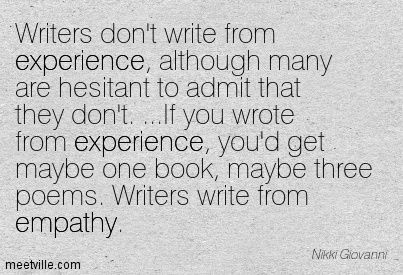
The advice to “write from experience,” doesn’t mean to tell about the time you accidentally shoplifted Road Warrior at the mall. It means to write about the broader themes that you are familiar with. Like friendship, loneliness, romance, betrayal, etc.

For example, I have six kids irl, and I write a lot about pregnancy and motherhood in my stories. None of my fiction is autobiographical, but the themes are reflective of my real world experiences.

A few years back I read an article written by a woman who began her career as a midwife before she had her first baby, and how experiencing natural childbirth firsthand changed the way she interacted with her clients. As I recall, she hadn’t expected it to be so different on the other side, and personally understanding what other women were going through helped her be a better midwife.

You can’t simply empathize with natural childbirth to know what its like; you have to experience it.

You can’t empathize your way through writing about things like love, betrayal, fear, hope, etc, and produce a story that’s relatable to people who have experienced it. You need to know what the heck you’re talking about.

And if your experiences are so limited that you can only produce one book from them, then maybe you should put down the electronic devices and go live a little.

About Writing

Currently

I had intended to post 1000-word installments of The Scions every other week, which seemed like an easy goal.

As it turns out, my life is currently a little too hectic to pull that off.

I’m not even averaging a 100 words a day.

More like, “I wrote a sentence and fixed up some word choices today.”

But that’s how it currently is. I don’t mind — it always feels like one of the largest miscommunications that I’m always struggling with is that other people don’t understand how much I love the journey. Life is too interesting for me to complain about how I don’t have the time or energy to write much these days. Besides, this is basically the reason why I don’t do deadlines.

The story is still very much on my mind, and I have no intention of abandoning it (not than anyone wants to read it anyway), it’s just coming more at a drip than a steady flow.

About Writing

Pathos

Writing a dark story is turning out to be more of a challenge than I expected.

I have an idealist inside of me that tries to insert insights and epiphanies that would prevent the Traumatic Climax from happening, so I have to pull back and rewrite. The result is that the characters keep coming oh-so-close to redeeming themselves, then turning away and clinging to their dysfunctions.

It’s realistic enough; I’ve watched plenty of people do that in real life.

I’m not the sort of writer than deliberately sets out to manipulate the emotions of readers. The only reason why I’m writing this story at all is because it’s stuck in my head too badly to be ignored, and the only person intended to ride this roller coaster is me. There is no sadistic glee happening behind the scenes.

Perhaps this is a concept that’s difficult to grasp in our society, but I don’t write for money or popularity. I write for me. I write because I gained knowledge too heavy for me to bear, and my childhood hobby became my vessel of expression. I need it to remain artistically pure for the sake of my sanity. That’s why I always pull away from online groups and self-advertising — anything that could influence my writing away from what I need it to be.

Is there anyone out there capable of understanding?

So here I sit, feeling bad that Hartmann is too caught up in self-pity to realize what he’s doing, that Carol’s personality is too weak to resist, and that Lambert’s too checked out to notice. All it takes is one sentence to turn everything around, but I can’t let myself write it until it’s too late.

If this story wasn’t pounding at my head, I wouldn’t be writing it at all.

About Writing

Yarn and Readership

I was comparison shopping yarn and browsing through reviews, when I came across someone complaining that 100% wool yarn smelled weird when wet.

Well, yeah … being wool and all, it does smell like it came from an animal — especially when wet.

So

Last year I made inquiries about different self-publishing avenues, and was warned that I needed to be careful about the sort of readership I catered to. I’m not talking about “target audience,” but rather something more specific that has popped up with the rise of social media.

For example, the general consensus was that people who wanted to read books for free, were also the most entitled, demanding, and critical. So, while it might be easier to get readers, the “fans” were abusive enough to make you regret it.

To get back to the beginning, the review complaining about the wool yarn made me think about self publishing.

On the surface, you might think that “crafty yarn people” counts as a specific group, but once you dig deeper, you discover that some of them can’t stand things like inconsistent thickness, knots in the yarn, or the smell of animals fibers. Others, like me, prefer the unique personalities of handspun yarns, don’t mind working around knots, and enjoy the characteristics of natural fibers. The two groups might fit under the same crafty umbrella, but the sort of yarn they want is completely different.

Self-publishers need to think about more than a general target audience. Metaphorically speaking, trying to sell handspun wool or acrylic yarns to the wrong subgroup is going to end miserably.

And frankly, with something like writing, authors need to be mindful about where they go searching for their readers. No one wants to get sucked into catering to an audience that kills all the joy out of writing.

About Me

The Scions Part 1

I didn’t want to write this.

It felt too much like taking all of the worst traits of these characters and amplifying them into a sordid and depressing story. I very much didn’t want to do that.

But the idea has been niggling at me for months. It won’t leave me alone.

I’ve caved. Fine. I’m writing it.

But this is a very sordid and depressing story.


Master sergeant Hartmann wasnโ€™t certain when he had first begun to notice the cleaning lady. Two years prior, more for the sake of politics than anything else, the General had declared that they were going to improve national security by limiting the soldiersโ€™ access to the Suit, and a civilian was picked out of the Baseโ€™s janitorial staff to be the designated caretaker of the militaryโ€™s top asset. It turned out to be a plain, mousy woman, who quietly devoted herself to the job then faded into the background as another functioning cog, and business moved on as usual.

Hartmann was by far the best at piloting the Suit. Although it was obviously alien technology, he had an intuitive understanding of how to operate it, and was consequently given all of the important missions. He had already been considered something of a hero due to his โ€˜braveryโ€™ and โ€˜leadershipโ€™ beforehand, but the Suit had skyrocketed him to the status of a superstar. He was worshiped by those below his rank, and greatly respected by those above. It was unspoken, but everyone pinned their hopes of winning the war on his abilities, and he was more than willing to accept the mantle.

Yet, somehow, the moments he had spent basking in the adulation of a job well done melted away as the cleaning lady took up more and more of his awareness.

There were moments when it was comical to watch her, a slim 5โ€™4โ€ woman standing on a stepladder with a soapy sponge, contrasted against the 12-foot mecha that she rigorously scrubbed. However, when she worked on detailing the interior, it stung to realize that she was more intimately familiar with the Suit than he was. He felt like the interloper, good for a wild ride before the Suit returned home to its loving family. He never had the liberty to simply touch and examine the Suit, no matter how much time he spent inside.

To make it worse, the cleaning lady was completely unaware of him. Hartmann was attractive and muscular, with sandy blonde hair and sharp eyes, and took it for granted that women would preen and flirt as they competed for his attention. The cleaning lady, however, never smiled or brushed her hair behind her ear; her eyes slid over him as if he was any other uniform in a sea of soldiers. He had even bumped into her deliberately to see her reaction, but she had tersely apologized then skirted around him, never quite managing to raise her eyes to his face during the entire exchange. The other soldiers had snickered, and someone had said, โ€œI guess you arenโ€™t her type,โ€ as Hartmann stared after her, his face hard.

That was two strikes against her.

In between missions, he kept an apartment off Base, and he liked to amuse himself by taking out a few of his buddies to pick up women at bars and clubs. The thrill of simply bedding them had vanished years ago, but he still got his kicks out of playing with them. He had developed a good eye for finding the ones that were attractive enough to be worthwhile, but still had the shadow of desperation that spoke of a willingness to do anything. That night, he imagined that he had the cleaning lady in his clutches, and pushed the woman to a level of filthy that he had never gone to before. Unsatisfied with how easy it had been to control and degrade her, he sent her away from his apartment with one of his friends, and from the way she giggled he knew that she was up for another round of debauchery.

Alone, he knew the folly of his fantasy. The cleaning lady was the sort who spent her evenings curled up with a book and a glass of wine โ€“ she would never be under his power.

So he watched her. He watched her clean his Suit, watched her love what should have been his, all the while knowing that she was untouchable. The cleaning lady was ranked above him, the master sergeant.

And that was strike three.