I often think to myself that I ought to treat writing more like a part-time job than a hobby, and make some adjustments to our routine so I can write in the mornings when my mind is sharper. The benefit is that I’ll be able to work much faster than I currently do.
I’ve given myself the goal of publishing a new novel every year, which is a perfectly respectable pace all told, and in that regard I think that I’m doing just fine. But I’m also interested in exploring creative writing in different formats, and that’s going to take up more time. A lot more.
Which means that I need to manage my time more efficiently.
Which is a bit of a trick with a 10-month-old crawling all over me. >.<
So, in addition to writing novels, I’ve decided that I want to turn The Scion Suit into a text-based game. i dunno why im such a nerd. That means writing a multi-pronged script, and learning basic programming (which has my husband tickled). You’d think that I have enough going on, but writing the script for a video game is one of my bucket-list items, and there’s no time like the present. We’re probably not going to be spending every weekend at the pool this summer anyway.
Besides, as long as I stick to the adage that “Progress is progress,” even just an hour a week will eventually add up. I’m pretty certain I do everything in 10-20 minute increments.
So I plan on starting off with a “choose your own adventure” format, but I want to get stats worked in as well.
I’m also looking forward to when the New Pokemon Snap comes out at the end of the month, so I’m probably going to have to quit watching movies and youtube. Frank James will just have to continue on without me. XD
The rule, “Show, don’t tell,” originated with the theater. Instead of having a narrator standing on the side of the stage loudly announcing that Aunt Martha is a mean #$%&, it’s far better to portray her with aggressive body language and a sour face.
However, somewhere along the way, the rule was applied to written fiction as well. Fact is, it’s pretty stupid as a rule for writing.
When your medium is words, you are literally telling everything.
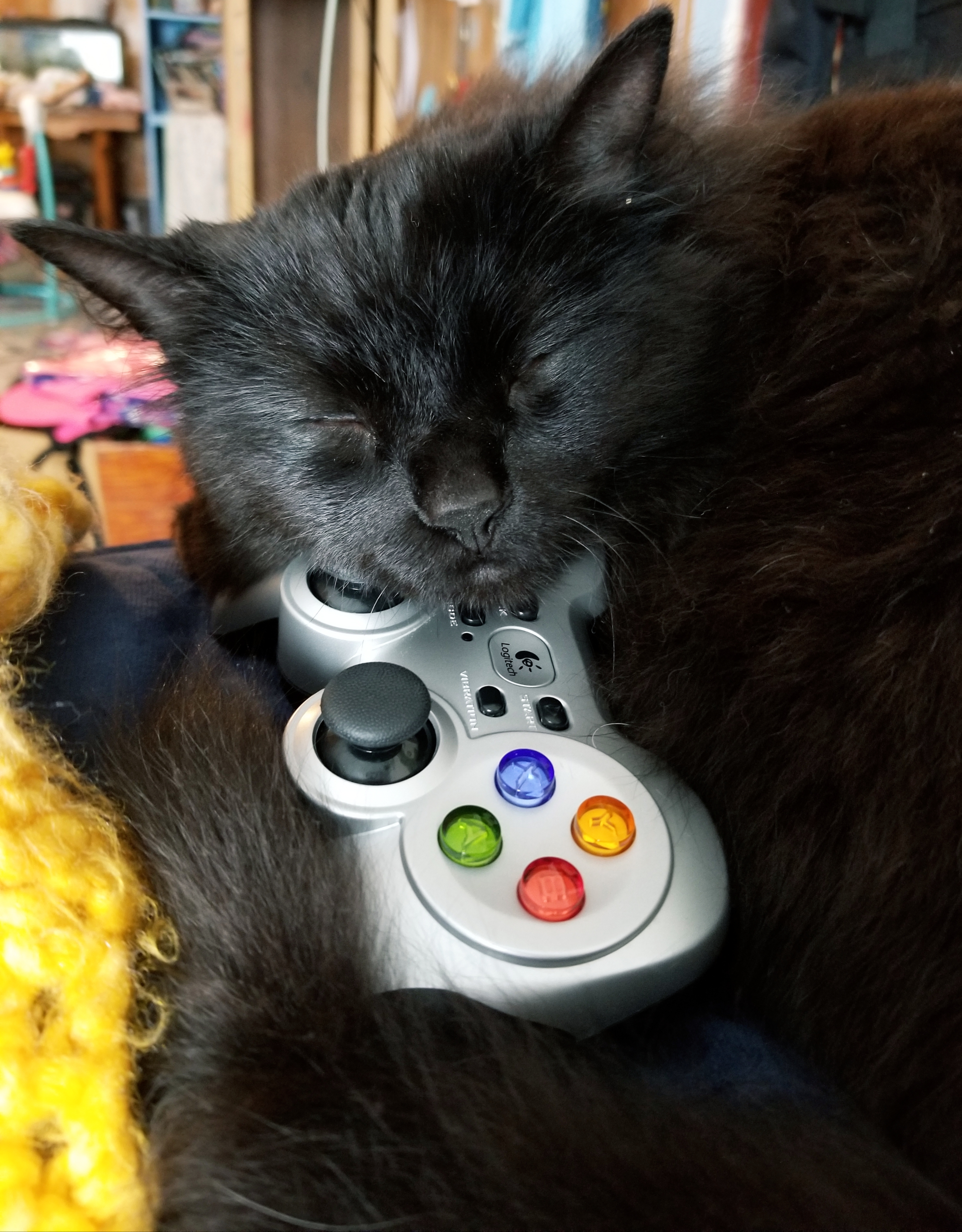
To illustrate my point, I’m going to show you a picture:
Yep. Pretty awesome.
…
The visual part of your brain interprets that the picture is a photograph of a black fluffy cat sleeping on a game controller. There’s something knitted with bright yellow yarn on the bottom left, and the background has child-clutter, bookshelves, and even a fish tank. How ’bout that.
That’s show.
It works with theater, because the audience is watching actors, costumes, and props in front of them. The appropriate parts of their brains are lighting up to make all the correct interpretations of what’s going on.
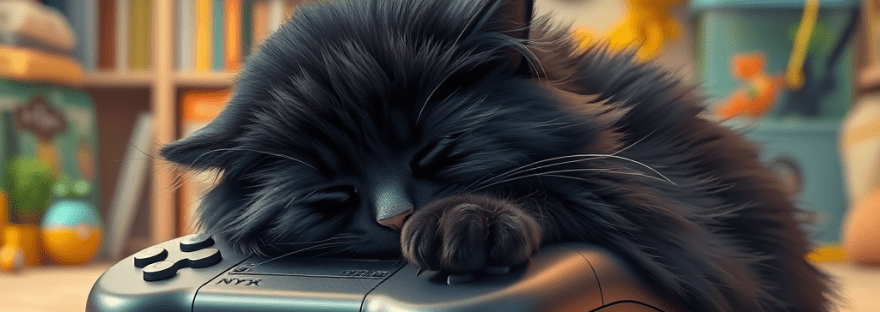
Reading activates a different part of your brain, and to put it bluntly, not everyone has a good visual imagination to properly construct a scene that’s described to them with words. When I say, “fluffy black cat,” instead of picturing anything like the photograph above, their imagination is going to construct something more like this:
Stick legs
Or maybe their visual imagination is REALLY bad, and this is the best they can manage:
Instead of imagining a vivid scene with a real cat that’s doin’ stuff, they’re going to find themselves bored with the descriptions. It doesn’t matter how detailed you get, or how poetic you wax, it just isn’t going to do it for someone who can’t visualize that well. Chances are, they are far better at hearing the words, than seeing the scene.
Now, I’m going to tell you about that cat:
His name is Nyx, and yes, he was named after the goddess even though he's male. We rescued him and his sister when they were six weeks old, both very undersized and malnourished at the time because of untreated intestinal worms. We got them the necessary veterinary care, fed them lots and lots of kitten formula, and generally loved them into being healthy, energetic kitties. Nyx isn't fond of anyone other than me (which my husband considers to be a great betrayal), and he's got one of the whiniest meows that I've ever heard, but he likes to snuggle up with me and suck on my blanket when I'm lounging on the couch after the children have all gone to bed. He's the one I consider to be my animal familiar.
Now it doesn’t matter if your visual imagination can’t construct a vividly detailed picture, because you can piece together the information that I told you about his history and personality to construct an idea of what sort of cat he is. You get a lot more abstract information than the photograph gave you, and the irrelevant stuff is completely filtered out (I know, you were just dying to learn about that yellow yarn).
Here’s what I’ve discovered: People who have powerful visual imaginations are going to ‘see’ a scene or a character even if you don’t describe very many physical details. It does a pretty good job even without the purple prose.
But those who are better at hearing are often left in the dark, so to speak. Writers don’t play with things like alliteration or rhymes in fiction anymore, as they are far too busy trying to “show” everything to someone who may or may not be able to appreciate it. They don’t pay attention to the way the story sounds.
Because your audience is reading a book and NOT watching a movie, pay attention to the way the syllables and consonants flow. Read your story out loud to give yourself a chance to hear it.
Go ahead and tell your audience that Aunt Martha is a mean #$%&. Have that be the first sentence of the story, and spend the next few paragraphs telling everyone why. Imagine Morgan Freeman is narrating, or Vincent Price. Don’t be afraid to have a strong voice as an author.
I plan on keeping it up for awhile, and I’ve also tried to make it easy to navigate through the chapters for anyone who wishes to read it in the future. Yah, I know, doing this isn’t going to earn me any money, but we could all use a distraction every now and then.
So
I’ve got “Miranda and the Convict” coming up (which I’ve been referring to as fan fiction) and I’ve decided to do something fun with it. I’m actually pretty excited about this, and you don’t want to know how much time I’ve put into setting up this little side project.
It’s kind of a big deal for me that I managed to maintain updating AatW for over a year. I’m the sort that’s prone to forgetting which dimension I’m in, so I’m proud of myself for sticking with it, even when I had a baby during last summer. To celebrate, I’m going to be posting even more fiction!
Maybe I’ll convince someone to stop being a lazy bum, and to read a book instead of watching Netflix.
An ambitious and spunky woman hits a low point in her career, so she leaves the big city to visit her small hometown, where she rekindles an old flame and learns a lesson about what’s really important in life. *cue heartfelt music*
Which basically means that once you’ve read one such story, you’ve read them all. *yawn* Yet a lot of writers keep sticking rigidly to the “basic plot” for whatever their chosen genre is, which ultimately makes them uninteresting to read.
I’ve decided to go ahead and break it down farther, to give you the analysis of the framework, so you know how to write a story without relying on imitating a plot that’s already been done.
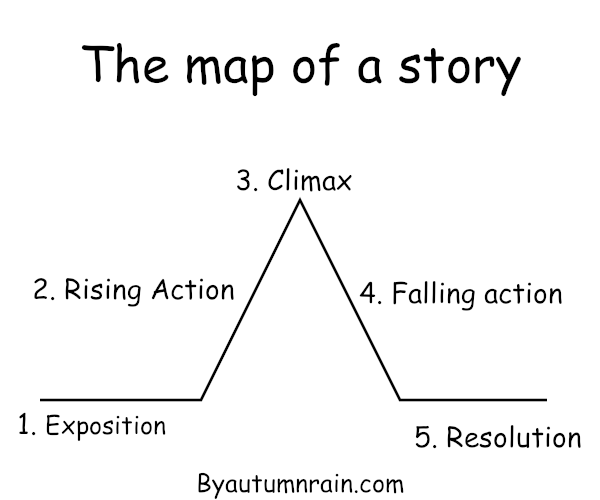
I give you, the bare bones:
1.Exposition – Tell us who the story is about, the setting, and anything else that’s relevant to understand the rising action.
From our example above, this would be the description of ambitious and spunky woman, her chosen career, why she’s in a slump, why she chooses to return to her hometown.
To mix it up: An introverted yet successful cake decorator is given the challenge of a lifetime — making a cake to welcome the alien invasion. Describe how she’s successful, and why she was chosen.
2. Rising Action – This is usually the bulk of the story. The conflict has been introduced, and now it’s up to the characters to play it out.
From the example: The spunky woman meets her old flame, swoons over how gorgeous he is, then gets upset that he’s a jerk. Meanwhile, she has several deep conversations with her mom and/or best friend.
To mix it up: The cake decorator is teamed up with some important guy from the government, and together they work out the alien symbology to avoid accidentally offending the invaders. Meanwhile, they discover the aliens are allergic to buttercream, and need to come up with a substitute.
3. Climax – This is the culmination of events, and often the turning point in the story. It’s usually exciting.
From the example: Spunky woman and her old flame are stuck together somehow. They reveal their feelings and begin their relationship.
To mix it up: The cake decorator and government man realize that they were set up as scapegoats, and decide to hijack an alien cruiser to flee to the stars. Earth is doomed.
4. Falling action – This is where the characters work through the consequences of the climax.
From the example: The spunky woman is offered a new job, and she must choose between returning to the big city, or staying in her hometown with her old flame.
To mix it up: The cake decorator and government man discover an established colony of humans on Mars. Turns out, the aliens have been kidnapping people to populate it for years. They settle down together to live inside a dome city.
5. Resolution – The conflict is resolved, and the loose ends are tied up. Basically, it’s the author’s job to bid us a proper farewell so we feel satisfied that the story is over.
From the example: The spunky woman learns an important lesson about life and love, and decides to spend a little less time working, and a little more time living.
To mix it up: The cake decorator opens a new business on Mars, because frosting is her passion in life. Thanks to her knowledge that the aliens are allergic to buttercream, the colony can live in peace as long as they eat cake regularly. She is much happier than she ever was on Earth. She and government man have an unbreakable bond because of their shared experiences.
It’s essential that every story have all five parts. The climax doesn’t necessarily have to be big and dramatic, but there does need to be some pivotal event. Also, if you just end abruptly without a resolution, the story is going to feel unfinished.
If you use the story map as a guide for the events in your fiction, you can come up with new and exciting plots that don’t repeat the same old tropes over and over and over. Branch out, do something new, and still leave your readers feeling satisfied in the end.
I took my first creative writing class 18 years ago.
Technically, I guess I did three years of creative writing as a teenager, then majored in the subject for two years in University before dropping out.
Anywho
It rather leaves me speechless at how creative writing has “modernized” since then. Absolutely no one talks about literary devices, story organization, or how to utilize punctuation. Instead you get an onslaught of articles promising to teach you, “How to write an emotionally manipulative villain”, or, “The best way to avoid burnout” — not to mention, the standard attacks on adjectives, and the word, “said.”
(That’s like painting a picture without using any shades of green and blue. Yes, it can be done, but it’s pointlessly limiting. If the words exist, don’t be afraid to use them.)
The other day it occurred to me that I’ve developed my own style of writing to the point that I could publish a how-to book on it. Then you, too, could be a famous author like me!
Except not really.
Because if there’s one thing I’m really bad at, it’s marketing — which has more to do with popularity than quality does.
And, well, it’s my writing style. Even if I listed everything I do out with bullet points and detailed explanations, you would still never write like I do. Could I even reduce it down succinctly? Is it possible to teach others how to talk to people who aren’t real?
Not to mention, some of my most poignant lessons happened while my husband and I were living out of a car, and that has been a major influence on what I write. You can’t teach that through a book.
I’d much rather encourage people to develop their own process that makes them happy. Ultimately, that’s what writing should be about.
But I’m really starting to think that literary devices need to make a comeback, and someone ought to give that push.
When you’re a creative sort, the number one advice is always, “Use social media to promote yourself.”
I don’t.
(I have nothing good to say about social media, so it would be rather hypocritical.)
This blog is the closest that I get to that sort of thing, and instead of trying to encourage any sort of ‘community’, I’m content to post my musings to the void. Lurk as much as you want — it’s fine by me. Personally, I miss the days when I could sit down in a private corner and read something entirely for myself without having to taint it with everyone else’s opinions, so I like to imagine that I’m recreating that here. Feel free to not leave any likes or comments. You don’t have to share if you don’t want to. What you experience when you read my blog and stories belongs 100% to you.
Note: If you are interested in helping me build a community, then join us over on Discord! We can chat in a more intimate setting, free from the pressure of garnering ‘likes’ or looking cool. Not to mention, I share my plans for my stories over there before posting anything about them here, so you, too, can be among the first to know.
Of course, I can’t be too well kept of a secret, because then I might as well stuff everything in a drawer for all the good it does. Writing is my form on self-expression, and I have some idealistic notions about being a positive influence on the world. I know, I know, but my north node* is in Pisces, so I can’t help it.
So, the question of how to reach people is always on my mind.
I’m trying to be creative about it, especially because I have a very rich real life that demands an enormous amount of time.
I’m still very much figuring out what I’m doing — because it’s very much my own thing. I’m not going to get myself into something that’s going to end up sucking out my soul and destroying my creativity.
How would you do it? How would you promote yourself without using social media?
XD
*In astrology, your north node is your overall life purpose/goals. In this context, Pisces represents empathy and healing.
Once upon a time, I bought some carded wool and a drop spindle, and made a bunch of yarn that I knitted into a baby blanket. Then the baby was born, and I never spun yarn again. True story.
I absolutely love the color combination of pink and yellow, and the way they blend together into a scrumptious rose gold. Too irresistible!
So I placed the order and dug out my drop spindle for a revival.
For some reason, the camera on my phone is making everything more orange than it should be.
Last week I mentioned that I prefer working on fiddly crafts, and this is one of them.
I’ve also got a lace tee that I’m crocheting, a t shirt that I’m decorating with embroidery, and a button up shirt that I’m sewing for my husband. What can I say? I’m totally out of control.
I know what you’re thinking, and the answer is that housework is so 2019. That’s how I have time for all of this. Ha ha. (I also make the kids earn their screen time by doing chores)
Anyway
The real reason for writing this post:
As an author, I have a compulsion to spin yarns — in one form or another.
My usual tradition is to read a book after finishing a first draft, before beginning on the second. This time, circumstances aren’t quite usual.
In one sense, I’m barely aware of the world. Truth is, ten years ago I saw too much, and turned my back on society in disgust. I don’t like being a negative person, but there’s really no other way for me to describe why I live like a hermit in the middle of suburbia. Heck, we even tried going off grid several years ago, but that proved to be too difficult with the resources we had.
And yet, there’s a great deal that even I can’t hide from. I feel it every time I see a face mask littering the sidewalk. I know it’s out there, lurking just outside our fence line.
It’s seemingly taken away my ability to focus on reading. I can do everything else, but whenever I sit down with a book, I can’t follow what’s happening on the pages or remember who’s who. I can only finish short novellas if I read them out loud to my children (We’re currently reading The Fairy Rebel). I end up doing some sort of fiddly craft with my hands instead.
I can’t follow my usual ritual this time around. When I don’t spend my evenings re-centering my balance and exploring my fictional world, the noise from the children during the day gets inside my head too much.
So it looks like I’ll be plowing through the second draft of Alice and the Warden without “cleansing my mental palate” first. I have to work with what I’ve got.
I haven’t the slightest clue who’d want to talk to me, but it exists. I’ll probably post pictures of my cats.
If you want, you can ask me to read the first chapter of your novel, or for insider gossip about my fictional characters, or tell me that I’m the best person to ever exist (lawl jk).
Of course, as an FYI, I only get around to conversing when I feel good and ready to, so don’t expect me to be constantly plugged in 24/7.
Also, I can’t figure anything out. I am not super internet-literate.
I keep an eye on current creative writing practices, even though I think that it’s shallow and inane. Yeah, I know, I’m a total snob about this. Egotistical. Et cetera.
But srsly
When the masses are saying, “Make sure that your characters act like real people,” I can’t help but scratch my cheek with a sense of bafflement. Okay. Yeah. Sure. Sounds solid.
BUT HOW DO REAL PEOPLE ACT?
I know it sounds silly on the surface, but it’s a legitimate question. When was the last time you went out of your way to watch real people, see what they do, and wonder why? (probably not since March 2020, snerk)
Which is why I say, “Study psychology.”
Personally, I like self help books, since they’re easier for individual study and are written with “real world application” in mind. I have a huge number of books on marriage and relationships, and also topics like manipulation, business, “how to be happy”, spirituality, etc (I’m a knowledge junkie, so I’ve never been all that picky). Heck, even developing an understanding of astrology will give you a good base for creating characters, not to mention the Myers-briggs personality types.
No, it doesn’t wrap up neatly for a bullet point in an article. You can’t churn out a story, look at it and say, “Yeah, that’s totally how real people act,” then give yourself a pat on the back. When it comes to truly understanding people, you never cross the finish line. People are beautifully complex and unique like that.
And ultimately, fictional characters are supposed to be larger than life anyway.














 By Autumn Rain