This appealed to the dark and morbid part of my soul.
Though truthfully, I drink coffee with tons of sugar, cream, and flavorings, ha ha.
An author's collection of thoughts and stories

This appealed to the dark and morbid part of my soul.
Though truthfully, I drink coffee with tons of sugar, cream, and flavorings, ha ha.
I majored in Creative Writing during my stint in college. In one of my regular English classes, that focused on teaching grammar of all things (who does that?), we had a published author come as a guest speaker one day. After class, offhandedly, he commented, “Majoring in Creative Writing is the worst thing you can do as a writer.” He advised me to switch majors immediately.
I can’t remember his name or the title of the book he wrote. Shame, really, because that was probably the best advice I’ve ever gotten.
If you’re on this journey, don’t read books or websites that teach creative writing. Just don’t.
Learn grammar. Learn what prepositions and interjections are. Watch School House Rock. Internalize it. Use it all the time, even when texting. Embrace being seen as snooty. Words are your medium, and you need to understand how to use them correctly. Just don’t turn into a “grammar nazi” who compulsively hyper corrects everyone else — people hate that. Part of the rich complexity of English is that it can, and often does, accommodate oddities and mishmashing, so learn how to use that effectively.
Read non-fiction. I particularly like self-help books, as they tend to be a rich reservoir of foibles and psychology, wrapped up in layman’s descriptions that are easy to understand. And hey, if I happen to also benefit from it, all the better. These sorts of books will give you a better understanding of how to create realistic characters than worksheets ever will.
And of course, research your genre. Don’t write a Highlander romance based entirely off of all the other Highlander romance novels you’ve read; find a history book about Scotland first. This is especially important if you are writing in one of the realistic genres; its easy to alienate those who could be your most loyal fanbase if you completely misrepresent their field.
Finally, practice. Write all the time. Write about everything. Write and rewrite. Write. Write. Write. Compose stories in your head while you’re at the dentist or driving in your car. Don’t start judging anything until the 2nd or 3rd drafts; instead, enjoy the flow of creativity. Just frickin’ write!
You’ll learn far more than Creative Writing classes will teach you.
I have a thing for watching corny Christmas movies in December, which is how I came across The Man Who Invented Christmas. It’s about Charles Dickens during the time period in which he wrote A Christmas Carol.
Overall, it really wasn’t my cup of tea. I finished watching it anyway, despite interruptions breaking the movie up into multiple sittings, because I did like how it portrayed Dickens chatting with the fictional character of Scrooge whenever anyone else wasn’t around.
My favorite moment was when Dickens entered his study, stuffed full of fictional characters milling around, and one of them asked, “Who is that?”
Scrooge replied something like, “No one of any import — just the author.”
I busted out laughing, because that’s how I write.
My characters are as real to me as, well, real people. I talk to them and listen to the stories they tell me. Writers block happens when they refuse to answer my questions, and getting through it is a matter of finding out how to get them to open up again with better questions. Sometimes, I feel like I’m helplessly scribbling down as much as I can while they chatter away too fast for me to follow. Othertimes, they patiently work with me through the interruptions that come with being the mom. It’s often very sad when the story is done and we say our goodbyes.
I suppose that being crazy isn’t necessary for being a writer, but it certainly helps!
I look at Pinterest when I’m too tired to function, and the site is always eager to suggest infographics and articles about how I should be writing; everything from tips to make scenes more emotional to character questionnaires.
If there’s one thing I hate, it’s being told that I have to follow a formula.
Ages ago, I didn’t want to go to college, but everyone told me I had to if I wanted to have a future. Two years in, I was so badly burnt out that I cried every morning when I got out of bed. Then one day it hit me: I didn’t have to be there.
I dropped out, got a full time job, and rented my own apartment. Complete strangers had a meltdown over my actions. Didn’t I care about my fuuuuture????!!!
Meh. I was happier. I met my husband during that time period.
And yeah, so life did get crappy when the job market crashed. Having a college degree wouldn’t have saved me from that, however, and experience isn’t a bad thing. I didn’t cease to exist, and I learned how to really appreciate life. I like who I am now, scars and everything.
Unfortunately, formulas seem to make a lot of people happy. You know, guaranteed results in three easy steps! If you follow the formulas perfectly enough, you’ll be rich and famous. And my knee-jerk reaction is: you can’t tell me what to do! I make my own paths.
When I create characters, I don’t fill out worksheets. I give them names, ask them, ‘what makes you tick?” then listen — that’s the important part. It’s chaotic and unpredictable. It doesn’t follow any rules. It’s fun.
I can’t guarantee results. Heck, other than really enjoying myself as a writer, I haven’t seen any myself! But you know what I’ve learned? It’s the journey that counts.

It’s been one of *those* days, so I’m going to leave you with this.
The book, Lost in Math, talks about how some dudes, using the magical power of MATHS, scientifically prove that, on a scale of 1 being super predictable and 10 being extremely unpredictable, all popular music, from Beethoven to Lady Gaga, rated about a 4-6. Only, you know, they used sciencey terms to make it all official and whatnot.
The author goes on to say:
Intuitively this means that good music lives on the edge between predictability and unpredictability. When we turn on the radio, we want to be surprised — but not too much. Not so surprisingly, then, popular music follows quite simple recipes, and you can sing along when the chorus repeats.
This observation about music, I think, carries over to other areas of human life. In the arts, in writing, and in science too we like to be surprised, but not too much. …
The author then goes on to explain the effect that this has had on the scientific community, but this isn’t a science or math blog, so we’ll stop there.
We’re going to apply this phenomenon to novels.
As readers, we don’t like stories about people who simply wake up, brush their teeth, go to work, eat dinner, then go to bed at night. Why? Because that’s how most of us live. Sometimes we mix it up with vacations, trips to the zoo, or whatever floats your boat, but day-to-day life is routine. We don’t have to pick up a book to experience it.
As readers, we also don’t like stories that are too bizarre. We don’t like having too many new concepts and terms thrown at us all at once, or reading a story that is completely unrelatable on any level. That’s why the Redwall series, for example, humanizes its animal characters — they wear clothes, cook food, fight with swords, and refrain from leaving droppings on counter tops — because that’s what the human audience relates to.
Therefore, writers need to learn how to balance between predictable and unpredictable if they desire a wider audience. Make it interesting, but relatable. Put a new spin on old ideas. Blend cliches with unique concepts. Trust me, most readers won’t constantly reference a companion encyclopedia to know what the heck you’re talking about; they’ll just quit reading.
Twilight was insanely popular despite its amateur writing, because it took the familiar ideas of romance and teenage angst, and paired it with the brand new idea of vampires that sparkled in the sunlight. Just one new angle on a mountain of cliches skyrocketed it into a #1 best seller. I mean, c’mon, who else would have ever thought of sparkly vampires?
So…
Surprise your readers!
But not too much.
I wrote this when I was 15, and it won a Moderator’s Choice on Elfwood — one of the most exciting things to ever happen to me during my teenage years. I’ve decided to post it in its original, award-winning (snerk), form, for old time’s sake.
I’m honestly really embarrassed by this, so do me a favor and don’t read it.
It’s strange, how you never think you will become the subject of discrimination. When I was a child, such a thing happening to me never crossed my mind. I never thought that my existence would be confined by a barbed wire fence. I remember how it all started, as clearly as if it had been engraved into my mind. I’m one of the few who can wield the power of magic, and for that reason alone I was hated and despised.
I like to work on one novel at a time, as I have found that not only is my focus much better that way, it serves as good motivation to actually finish the story before moving on to the next — otherwise I’d have a million works-in-progress and no endings.
Inspiration, on the other hand, doesn’t follow my schedule. It strikes whenever it pleases. That’s one of the reasons why I prefer keeping a handwritten binder rather than typing on a laptop. My binder is indispensable, always nearby, and never low on battery.
Whenever a new idea hits me, I write a page or two like this:

It’s not beautiful or elegant. In and of itself, it’s too vague to be particularly enjoyable for reading, but it contains everything I need to remember the idea.
Sometimes I don’t know any names, so I write down variables instead, such as “B” or “Z”. Those pages tend to look really weird.
Then it goes into the back of my binder, and waits for its turn. The proximity ensures that I often see it and thus never forget its existence.
When it’s time to start a new novel, I pick the idea that has the loudest voice.

I need to find out what these pictures are from, because I think they are ridiculously adorable.
The book I’m currently reading (Mythago Wood by Robert Holdstock) has a great big picture of the author on the back cover. I showed it to my husband and commented, “It would be absolutely mortifying to see a picture of my face displayed like that.”
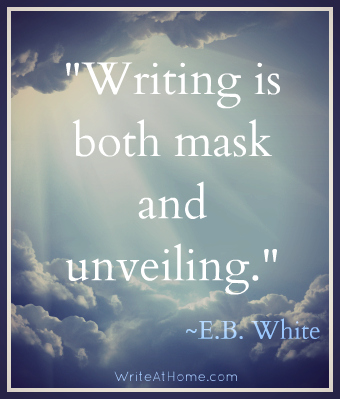
One of the things that I really like about writing is the anonymity of it. I can hide behind characters, and reveal my innermost thoughts without revealing anything at all. I strive to be, as the author, completely invisible in my novels.
Of course, with setting up an author’s page on Amazon, they ask for a bio and photos.
I wonder, do readers really care what the author looks like?
Personally, I don’t.
Personally, sometimes I wish that I didn’t know what an author looked like.
I’m contemplating whether or not I ought to include that particular bit of info, and hide safely in my anonymity.