About Writing

What AatW isn’t…

My husband and I like each other, so we tend to talk a lot. Like, for at least a couple of hours every day. We’re serious BFFs.

Recently, my husband said, “The only reason Hackett isn’t a cuck is because of his sense of dignity.”

I both laughed and felt mortified.

Because for the last eleven months that I’ve been working on this story, I’ve been worried that it was going to be misconstrued as a cuckolding fantasy, or the MGTOW narration of, “Girl gets pregnant by sexy alpha, then dupes nice guy into financially providing for her.”

It’s not.

One of the main themes of the novel is the value of self-worth. Hackett comes in with a strong sense of who he is, and doesn’t let others belittle or manipulate him. Alice, on the other hand, starts off struggling to figure out her identity, while dealing with the aftermath of “living like she was disposable.” Essentially, Hackett becomes the example that inspires her.

Hackett still expects fidelity, and to be treated fairly and respectfully. He ain’t no cuck.

But I can see how the same scenario with a weak male lead would very easily be along those lines.

About Me

Knitting Patterns

My baby is teething. And I am so tired.

I’m one of those excessively creative sorts, and writing is just *one* of the things I do — since it’s my favorite, it’s the one I blog about. Ostensibly. Since I’m not particularly ‘plugged in,’ I usually work on some sort of yarn project when most others are on their phones. I know that this is an obsolete thing to say now, but once upon a time I used to be the only mom at the playground who wasn’t glued to a screen. You know, back when the world still existed.

Sometimes I think everything really did end back in 2012, and we just didn’t realize it at the time.

Don’t mind me … I’m not getting enough sleep.

So, one of my other dreams is to publish crochet and knitting patterns. I’ve already made a few of my own designs, too.

The problem comes with writing them down. Following a knitting pattern is one thing, but writing one is agonizingly boring. Then, of course, in order to make them more commercially friendly, you need to work out different sizes, as well as gauge. I’ve always found it much easier to simply hand the sweater/scarf/hat over to whichever child I made it for, for them to promptly lose in a giant mess of laundry, never to be seen again.

Then I tell myself that since I can’t take a picture anyway, there’s no point in writing down the pattern.

But I still think that I would like to come up with designs that are based on the stories I write. Like, “Alicia’s baby booties,” or “Gertie’s shawl.” It would be a fun way to share this magical world of mine outside of the stories.

So, I’ve decided that one of my 2021 goals is to design and publish at least one knitting pattern for Alice and the Warden.

Here’s hoping I actually make that happen?

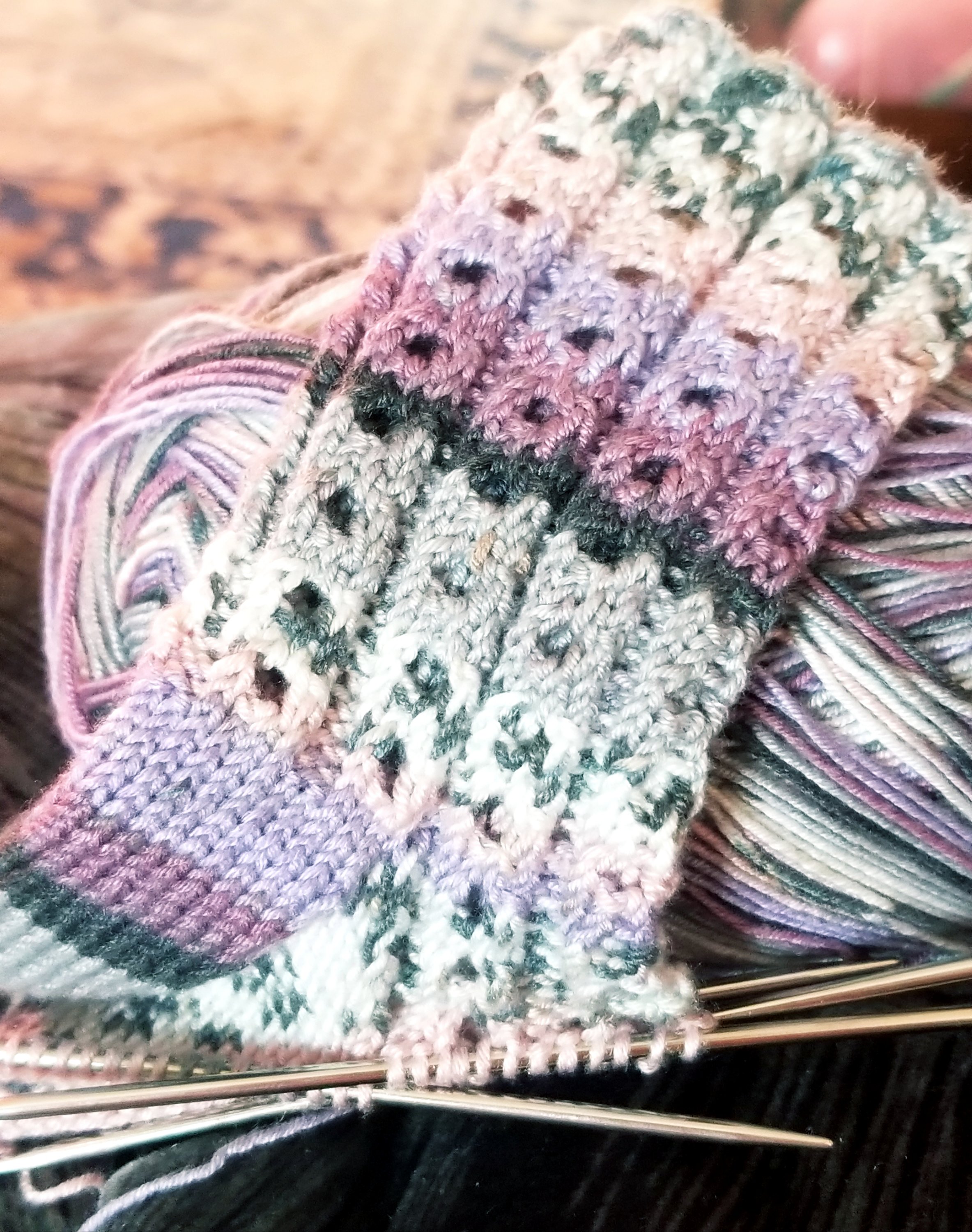
I’m currently knitting socks for my 8-year-old.

About Writing

Romance Genre

I’m not entirely sure which genre Alice and the Warden properly belongs to. I call it Romance because the primary focus is on the relationship between the two main characters, but it’s very different from your stereotypical romance novel — it’s not based on any self-serving fantasies (*cough*50 Shades*cough*) that the ‘romance’ label usually connotes.

I also joke that if AatW were Women’s Fiction, Alice would immediately put her baby in daycare, go to college in pursuit of friendship and career, and desperately seek to regain her “lost” years — while Hackett was relegated to the background as a supportive cardboard cutout. Bonus: She’d call herself a good mother after constantly complaining how much time and energy babies take up.

Then there’s the Damon chapters…

(Yes, I am fully aware that I could never be a Hallmark movie writer.)

It’s always a bit awkward saying, “I write romance,” because people automatically think of books like Twilight — the whole, “Oh, you’re just writing shallow fantasies about rich men off the top of your head,” reaction. Personally, I see it as a very serious topic; one that I’ve applied years of research and real life experience into, because frankly, successfully writing marriage and love actually requires a deep understanding of psychology and relationships, and doing it wrong alienates readers.

And yes, writing romance even requires a philosophical stance, too. I portray “complementary” relationships, instead of the more popular “egalitarian” model.

So maybe it’s time to revamp the “romance” genre to include actual research, to reflect how real relationships work, instead of being purely the realm of self-serving sexual fantasies.

Goal number two: Write romance that appeals to men, lol.

About Writing

Writing babies

One of my pet peeves with fiction is when child characters start out important, then are reduced down to props or are inexplicably absent at the end. A good example of this is from An American Tail, when Fievel’s baby sister Yasha is completely nonexistent for the latter half of the movie.

If you’ve been following my blog this year, you’ll know that I had a baby about six months ago, and that I’m currently working on a fictional story about a woman who had a baby. The silly thing is, having those parallels is actually making it harder for me to write about motherhood.

I spend all day snuggling, kissing, playing with, and caring for my baby, then at night after the older kids go to bed and I settle down to work on my writing, I feel self-conscious about describing all of that. It’s a little too autobiographical.

And it’s bothering me enormously.

I’m going to add in more descriptions of motherhood when I rewrite it, but for now I feel like the first draft has a giant hole in it.

Chalk it up as part of the process.

Photo by Pixabay on Pexels.com
About Writing

Why Readers Deserve Happy Endings

I have a straight-forward style of storytelling, where I deliver what I promise with no gotchya’s or plot twists. When I was posting stories on Reddit, I’d occasionally get comments from people who were relieved that I ended on a happy note, instead of abruptly implementing, “rocks fall, everyone dies” for dramatic impact.

I confess that my tastes in fiction are quite old school, so I can’t speak with 100% certainty of what’s being done currently, but from what I saw others posting on Reddit, and what I know of popular series like Game of Thrones and Harry Potter, a lot of writers are obsessed with killing characters, plot twist betrayals, and numerous cheap ploys that tug on emotions.

Sometimes I wonder, at what point does it become emotional abuse?

Bear with me a moment here.

As a writer, I have an ego — my decision to make my stories available for other people to read is testimony of that. I’ve spent years practicing, studying, and philosophizing, and while I don’t think that I’ve achieved perfection, I do believe that I’m better than average.

But I don’t think that I command any sort of god-like control over anyone who chooses to read my fiction.

I am not out to deliberately manipulate your emotions.

My goal is to tell a story.

The thing is, if you were in a relationship with someone who was deliberately keeping you off-balance, utilizing your emotional attachments to punish you, and dangling good promises with no intention of delivering, that would be a horrendously abusive and toxic relationship, right?

Well, guess what?

Writer – reader counts as a relationship.

Readers have the power to put down a book at any point for any reason, so on some level Game of Thrones fans are agreeing to be subjected to an endless parade of death, etc. However, the frequent use of manipulative tactics combined with persistent anxiety, makes me think that readers might not realize they have that power.

We don’t have to accept being jerked around so much we can’t enjoy a happy light-hearted story without panicking that something bad is going to happen.

There is a point where enough is enough.

Stories

Concept Story – The Goddess Mask

I had wanted to write a fun short story for Halloween, but that ain’t happenin this year.

I did come across this concept story that I had written in 2011, for one of my more surreal ideas, though.

Good enough.


Esriel shivered, holding the brick tighter in her hand, fearful that the rain could compromise her ability to use it. In a moment the girl would be close enough, and Esriel would fix her mistake. It had been wrong of her to descend to the lower realm, and unfortunate that she had been seen. It was disastrous for the girl, however, that she had chosen to follow Esriel.

Never leave a loose end.

The girl was clumsy. Her breathing was loud, and her footsteps louder. She kicked pebbles, and cursed when she unexpectedly stepped into a puddle, soaking her shoe up to her ankle. Then, just barely out of position, she stopped.

โ€œI saw you . . .โ€ she began, her voice quavering. โ€œI want to know . . .โ€

For a moment there was a twinge. No, she thought, never back down. Never let a mistake go unfixed. It wasn’t guaranteed to be a killing blow at that range, but it would do enough damage to let the second one do its work.

โ€œPlease, come out . . .โ€

Closing her eyes, Esriel steeled herself for the task and began to slowly count down. Three . . . two . . .

The signal.

Esriel’s eyes snapped open, the urge to obey already tearing at her body. She couldn’t leave the girl here, not with what she had seen. Willing herself to believe that she didn’t have any other choice, Esriel bounded out of the alcove that she had hidden herself in and grabbed hold of the girl’s shirt, dragging her along as her form shifted and dissipated, taking both of them to the higher realm.

Alice and the Warden, Stories

Gud Riting

Outside, Damon kicked something or other and threw a major fit, picking up a lawn gnome and hefting it over the fence.

Miranda asserted, โ€œCalm down! We can use this to our advantage!โ€

โ€œNo, we’re going to drop it,โ€ Damon explained. โ€œWe don’t have a case.โ€

โ€œWhat do you mean?โ€ Miranda inquired.

โ€œI kissed her first,โ€ Damon confessed.

~OR~

Having egressed from the abode, Damon sulkily perambulated about the premises, seeking to obviate himself of his indignation, and finding outlet in his frustration through the act of kicking some object or other before truculently hefting a hapless garden gnome through the air with an ungainly heave of his torso.

Miranda ejaculated, โ€œCalm down! We can use this disadvantage to our advantage!โ€

โ€œI’m afraid that I must disagree,โ€ Damon countered obstinately, โ€œThere are major show stoppers preventing us from leveraging the turnabout successfully.โ€

โ€œI need your hot, throbbing elucidation,โ€ Miranda desperately entreated the roguish dandy, her bosom heaving breathlessly.

โ€œI must woefully confess that my passions overcame my better judgement,โ€ Damon confessed woefully, โ€œI kissed her before she kissed me.โ€


An explanation: I had a particularly stressful day, so I was too frazzled to think when I sat down to write. Instead, I jotted down the lamest thing I could think up.

When I shared it with my husband, his response was along the lines of, “Hold my beer.” He wrote #2.

About Writing

Unique Approaches to Characterization in Fiction

‘Round about a decade ago, I mentioned in some writing community that I liked to go window shopping and find clothes that would fit my fictional characters’ sense of style. I was promptly informed that I was crazy and weird.

Well, duh.

Why else would I be a writer?

Now that I never go anywhere without my ever-growing entourage, I don’t go window shopping anymore. I also don’t have anything to do with writing communities anymore, because the sheer level of “not getting it” is beyond astonishing. For people who claim to be all about writing fiction, they’re a little too concerned about appearances in the real world. Seriously, who cares if you’re weird?

But anyway

I love characterization. It’s probably the facet of writing that I’m the most enamored with, and I’m as passionate about my villains as I am about my heroes. I adore those meditative moments when I seek out their voices and listen to their stories.

And I guess that, given my apparent insanity, I have a different approach to characterization than other writers.

For some reason this is an unpopular thing to say, but the truth of the world is that the way you dress reflects your personality. That’s why some people are all about leggings and messy buns, while others like vintage fit-n-flare dresses. You know. Because they have different personalities.

So, my once-upon-a-time window shopping was part of my characterization process. Getting a clear picture of how they dressed also gave me a clear picture of who they were. I still like to browse online for what so-and-so would wear, and I put the clothes into my stories.

My approach also relies heavily on the preconceptions that the readers are bringing into the story, and gives a lot of room for individual interpretation (which I happen to enjoy, because it personalizes the experience). Instead of describing Miranda as “professional”, I put her in a pantsuit and it’s up to you to view her as “empowered” or “narcissistic.”

Me? I don’t think of her as either. But that’s a ‘nother post.

There you have it: clothing matters in fiction.

About Writing, Alice and the Warden

Miranda Grainey

Aged 34. Blonde hair, usually in simple updos, blue eyes, oval-rimmed glasses. Lawyer.

Miranda is a foil to Alice.

She and Hackett were together for about ten or so years, then broke up three years before the start of the story. As described, โ€œIt was a comfortably low-maintenance relationship, and Miranda never cared how many hours I worked, because she was putting in just as many herself. In retrospect, I don’t think that either of us put an ounce of our hearts into it, and we were only together to ease the strain of our careers.”

However, Miranda was the primary motivation behind Hackett’s career advancement, because she cared about prestige and image. They worked well together as long as he kept moving upwards, but Hackett’s satisfaction with his position as warden put a strain on their relationship. Eventually, his desire to switch gears and begin a family is what brought their relationship to an end.

Miranda’s main weakness is that her self-image is externally defined. She needs the fancy job, car, money, etc, to feel like she has worth, and any threat to those things is a threat to her as a person. She rejects the idea of motherhood completely, because in her mind it would rob her of who she is.

She views Hackett’s marriage to Alice as a huge personal insult. They were together for ten years without ever once mentioning marriage, then out of nowhere he up and elopes with someone 17 years younger than him. Worse yet, Alice is a high school drop out, with none of the education or ambition that Miranda deems valuable. She writes off Hackett’s marriage as a lapse in judgment brought on by a midlife crisis, and hopes that they’ll eventually divorce.

She also listens to too much modern music.