About Me

Inner Voice

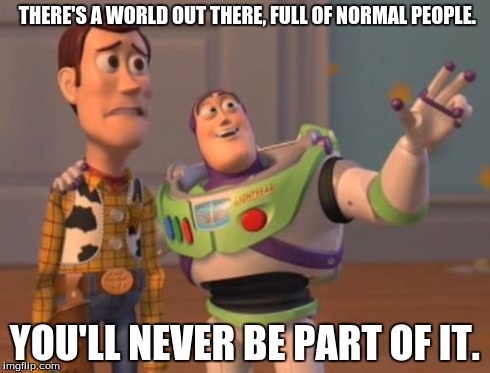
I have an extraordinarily loud inner voice, and I took it for granted that everyone had some sort of private dialogue with themselves, until I found out differently a few months ago. Read the title of this article, which says all you need to know. I still struggle with the idea, but it also explains why so many people have assumed that if I don’t say my thoughts out loud, my thoughts don’t exist.

I started off extremely shy, and once I was labeled as quiet, no one wanted to hear anything I had to say. However, that didn’t mean that I possessed an empty mind, so I’ve spent most of my life telling myself all of those thoughts that no one else ever bothered to listen to. In many ways, I was my only confidant during my formative years, and I suppose that my chatty brain is the natural consequence of that.

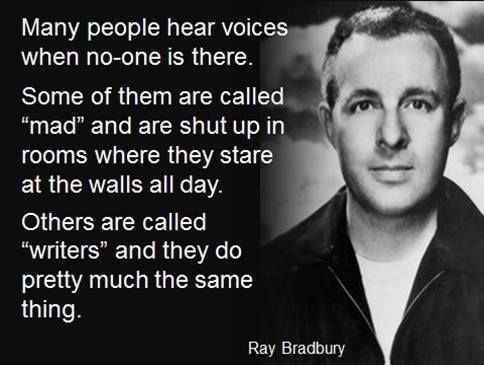
I often have a monologue going on in my brain. It doesn’t matter if I’m sewing or washing dishes, I’m always chattering away with myself in my head. I can even talk to my own fictional characters as if they were real.  It’s one of those things that I don’t tell most people about, since they aren’t very likely to understand — I’m sure that a psychiatrist would have a field day with me.

Ultimately, that’s why I write: the Voice has to go somewhere. That’s also why I feel compelled to self-publish, instead of keeping my stories hidden away on a flash drive somewhere. At the end of the day, I’m still human, and I still want to feel like someone hears me.


aaea2391c80f95e1506cecb103602cf6

About Writing

The Hopeless Romantic’s Guide to Writing Captivating Characters

My Venus is in Pisces, which is the astrological way of saying that I’m the quintessential hopeless romantic. This was not a personality trait of mine that was ever supported during my formative years, and as a teenager I was frequently warned that I was setting myself up for disappointment; I was also told that I shouldn’t expect to get married.

When I talk about romance, I mean the earth-shattering, butterfly-inducing, dizzying, elevating, whirlwind of excitement sort. The kind that we’re constantly told doesn’t exist. That kind.

A major motivation behind reading is to enjoy stories that I can’t hear by simply talking to the neighbors (even if they are sordid and juicy). I like stories that are larger than life and inspirational; I just can’t find books like that.

Most romance novels are about an attractive, powerful, rich guy, and since I frequently indulge in that fantasy myself as a writer, I’m not going to knock it. It’s obvious why she would fall for him, but why does he fall for her? The heroines range from mediocre to psychotic harpies; with heavy heapings of selfishness on top.

That question, ‘Why does he fall for her?’ is often left unanswered, and that kills every chance of deeply capturing the spirit of romance. If I hate the heroine, I’m not going to empathize if she captures the attention of Mr. Mega Hunk. I usually declare, “This book is stupid!” and give it a bad review on Amazon. No vicarious butterflies, no point in reading.

When I write my female characters, I write them as someone that I could fall in love with myself, and I have zero interest in Anastasias or Bellas. Perhaps I relate to novels in the wrong sort of way, but I like to think that’s what differentiates me from the Mary-Sues.

My hope is that if I write a scene that gives me butterflies, others will experience that as well when they read it.

I am a hopeless romantic, after all.

About Writing

Creating Dynamic Characters: Balancing Depth and Archetypes

No one wants to read a novel where half of the characters could be replaced with cardboard cutouts and have no effect on the story, yet so many authors struggle with that very thing; even professional ones. We all know the criticisms of wooden and flat characters who never develop, but what to do about it is not so obvious.

I can tell you though, the answer is probably not found by playing 20 questions with character sheets. You’re writing a person, not a profile.

Me? I turn to nonfiction.

One of my favorite books is Chakras and Their Archetypes by Ambika Wauters, which I highly recommend. It gives a good breakdown of dysfunctional personality types, then contrasts it against what the strong, functional personality looks like. While a person may be weak in one area, they are likely going to be strong in another.

I think that something writers forget is to make their characters internally balanced in some way. Joe may be a maniac bent on power, but he fixes up injured birds in his backyard. Throw in some exposition about the bird bath owned by Mrs. Roberts, who always fed him cookies after his dad beat him up, and the characterization practically writes itself. Why is he bent on power? He hated being helpless and hurt, and thinks that it will protect him. Why does he help injured birds? Because he secretly relates to them, and thinks about the good that Mrs. Roberts had in his life, even if it was just a tiny part. Joe isn’t bad, he’s just badly damaged. Maybe he’ll find redemption, maybe not.

Hey, that wasn’t hard at all.

Archetypes are useful tools. Personally, I think they are a little too one-dimensional to base a character entirely off of one archetype, but combine a few in different areas (a rebel with people, but a caregiver to animals), and you can build some unique and dynamic characters.


37c91f41f21099b03149879c39b66d23

About Writing

Fantasy

Fantasy is one of those umbrella genres that has about as many subcategories as you can imagine. Typically, when I tell people that I enjoy reading fantasy novels the best, the immediate response is, “Like, Lord of the Rings and Harry Potter?”

No.

Not at all.

As a kid, I burned through the Chronicles of Narnia and the Redwall series as fast as I could get my hands on them. As an adult, I tend toward books that are more esoteric in nature. I also, for whatever reason, have a weak spot for punk urban fantasy, as long as there are fairies involved.

I feel that I should mention that Lovecraft is a god in my eyes, and while he is categorized as horror, I adore anything that can be described as ‘Lovecraftian’ (*cough*Stranger Things*cough*).

My foray into epic medieval fantasy actually put me off reading all together for awhile. I’m just not a swords ‘n sorcery sort of girl.

Maybe, to people who never read fantasy novels, pointing out the variations in the genre seems geeky and arbitrary, but those differences make … well, all the difference. Harry Potter fans aren’t the same as Game of Thrones fans.

story_time_by_alectorfencer-d5h7ntv

About Me

Real Life

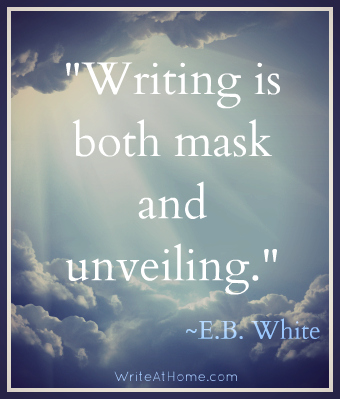
It always feels a bit strange when I draw from my real life with my stories. I never include the Big Stuff; truth be told, I have a possessiveness over my experiences that lends itself towards secretiveness. Barriers, and all that.

Hey, if I was perfectly well-adjusted, I wouldn’t be a writer!

Often, I’ll be out and about, see some curtains that I think are beyond gorgeous, and make a mental note to use them the next time I ever need to describe curtains. Is it deep? Not remotely. At the very least, reading my books will give you a good idea of my tastes in fashion and home decor.

You will not, however, get any sort of autobiography about my life.

Barriers, and all that.

White_Mask_Unveiling.jpg

About Writing

Music and Writing

For the past several months, I’ve been working on the rough draft of a new novel, and for the past several months, I’ve been listening to Kamelot on repeat. Specifically, the song, “The Last Day of Sunlight” (which as far as I can tell has not been posted YouTube).

When my husband commented on it, I muttered vaguely about how that particular song “kept the channel open” for writing my novel.

Music is a powerful tool for putting one in a specific mindset for writing. Each story has a different “feeling” about it, and finding a song that suits that “feeling” is often a powerful way of tuning in to inspiration and creativity. I don’t know if this is something I can explain accurately, but I’m certain that those who have experienced it know exactly what I’m talking about.

Often, the earliest stages of a novel involve also finding the music that fits the story, to compose the playlist that will sustain the channel of creativity for the duration of writing. Then, I will listen to that playlist on repeat, to the exclusion of pretty much everything else.

Even if it does start to wear on everyone I live with.

Thankfully, my husband understands.


About Writing

Improving Story Progression Through Handwritten Drafts

I’ve mentioned before that I write all of my rough drafts by hand. One of the benefits of doing this is that ink is permanent, thus effectively neutralizing the urge to edit as I go. My main focus with my rough drafts is getting the story down on paper with as little critical thinking as possible.

I’m a firm believer in the power of editing and let quite a lot slide through in my rough drafts, but every now and then I do write something that’s so bad, it grinds the story to a halt. Sometimes it’s necessary to rewrite as I go, just to keep the story progressing. I average rewriting about five pages out of a hundred, which is more a testament to how forgiving I am than anything else.

Since transcribing onto the computer is an eventual necessity, that’s where I do the bulk of my rewriting. That’s when I start to think, “How can this be better?” I usually end up rewriting about 90%.

Ever since I started cleanly separating the steps of writing and rewriting, I’ve been able to finish books, rather than collecting files of unfinished beginnings.

Tiny frog
About Writing

Practical Writing Tips for Creative Success

I majored in Creative Writing during my stint in college. In one of my regular English classes, that focused on teaching grammar of all things (who does that?), we had a published author come as a guest speaker one day. After class, offhandedly, he commented, “Majoring in Creative Writing is the worst thing you can do as a writer.” He advised me to switch majors immediately.

I can’t remember his name or the title of the book he wrote. Shame, really, because that was probably the best advice I’ve ever gotten.

If you’re on this journey, don’t read books or websites that teach creative writing. Just don’t.

Learn grammar. Learn what prepositions and interjections are. Watch School House Rock. Internalize it. Use it all the time, even when texting. Embrace being seen as snooty. Words are your medium, and you need to understand how to use them correctly. Just don’t turn into a “grammar nazi” who compulsively hyper corrects everyone else — people hate that. Part of the rich complexity of English is that it can, and often does, accommodate oddities and mishmashing, so learn how to use that effectively.

Read non-fiction. I particularly like self-help books, as they tend to be a rich reservoir of foibles and psychology, wrapped up in layman’s descriptions that are easy to understand. And hey, if I happen to also benefit from it, all the better. These sorts of books will give you a better understanding of how to create realistic characters than worksheets ever will.

And of course, research your genre. Don’t write a Highlander romance based entirely off of all the other Highlander romance novels you’ve read; find a history book about Scotland first. This is especially important if you are writing in one of the realistic genres; its easy to alienate those who could be your most loyal fanbase if you completely misrepresent their field.

Finally, practice. Write all the time. Write about everything. Write and rewrite. Write. Write. Write. Compose stories in your head while you’re at the dentist or driving in your car. Don’t start judging anything until the 2nd or 3rd drafts; instead, enjoy the flow of creativity. Just frickin’ write!

You’ll learn far more than Creative Writing classes will teach you.

About Me

The Man Who Invented Christmas and Characterization

I have a thing for watching corny Christmas movies in December, which is how I came across The Man Who Invented Christmas. It’s about Charles Dickens during the time period in which he wrote A Christmas Carol.

Overall, it really wasn’t my cup of tea. I finished watching it anyway, despite interruptions breaking the movie up into multiple sittings, because I did like how it portrayed Dickens chatting with the fictional character of Scrooge whenever anyone else wasn’t around.

My favorite moment was when Dickens entered his study, stuffed full of fictional characters milling around, and one of them asked, “Who is that?”

Scrooge replied something like, “No one of any import — just the author.”

I’m going off of memory here, so forgive me if I got the line wrong. The spirit is there.

I busted out laughing, because that’s how I write.

My characters are as real to me as, well, real people. I talk to them and listen to the stories they tell me. Writers block happens when they refuse to answer my questions, and getting through it is a matter of finding out how to get them to open up again with better questions. Sometimes, I feel like I’m helplessly scribbling down as much as I can while they chatter away too fast for me to follow. Othertimes, they patiently work with me through the interruptions that come with being the mom. It’s often very sad when the story is done and we say our goodbyes.

I suppose that being crazy isn’t necessary for being a writer, but it certainly helps!

About Writing

Pinterest and formulas

I look at Pinterest when I’m too tired to function, and the site is always eager to suggest infographics and articles about how I should be writing; everything from tips to make scenes more emotional to character questionnaires.

If there’s one thing I hate, it’s being told that I have to follow a formula.

Ages ago, I didn’t want to go to college, but everyone told me I had to if I wanted to have a future. Two years in, I was so badly burnt out that I cried every morning when I got out of bed. Then one day it hit me: I didn’t have to be there.

I dropped out, got a full time job, and rented my own apartment. Complete strangers had a meltdown over my actions. Didn’t I care about my fuuuuture????!!!

Meh. I was happier. I met my husband during that time period.

And yeah, so life did get crappy when the job market crashed. Having a college degree wouldn’t have saved me from that, however, and experience isn’t a bad thing. I didn’t cease to exist, and I learned how to really appreciate life. I like who I am now, scars and everything.

Unfortunately, formulas seem to make a lot of people happy. You know, guaranteed results in three easy steps! If you follow the formulas perfectly enough, you’ll be rich and famous. And my knee-jerk reaction is: you can’t tell me what to do! I make my own paths.

When I create characters, I don’t fill out worksheets. I give them names, ask them, ‘what makes you tick?” then listen — that’s the important part. It’s chaotic and unpredictable. It doesn’t follow any rules. It’s fun.

I can’t guarantee results. Heck, other than really enjoying myself as a writer, I haven’t seen any myself! But you know what I’ve learned? It’s the journey that counts.