About Me

The Predicament – A Short Story

This got out of its cage, and stubbornly refused to leave my shoulder.

While this chased me around, begging me to let it play with the colorful flying thing.

About Writing

Exploring What ifs

I confess, when it comes to writing I often feel like I’m inserting things that most people are never going to notice.

Which is how The Scion Suit became a love triangle.

It’s not the stereotypical “Which guy will she choose?” sort of thing, though, because of the branching timelines. Carol never attempts to pursue both men in the same story arc. She’s not remotely the sort of character who would even think about doing such a thing, considering that she starts out completely asexual.

Aaaand I’m not remotely attracted to the sort of woman who plays/exploits multiple men. It’s a quirk of mine to write female characters that I would marry if I were a man, which drastically changes how everything plays out. Hence why Carol’s romantic prospects both make around $80~90k a year, and will never buy her any expensive cars or jewelry, lol.

Instead, it’s more about exploring a number of “what ifs”.

What if Carol’s human nature overrides the Commander?

What if Carol never gets back into the Suit?

What if Hartmann is the antagonist?

What if Lambert is the antagonist?

But since I’m not bluntly labeling each timeline with my underlying reason for writing it, I figure that most of my themes are going to slip by unnoticed. People are going to assume that I’m aiming for “Team Hartmann” vs “Team Lambert” and not realize that one of them works with the Commander, while the other fights against it.

Not to mention, Carol starts off as a blank slate, and the final shape of her personality depends on which man she interacts with the most, versus how much time she gets in the Suit.

Photo by Suzy Hazelwood on Pexels.com
About Writing

Carol, again

A bit of random trivia is that Carol was actually the name of the main character from the first novel I ever finished … when I was 14.

I technically still have the file, but it’s encrypted so it can never come back to haunt me, lol.

As you’d expect from a novel written by a 14-year-old, the main character was a Mary-Sue. She had unlimited magical abilities, fell head over heels for a handsome prince, but was tragically the daughter of The Evil Antagonist. So. Epic.

But, because I’m a MAJOR weirdo, I didn’t name her anything AWESOME like Silver Raventhorn or whatever.

I named her Carol.

Yeah … I dunno.

I guess I had a pragmatic streak back then, too.

My current Carol, with The Scion Suit, is not in any way related to or inspired by the original. I recycled the name because it fit as normal and average.

And maybe also as a nod to my teenage self.

Photo by Karolina Grabowska on Pexels.com
Quotes, The Scion Suit

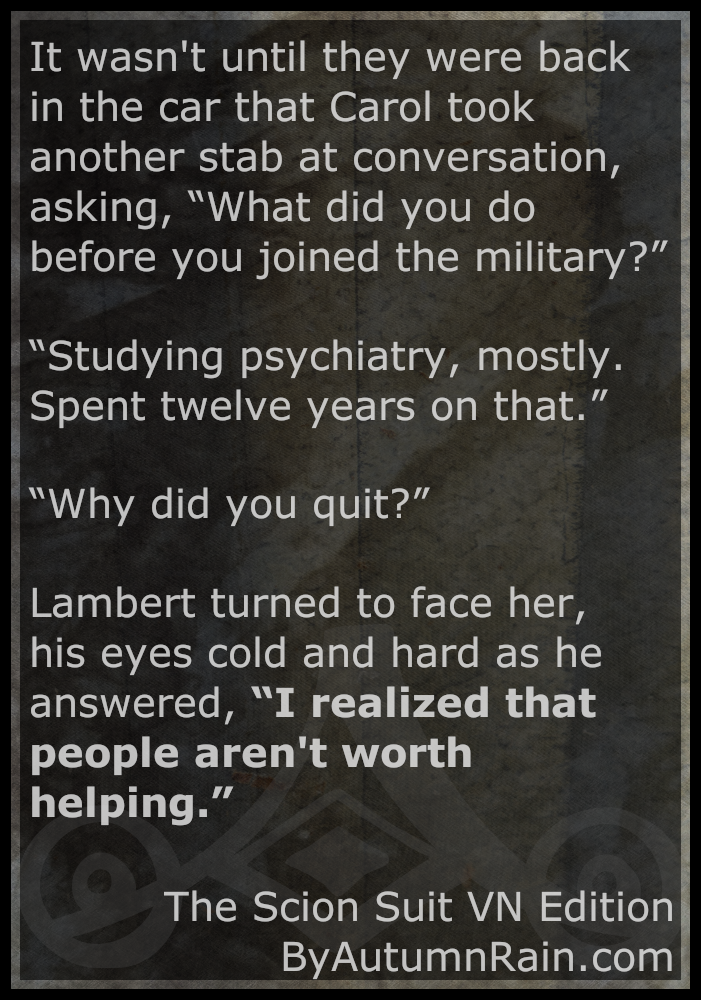
Quote

Carol had never felt anything towards anyone before, and had never had a reason to be uncomfortable with that fact, either. But something about Lambert was strangely familiar, as if they were simply falling back into a relationship that had begun long ago. Somehow, she was certain that she had been to his house before, and had sat in the living room watching a movie in much the same way, only this time they were finally indulging in their feelings for each other.

It was a very odd sensation.

The Scion Suit – Multiverse Edition
About Writing

Five Essential Elements for Compelling Stories

A stereotypical formulaic story:

An ambitious and spunky woman hits a low point in her career, so she leaves the big city to visit her small hometown, where she rekindles an old flame and learns a lesson about what’s really important in life. *cue heartfelt music*

Which basically means that once you’ve read one such story, you’ve read them all. *yawn* Yet a lot of writers keep sticking rigidly to the “basic plot” for whatever their chosen genre is, which ultimately makes them uninteresting to read.

I’ve decided to go ahead and break it down farther, to give you the analysis of the framework, so you know how to write a story without relying on imitating a plot that’s already been done.

I give you, the bare bones:

1.Exposition – Tell us who the story is about, the setting, and anything else that’s relevant to understand the rising action.

From our example above, this would be the description of ambitious and spunky woman, her chosen career, why she’s in a slump, why she chooses to return to her hometown.

To mix it up: An introverted yet successful cake decorator is given the challenge of a lifetime — making a cake to welcome the alien invasion. Describe how she’s successful, and why she was chosen.

2. Rising Action – This is usually the bulk of the story. The conflict has been introduced, and now it’s up to the characters to play it out.

From the example: The spunky woman meets her old flame, swoons over how gorgeous he is, then gets upset that he’s a jerk. Meanwhile, she has several deep conversations with her mom and/or best friend.

To mix it up: The cake decorator is teamed up with some important guy from the government, and together they work out the alien symbology to avoid accidentally offending the invaders. Meanwhile, they discover the aliens are allergic to buttercream, and need to come up with a substitute.

3. Climax – This is the culmination of events, and often the turning point in the story. It’s usually exciting.

From the example: Spunky woman and her old flame are stuck together somehow. They reveal their feelings and begin their relationship.

To mix it up: The cake decorator and government man realize that they were set up as scapegoats, and decide to hijack an alien cruiser to flee to the stars. Earth is doomed.

4. Falling action – This is where the characters work through the consequences of the climax.

From the example: The spunky woman is offered a new job, and she must choose between returning to the big city, or staying in her hometown with her old flame.

To mix it up: The cake decorator and government man discover an established colony of humans on Mars. Turns out, the aliens have been kidnapping people to populate it for years. They settle down together to live inside a dome city.

5. Resolution – The conflict is resolved, and the loose ends are tied up. Basically, it’s the author’s job to bid us a proper farewell so we feel satisfied that the story is over.

From the example: The spunky woman learns an important lesson about life and love, and decides to spend a little less time working, and a little more time living.

To mix it up: The cake decorator opens a new business on Mars, because frosting is her passion in life. Thanks to her knowledge that the aliens are allergic to buttercream, the colony can live in peace as long as they eat cake regularly. She is much happier than she ever was on Earth. She and government man have an unbreakable bond because of their shared experiences.

It’s essential that every story have all five parts. The climax doesn’t necessarily have to be big and dramatic, but there does need to be some pivotal event. Also, if you just end abruptly without a resolution, the story is going to feel unfinished.

If you use the story map as a guide for the events in your fiction, you can come up with new and exciting plots that don’t repeat the same old tropes over and over and over. Branch out, do something new, and still leave your readers feeling satisfied in the end.