I’m one of those writers that absolutely adores editing — it gives me the chance to slowly think, meditate, and deeply connect with each paragraph without the risk of losing the flow of creativity for the overall story.
When I was a kid, I used to pin my bright yellow blanket around my shoulders (the perfect universal costume, in my humble opinion) and play act having conversations with the characters from my favorite novels. I loved those hours I spent in my room, exploring worlds and “interacting” with Martin the Warrior and Prince Caspian.
One day when I turned ten, I got hold of some lined paper, picked up my favorite maroon marker, and started writing those conversations down. Truthfully I didn’t understand paragraphs back then, or quotation marks for that matter, but that solid block of text was the beginning of my dream.
As I grew, I joined Elfwood and Fictionpress, swapped stories with other teenagers online, took creative writing classes all through high school, and majored in creative writing in college. For me, there were no other career options — I was a writer.
Then life happened.
Somehow, the agonizing moments seamlessly blended into becoming a wife and mother of three, and before I knew it the better part of a decade had passed.
But you know what? Writing is the only thing that gives my life a deeper sense of meaning outside of the ordinary. What would be the point of all the pain and joy if those emotions stayed secretly locked up inside my own head? Sometimes it seems like it’s the only way I can peacefully live with the past.
I have my days of dark depression, when demons loom over me and whisper bleak things in my ear, leaving me too paralyzed to think. Then the sun shines again, I find a quiet moment nestled between games and chores, and I write.
Every time I read a novel, I experience two stories simultaneously — the one that’s written down on the pages of the book, and the one in my head of how I would have written it.
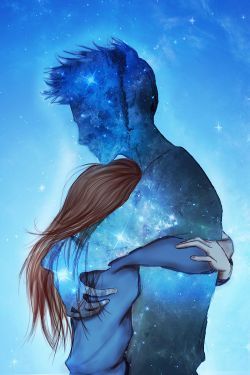
I found this picture on Pinterest (definitely not one of my crappy doodles, lol), and I thought that it perfectly fit the novel that I’m currently writing.
I’m not going to teach you how to write. Basic grammar is taught in school, and everything else comes with practice and experience. Use your brain and your talent, don’t be afraid to write a few crappy novels before you get the knack of it, and you’ll be fine. Besides, those crappy novels just might become best sellers — you never know these days.
I used to read blogs written by some of my favorite authors. I never cared about their technique, and didn’t visit their blog because I wanted to know how they did it. I wanted to know about them, as a person. Who were they? What were they like? What hobbies and interests did they have? Were they total weirdos like me?
I use my time differently now, so I don’t follow very many blogs anymore. I still have the same interest as before: I want to know about the author behind the stories.
The purpose of my blog is to answer that question for you. This is what I’m like.
I took three months to write the first draft of my current project, then I did something crazy:
I took two months off.
I read a book, worked on my hobbies, caught up on errands. I did lots of non-writing activities.
Because time is an essential component in writing.
Time to let the story simmer, time to get to know the characters better, time to gain more perspective, time to recharge.
As a writer, it’s easy to get too close to the story. It’s easy to skip over simple typos because the words are too familiar, or to be completely oblivious to the fact that actually, yes, that bit of dialogue really is unbelievably corny. Time gives distance to better see what your readers will be seeing.
But time can also be a dangerous thing, and too much time can result in a story that’s never finished. Writers need to learn how to manage it to utilize it properly.
During my first semester in college, someone told me, “Majoring in English is the worst thing a writer can do.” Sure enough, all of my English professors taught us how to write formulaic essays, endlessly analyzing literature, where word count mattered more than style. The other students never thought much about it.
But here’s the thing:
In my high school Creative Writing class, we were required to write stories in different genres for the practice. At the end of the year, after I had already used all of my favorite genres, I decided to write teen pathos for my final project. In just a couple of hours, I had cranked out a short story about a girl running away from home and getting her boyfriend killed in a car crash — it was very human interest-y, and I even laughed at how over-the-top it was while I was writing it. But hey, I needed a story for the grade, and I had already done fantasy.
And everyone thought it was autobiographical.
My mother threw a fit, and my best friend started wailing at me, how could you think such things? It caused quite a bit of drama in my real life, and no one believed me when I told them that it was meaningless.
A few months later when I sat in my college English class and listened to my fellow students analyze literature, I could easily imagine them discussing that story I had written. “A car crash symbolizes the author’s latent destructive desires.” Actually no, car crashes are easy go-tos for killing people, to make the story more melodramatic and pathetic. Not everything is symbolic.
I couldn’t take my peers or professors seriously at all. I started to play a game, to come up with the most absurd interpretations I could — supported with quotes from the text, of course — and my English professors loved and praised me with no inkling of what I was doing. It all just seemed ridiculous.
I dropped out of college entirely after two years. My best education came from the time I spent living in a van and traveling the country. In other words, living.
I understand why I had been told not to major in English. Those classes can teach you how to B.S. your way through formulas, but they can’t teach you how to write with your soul. Often, they are detrimental to that very practice.











 By Autumn Rain