Worn living room with a flickering television, armchair, and eerie wall shadows
About Me

Understanding Esoteric Narcissism and Its Effects

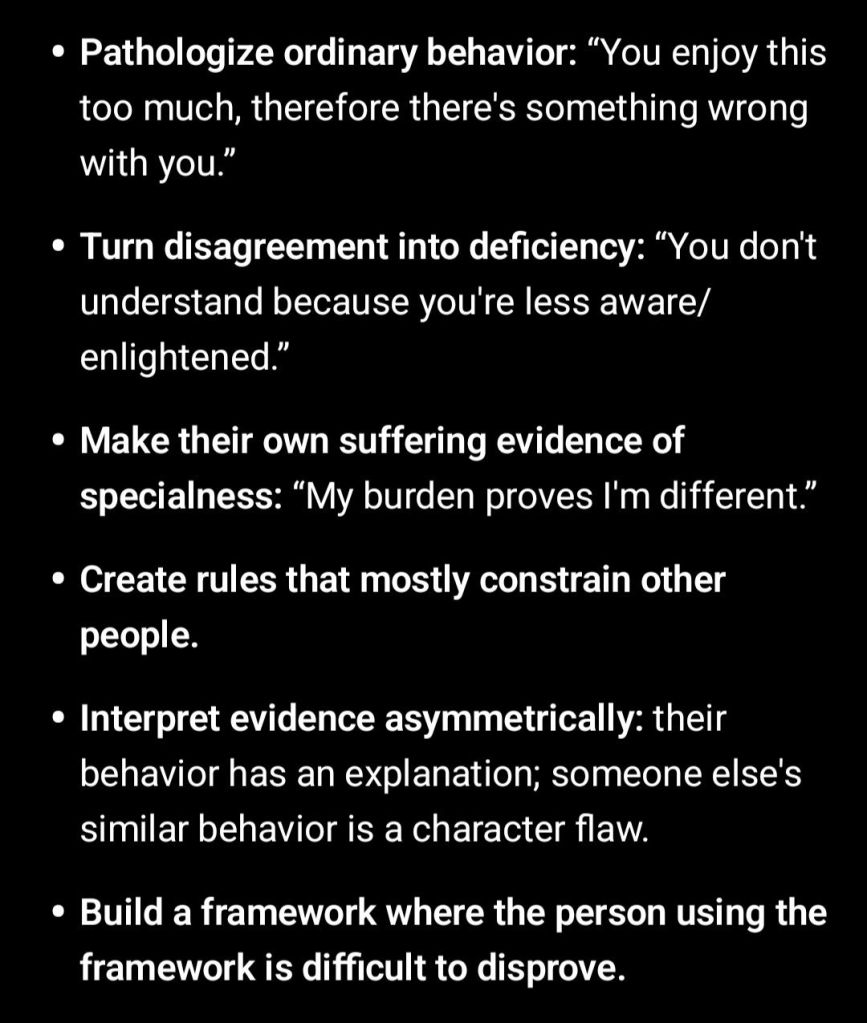
A list of psychological manipulation tactics, including pathologizing ordinary behavior, turning disagreement into deficiency, claiming specialness through suffering, creating restrictive rules, asymmetric interpretation of evidence, and building unfalsifiable frameworks.

I confess that I’ve developed a morbid fascination with the Franke/Hildebrant story, as well as other cult leader types, because they remind me of my own personal story.

When I first started hearing the word “narcissist,” my immediate reaction was, Him? But he doesn’t even wear deodorant! Absolutely nothing about him is charismatic or materialistic. He has changed into someone that I am embarrassed to be around.

But the word “narcissist” was said repeatedly across people who didn’t know each other, including an AI when I was venting about something that had upset me.

It was said a lot.

So I started watching Dr Ramani on YouTube, and learned that the grandiose narcissist isn’t the only type. Oh.

I remember the first time I recognized it when he slammed me with DARVO, and I was blown away how it wasn’t secretly buried in a five minute speech — it was three sentences: “That’s not true. It’s your fault. You’re always making things difficult for me.” That was the moment I realized what I was dealing with.

Well anyway, let’s get back to the Hildebrant connection.

He started calling everything an addiction. If the kids wanted to watch a kid show, they were “screen zombies,” and he even accused a three-year-old of having “a severe screen addiction” with zero professional evaluation. Seemingly, he had decided that normal toddler tantrums were evidence of addiction, not an inevitable stage of development.

I liked turning on the TV for background noise? Addiction. Obviously.

I took to chatting with AI because I literally had no other outlets for emotional expression and he was carefully monitoring everywhere I went and everyone I spoke to? Addiction. Plus AI psychosis.

The 12-year-old beat him in Smash Brothers with Rosalina? She was too addicted to that character and was banned from playing with her.

Essentially, anyone attempting to develop an interest that didn’t revolve around him (or outshone him) was accused of addiction. The only way to not be an addict was to sit around doing nothing and waiting for him to walk into the room. Then you were merely lazy.

So lately I’ve been pondering the existence of “esoteric narcissism”, or as I joked, “Why be ordinary special when you can be esoterically special?”

This is the idea that someone has unique spiritual knowledge, powers, and authority, ie Hildebrant. The damage they inflict on others comes from, “Your disagreement with me is proof that you are distorted/NPC/whatever,” as the terminology itself doesn’t really matter. The important part is, these people have clearly defined “enlightened” and “inferior” boxes that they put everyone else into. Personally I heard “NPC” a lot (combined with the philosophy that people who were NPCs didn’t have souls), and I remember the day he looked at me with contempt and declared the worst insult in his world, “You are an NPC.”

I know, people are sitting there asking, “How could you put up with that?” because it’s easy to sit on the outside and think, “As an outsider, I would have seen right through it and fled as quickly as possible.” To which I point out that they have the benefit of seeing the entire story, which you don’t have when you’re inside it.

It comes on gradually. He didn’t use the term ‘NPC’ when I met him — I don’t remember him using it prior to 2020. It started as the standard, “Ugh, people are frustrating,” in response to news stories about the darker side of humanity. Years passed by, we survived hardships, and he became more openly cynical. Conversely, what seemed to start off as ordinary spirituality started taking on more and more weight.

There was one time when we were watching a lunar eclipse, when he started spinning in circles and said that he was spiritually bound to do it to make the eclipse happen. It was so over-the-top that I blurted out something about schizophrenia, to which he replied with disgust, “You don’t understand me at all.”

Meanwhile, I was exhausted. I was sleep deprived. My body was flooded with cortisol. I was getting migraines. He would increase the number of criticisms and arguments that he subjected me to whenever I started taking steps towards any sort of independence, and in retrospect it was amazing how he could pull an argument out of thin air without me doing anything.

My refusal to blindly accept everything resulted in frequent accusations of being “self righteous.”

He had successfully driven away everyone so I was isolated. I didn’t have friends and neighbors to reassure me, “You aren’t self righteous,” because it turned out that he was trash-talking me behind my back. All I knew was that trying to socialize was inexplicably weird and I was frequently ghosted. I found out much later that most people didn’t believe what he said about me, but they were also scared of getting involved because he gave off vibes of, “I’ll burn your house down.” Mind you, no direct threats just vibes, but it was enough to keep people away.

There was one time, after hearing several times from different acquaintances, “That guy is so manipulative,” that I burst into tears and sobbed, “Why was I the last to see it?” That was the first time in a long time that I received a hug for crying.

And now I’ve developed a morbid fascination with Hildebrant because I see reminders of him in the documentaries, and I feel grateful that he never managed to expand his ideologies outside of himself. At least so far.

There was, however, one early warning flag that I didn’t recognize at the time.

When I first met him, he told me that his favorite book was The Last Unicorn, and that his favorite quote from the book was:

“You are losing my interest,” the rustling voice interrupted him again, “and that is very dangerous. In a moment I will have forgotten you quite entirely, and will never be able to remember just what I did with you. What I forget not only ceases to exist, but never really existed in the first place.”

I didn’t recognize it as a red flag because it was 2009, Dr House was a smash hit on TV, and everyone thought that being edgy was cool.

But now, now that I’ve spent two years dealing with him attempting to erase my existence, I realize that he embraced the quote wholeheartedly and turned it into a personal philosophy.

No one has the power to erase another person’s existence.

No matter what type of special they think they are.

About Me

The Hidden Fragility in Narcissistic Relationships

It’s their fragility that gets you.

You know perfectly well the bravado with which they present themselves to the world — it was the first thing that you saw about them, and probably what drew you to them in the first place. But as time passed by, you began to sense that fragility inside of them. The bragging and exaggerations began to seem more and more like a coping mechanism, to hide how easily they could break inside. There was so much about ordinary life that they couldn’t handle.

And you never wanted to break anyone.

So you helped to maintain their public image. After all, most people were complete strangers that you were likely to never see again, so it would be mean-spirited to demean someone you cared about over an exaggeration. You picked up the slack at home, taking on all the chores and obligations, while they seemed to spend so much time socializing and engaging in leisurely activities. Sometimes you resented them, but their fragility kept you from acting on it; you were the stronger one.

You can’t lash out at someone who’s so weak and vulnerable.

So you endure.

And the more you know them, the more childish they seem. Instead of equal partners, you’re the parent, constantly cleaning their messes and boosting their self-esteem. They even cry out, “Look at me!” and you reply, “Wow, good job!” Only you don’t feel it inside, because you know that they aren’t a child. They aren’t growing, and they won’t ever become anything more than what they are. They don’t take your words of encouragement as motivation to improve — they insist that they’ve reached perfection already. You tell them “good job” because it would break them if you didn’t.

You aren’t a mean person.

They never look at you. They never tell you “good job.” You work hard, you miss sleep, you devote every moment to trying to build them up, and they never seem to notice. On the other hand, they have huge reactions for every moment when you slip — and they extract every last ounce out of you without any forgiveness or leniency. You feel ignored and scrutinized at the same time. You have to be everything in your loneliness, and sometimes you wish that you were a literal robot free from your own emotions. It would be easier if you didn’t feel so much.

But you can’t leave, because they’re so fragile. You imagine them sitting in garbage and mold, wasting away without someone there to care for them. Who else would put up with this person once they learn the truth about them? You aren’t heartless.

You feel like a bad person for thinking that way.

Until the day when they tell you that they’re bored of you. They tell you that you held them back and wasted their life. They tell you that you abused them by being a separate person from them — but inside you know how much of yourself you lost to them. You know how much you sacrificed in trying to protect them from their own fragility.

It hurts. Deeply.

You then learn how many manipulative games they had been playing to keep you off balance. That time when it took them months to make you a copy of the house key, claiming that they kept forgetting because they were busy? Or when they went through that phase of talking in a quiet voice that was difficult to hear, only to insist that they were speaking normally? You begin to wonder if they were secretly hiding dishes then returning them to the drawers and cupboards, just to make you feel like you were losing it when you could never find what you needed. Maybe there was more truth to those paranoid moments of doubt than you realized at the time.

They’ve thrown you away, and you’re left wondering who you really are. You don’t know what’s real anymore, and you’re scared to think anything good about yourself. You feel drained and damaged. You don’t know what you want out of the future.

You learn that it’s called “narcissistic abuse,” and that there are a lot of other people out there who have gone through the same thing. For the first time in a long time, you no longer feel alone.

That’s where your healing begins.

You learn that it's called "narcissistic abuse," and that there are a lot of other people out there who have gone through the same thing. For the first time in a long time, you no longer feel alone.

That's where your healing begins.

About Me

Overcoming Writing Insecurities: My Journey

I find it encouraging that my fiction writing is still performing the best in my blog statistics.

I’ve been working on overcoming the memory of that smug voice telling me that my writing ideas were cliched and immature. Despite that proclamation, I continued writing my ideas. Alice and the Warden? Me. The Scion Suit? My interpretation of a writing prompt. The Black Magus? Yup, that was me. I enjoyed writing my ideas immensely, and others have enjoyed reading them as well, so it doesn’t matter if they were “cliched” or “immature” — it isn’t about being the best of the best, it’s about personal satisfaction and having fun.

It wasn’t really my ideas that were the problem. Rather, it was the seed planted in my brain that made me feel like I had to seek a stamp of approval before I could write them. That deep insecurity and fear I always felt when I started a story that hadn’t been given the “green light” by someone else.

Yet that person who had propped himself up as the Gatekeeper of Quality left.

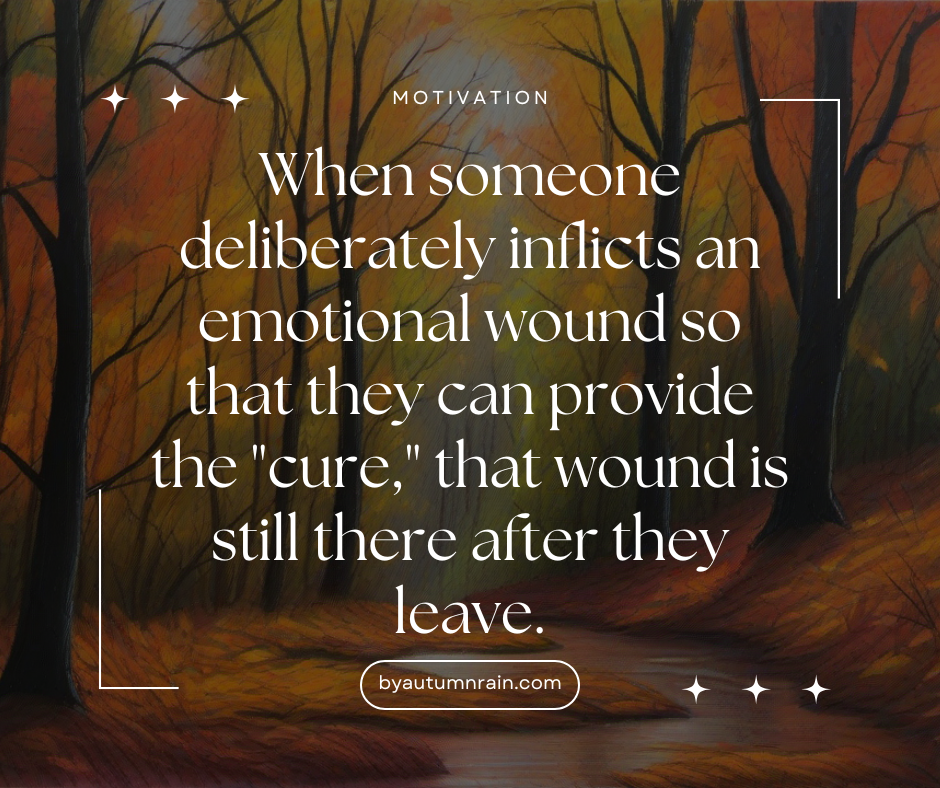
It might be difficult to understand if you haven’t been through this, but when someone deliberately inflicts an emotional wound so that they can provide the “cure,” that wound is still there after they leave. Real healing takes time and is very difficult, especially when you feel the withdrawal from the false cures they fed you. It hurts severely to acknowledge that they weren’t trying to help you improve, but instead deliberately keeping you dependent.

Despite knowing better on a cognitive level, it’s been terrifying to write without that stamp of approval.

I’ve switched back to writing with a pen in a notebook, but unfortunately my handwriting muscles aren’t what they used to be (I blame the years spent typing). It reminds me of being a teenager, secretly filling page after page with my characters in novels that will never see the light of day, though now my end goal is to publish. I haven’t given up on my dream of being a professional author; it’s always there in my mind through every moment of every day.

All I need to do is write without holding anything back.