About Writing

The Power of Telling in Writing: Beyond ‘Show, Don’t Tell’

The rule, “Show, don’t tell,” originated with the theater. Instead of having a narrator standing on the side of the stage loudly announcing that Aunt Martha is a mean #$%&, it’s far better to portray her with aggressive body language and a sour face.

However, somewhere along the way, the rule was applied to written fiction as well. Fact is, it’s pretty stupid as a rule for writing.

When your medium is words, you are literally telling everything.

To illustrate my point, I’m going to show you a picture:

Yep. Pretty awesome.

The visual part of your brain interprets that the picture is a photograph of a black fluffy cat sleeping on a game controller. There’s something knitted with bright yellow yarn on the bottom left, and the background has child-clutter, bookshelves, and even a fish tank. How ’bout that.

That’s show.

It works with theater, because the audience is watching actors, costumes, and props in front of them. The appropriate parts of their brains are lighting up to make all the correct interpretations of what’s going on.

Reading activates a different part of your brain, and to put it bluntly, not everyone has a good visual imagination to properly construct a scene that’s described to them with words. When I say, “fluffy black cat,” instead of picturing anything like the photograph above, their imagination is going to construct something more like this:

Stick legs

Or maybe their visual imagination is REALLY bad, and this is the best they can manage:

Instead of imagining a vivid scene with a real cat that’s doin’ stuff, they’re going to find themselves bored with the descriptions. It doesn’t matter how detailed you get, or how poetic you wax, it just isn’t going to do it for someone who can’t visualize that well. Chances are, they are far better at hearing the words, than seeing the scene.

Now, I’m going to tell you about that cat:

His name is Nyx, and yes, he was named after the goddess even though he's male. We rescued him and his sister when they were six weeks old, both very undersized and malnourished at the time because of untreated intestinal worms. We got them the necessary veterinary care, fed them lots and lots of kitten formula, and generally loved them into being healthy, energetic kitties. Nyx isn't fond of anyone other than me (which my husband considers to be a great betrayal), and he's got one of the whiniest meows that I've ever heard, but he likes to snuggle up with me and suck on my blanket when I'm lounging on the couch after the children have all gone to bed. He's the one I consider to be my animal familiar.

Now it doesn’t matter if your visual imagination can’t construct a vividly detailed picture, because you can piece together the information that I told you about his history and personality to construct an idea of what sort of cat he is. You get a lot more abstract information than the photograph gave you, and the irrelevant stuff is completely filtered out (I know, you were just dying to learn about that yellow yarn).

Here’s what I’ve discovered: People who have powerful visual imaginations are going to ‘see’ a scene or a character even if you don’t describe very many physical details. It does a pretty good job even without the purple prose.

But those who are better at hearing are often left in the dark, so to speak. Writers don’t play with things like alliteration or rhymes in fiction anymore, as they are far too busy trying to “show” everything to someone who may or may not be able to appreciate it. They don’t pay attention to the way the story sounds.

Because your audience is reading a book and NOT watching a movie, pay attention to the way the syllables and consonants flow. Read your story out loud to give yourself a chance to hear it.

Go ahead and tell your audience that Aunt Martha is a mean #$%&. Have that be the first sentence of the story, and spend the next few paragraphs telling everyone why. Imagine Morgan Freeman is narrating, or Vincent Price. Don’t be afraid to have a strong voice as an author.

Seriously.

Give it a try.

See what happens.

About Writing

Sequels

I’ve never written a sequel before.

Which is kind of … weird.

My writing history is pretty standard: started writing Redwall fanfiction as a kid, fell madly in love with the craft, and never quit. I had finished a couple of novels by the time I graduated from high school, etc, etc, et cetera. Maybe I’m supposed to care more about my “credentials,” but, meh. When I look back, all I see is inexperience and immaturity, and they ain’t nothing to brag about.

The other day when I started writing the sequel to The Black Magus, it struck me that in all this time, I’ve never written a book #2 before. You’d think that in over 20 years I would have at least experimented with it, but apparently not.

And sequels require a whole slew of new things to be mindful of.

For starters, I don’t want the second book to be completely incomprehensible to anyone who hasn’t read the first, which means that I need to artfully provide relevant exposition without devolving into “Previously on____” style recaps. This is going to require a fair bit of thought.

I also think that I ought to read The Black Magus and take lots of notes, to ensure better consistency between the books despite the real time that has passed between them. I’ve read too many sequels that ruin the gems introduced in the first book, so I want to do my best to prevent that from happening. Not to mention, retcon-ing is straight up awful.

I make the exception for “Rumors of my demise…” In the future, I think that I’m going to kill off a character just so I can bring them back in the sequel with that line, lawl.

Other things to be mindful of: Character drift, pointless repetition of the same plot elements, mixing new characters with the old, getting someone drunk again …

I’m definitely going to be learning on the go with this one.

Alice and the Warden, Stories

Miranda and the Convict – 1

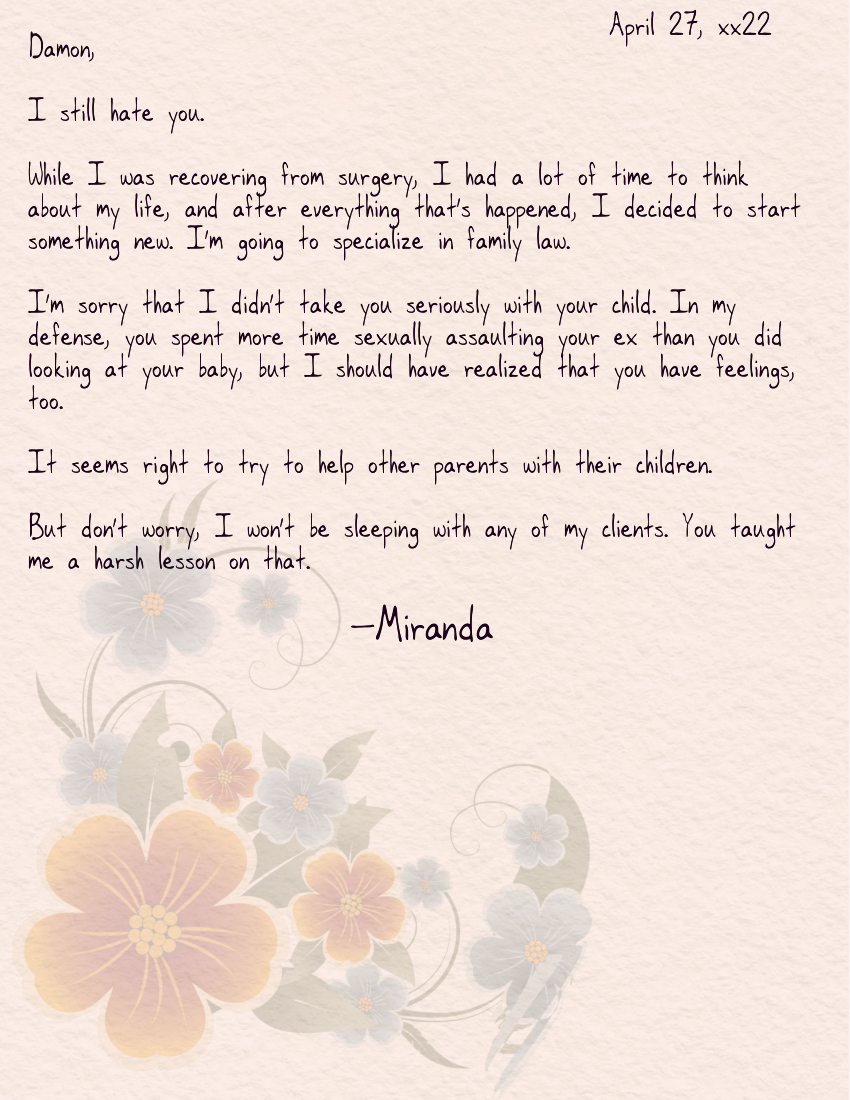
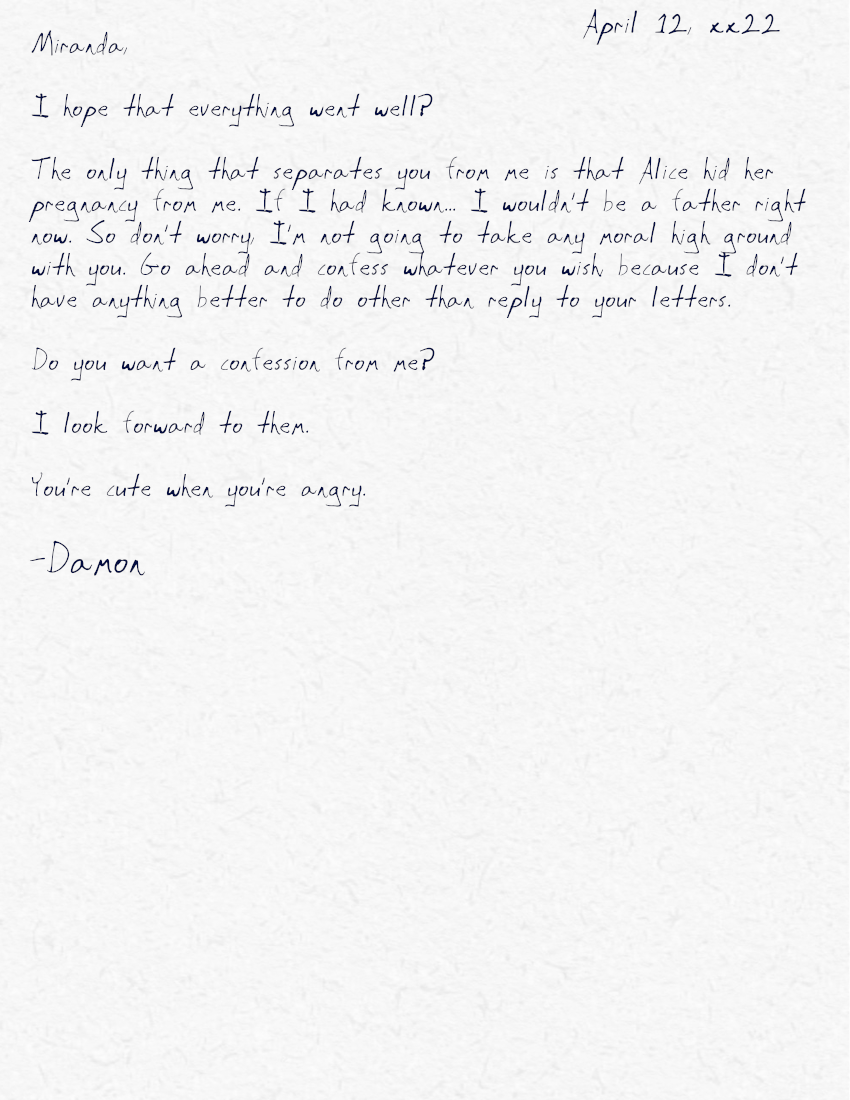
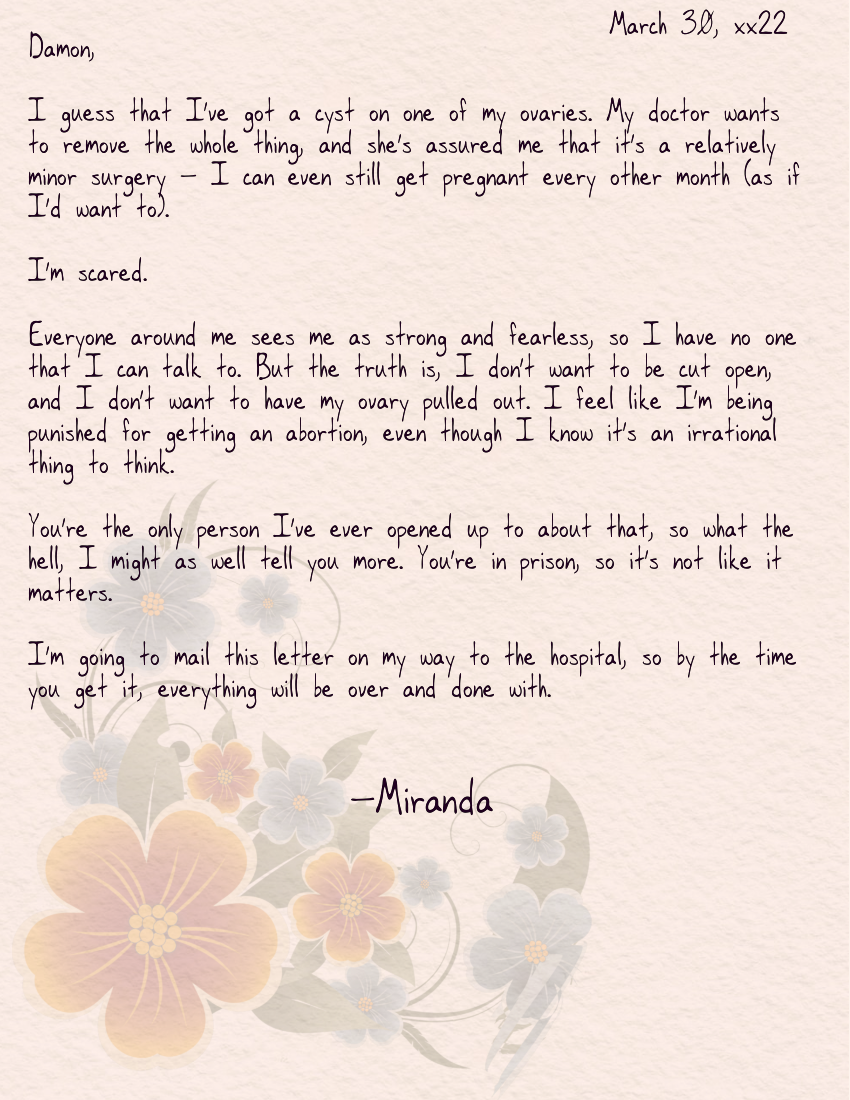
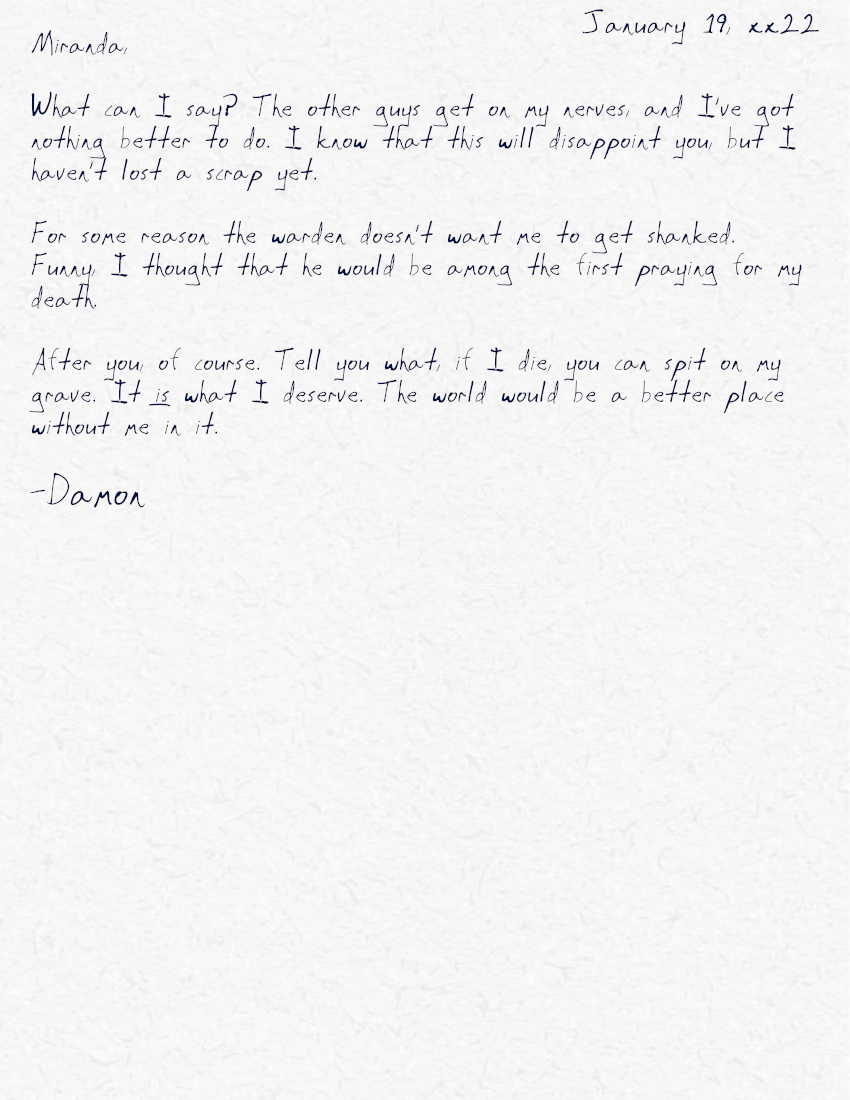
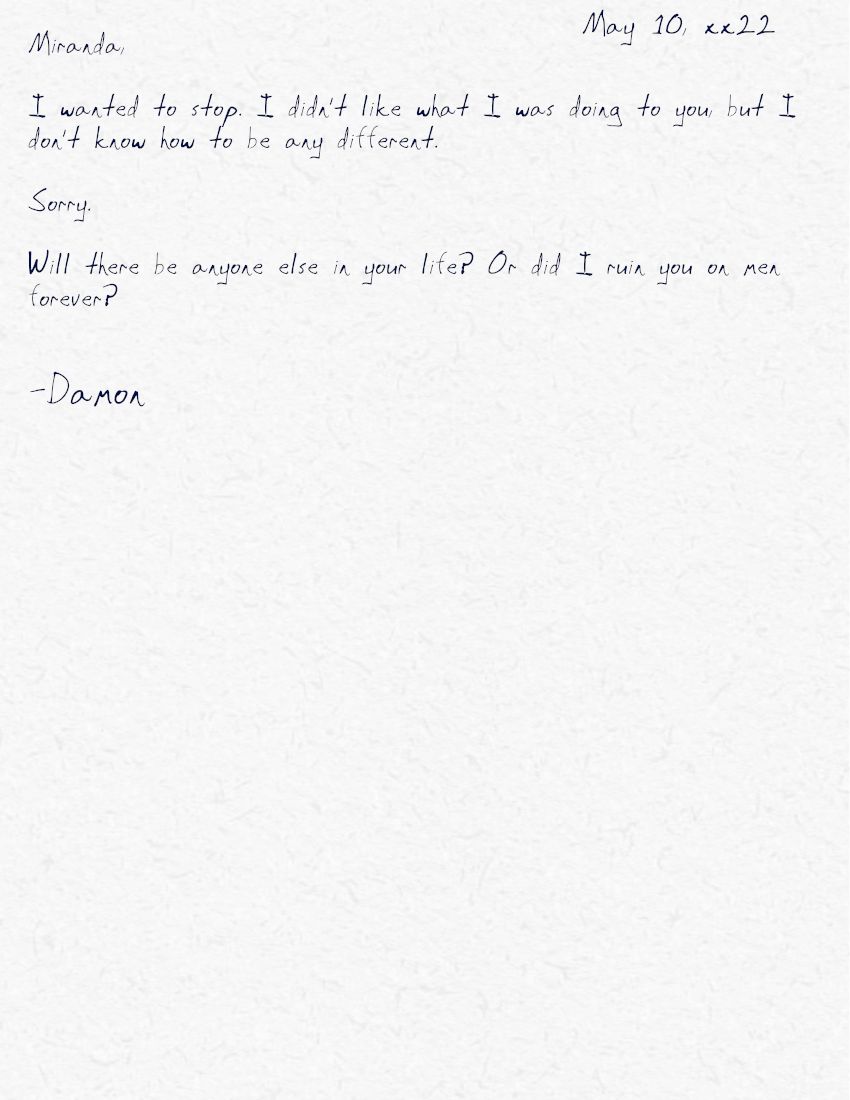
Miranda and the Convict is a series of letters written between Damon and Miranda during his time in prison, and I did something extra fun:

*Trumpeting* DUN DUN DUN DA DU-LAH!

I made custom fonts for their handwriting!

(I get way too nerdy sometimes.)

You have no idea how amazing it is to see my own characters come this alive like this.