
Title Reveal for the latest novel from Autumn Rain (OMG!!!)
An author's collection of thoughts and stories

Lately YouTube has been recommending videos about ‘The Witcher’ to me (totally didn’t watch ’em).
It’s a title that I’ve known for several years because I dabble in video games, but it’s not something that I’ve ever been personally interested in. Basically, I know enough to understand the parody reference in ‘Graveyard Keeper’, but I’ve never considered playing ‘The Witcher’ myself, let alone reading any books.
I assumed that the title had been made into a movie or something, and once again dumped it into my “don’t care” bin.
The other day my husband and I decided to watch an episode of ‘Sherlock’, so we ventured outside of Netflix Kids for the first time since . . . ‘Stranger Things 3’ came out. Lo and behold, there was a giant advertisement for ‘The Witcher’! Mystery solved, it’s a Netflix Original.
Instead of watching ‘Sherlock’, I launched into a rant: “You know what I really hate? The fact that the mass media treats the fantasy genre like its synonymous with dark, gritty violence.”
Seriously.
The Chronicles of Narnia and the Hobbit have been reduced down to endless war scenes in their latest Hollywood remakes. Heck, even Twilight and Harry Potter end with drawn out battle scenes. All of the online Originals seem intent on portraying the most graphic violence they can. Game of Thrones is . . . what it is.
I miss the old fantasy movies, where everything is covered in glitter, unlikely characters protect babies, True Love conquers all, and David Bowie serenades a wide-eyed Jennifer Connelly while she’s wearing the most beautiful ballgown ever created.
I miss the whimsy that fantasy used to represent.
My umbrage isn’t even ‘for the children.’ It’s for me. I grew up in a world full of wars, mass shootings, terrorist attacks, and endless news stories about people dying in horrific ways. There’s only so much a person should be expected to take, you know? I’ve reached the point where I really want to escape with my escapism. I don’t want the endless reminders of how dark the real world can be. I don’t want to watch graphic violence and death. Enough is enough.
I want to laugh. I want to feel inspired. I want to swoon over how visually pretty that scene was. I want something to be excited about. I want Jennifer Connelly’s ballgown.
And I’m a fantasy geek, so I want it wrapped up with fairies and magic. Is that really too much to ask?


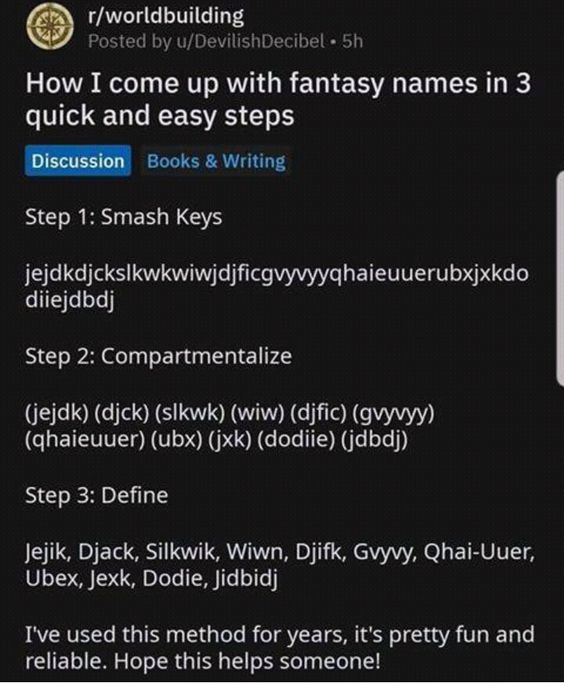
This made me laugh my butt off.
I quit using made up fantasy names when I was 15, and I don’t like reading books that use them either.
But I still laughed my butt off.

Aldric liked riding his dragon the way everyone else liked riding horses. He would often go on long expeditions through the sky, swooping and swirling to dance with the clouds, and trying hard not to expose his teeth to the grit that was always present no matter the altitude. As a matter of practicality, he took to wearing masks – black so he wouldn’t have to wash them too often – and due to his absent-minded nature, he often forgot to take them off once he was back home.
He ruled over a small, but economically powerful, country built on good sense and common courtesy. The children called him “The Candy King,” and looked forward to every Lammas when he would fly his dragon overhead and drop parachuted packages full of all the sugar and chocolate that his kitchen staff could put together, followed by a few stunts to scare and delight his people. He spent most of his waking moments focused on ensuring their happiness, and took enormous pride in being their king.
However, his benevolence did not extend beyond his borders. Aldric preferred to stay isolated from the world, and aside from a few well-established trade routes, kept his country entirely to itself in social and political matters with the reasoning that he had enough to worry about without dabbling in everyone else’s affairs. As a result, terrible rumors abounded unhindered about the “Dragon King,” who terrorized the countryside with fire and violence.
Aldric was blissfully ignorant until the first self-described hero showed up. He had been out on his daily ride, and had returned to play his organ while meditating on how to improve the healthcare for orphans, when he heard a sudden scream. He started and turned around, and to his horror found one of his guards injured by someone shouting hysterically about justice while flailing a sword.
The man was promptly jailed for his crime, but because he refused to state which country he had hailed from, Aldric didn’t know where to return him to. Thus, he was sent to a work camp, which was far more productive and reformative than letting people waste away in dungeons.
The next hero gave a speech before attempting to use his sword, claiming that Aldric was obviously evil from his black mask (he had forgotten that he was wearing it again), and threatened to slay his dragon. That made Aldric angry, so he sent this hero to the work camp as well – he wouldn’t allow anyone to menace his pet and get away with it.
This continued periodically for some time, with every single hero too absorbed in himself to listen to reason. Aldric was forced to tighten security around his borders, and his subjects became increasingly suspicious of outsiders in defense of their beloved king.
Mercifully, Theo the prince showed up on Lammas while Aldric was making his traditional candy drop. He had hoped to make a name for himself by defeating the evil dragon king, though through a series of unfortunately hilarious events, had brought his sister the princess Azalea along as well. Azalea was delighted to see the colorful parachutes drifting down from the sky, and even more enamored when she discovered they were carrying sweets. As a result, she refused to let Theo hide her away when he left to confront the dragon king about his evil ways – which were beginning to look less and less evil up close – and accompanied him to the castle.
Aldric settled in to play his organ upon his return, working on a song that had come to him while he had been flying on his dragon, and was deep in thought when Theo and Azalea arrived. Theo had wanted to burst in with his sword drawn, but Azalea insisted that they introduce themselves properly and speak to him first, arguing that anyone who cared that much about children couldn’t be all that bad. Theo had to turn his face in embarrassment while Azalea knocked and asked to see the king, stating their full names and kingdom in the process. It horrified him that his sister had so little sense.
As it was, they were shown into the audience hall and announced to Aldric. Upon turning from his organ, he was delighted to discover the most beautiful maiden that he had ever seen curtseying before him.
“Dragon king,” she said, her voice sweet and clear. “We have come to implore you to stop your evil ways…”
“I take care of my people, and I am loved by them,” Aldric replied, his eyes locked on the beautiful princess. “Is that evil?”
“Not at all, your highness, but you keep a dragon for a pet,” Azalea answered.
“She is a creature of the earth, as much as you or I, and I care for her deeply. Is it evil to love a pet?”
“No, your highness.” Azalea knelt down on the ground this time, and Theo’s face burned red with embarrassment. “But you dress all in black and wear a mask, and surely that is a reflection of the darkness in your heart.”
“Oh, confound it!” Aldric ripped off his mask and tossed it aside. “I have much on my mind, and I forget that I wear it to protect myself while on my rides. I wear black to save myself from worrying about my clothing. Is that evil?”
“No, your highness.” When Azalea looked up, her eyes were shining with deep admiration. Aldric stepped over to her and helped her to her feet, then stayed for a moment holding her hand as they gazed at each other. Theo saw it all in a heartbeat, and knew that his intended heroics were not needed.
A month later, Theo returned home to announce the news of Azalea’s engagement to Aldric, and talked freely about how wise and generous the dragon king was. The wedding was a grand celebration, and in the years that followed their children grew up happily as they played freely in the castle and enjoyed riding the dragon with their father.
The kingdom was never bothered by heroes again.
The end.
Look what I figured out how to do with the Reddit link, lol.

Writing communities always make me feel like I’m the crazy, avant-garde person that everyone dismisses because I’m just so out there.
Crazy is a given. But avant-garde? I don’t think so. I always thought I was more old-fashioned in my approach.
There’s a hyper-focus on world building, world building, world building(!!!1) with fantasy and sci-fi. This is obviously inspired by everyone fantasizing that they are writing the next Lord of the Rings.
Me? I thought Lord of the Rings was okay. Not inspiring, but not a waste of time. Certainly not something I want to emulate. Definitely not something I want to endlessly reread with different clothing.
The problem with novels based on world building is that they are dry. The plot is painfully generic, and the characters are one-dimensional props that bounce from explanation to explanation; about how dragons are blah blah blah, and the king’s daughter is blah blah blah, and magic is blah blah blah. Maybe the main character is given an interesting ability, but then their personality is so stereotypical that no one can be bothered to actually care. Insert weird names like fah’ri and el’wes in a effort to make it more unique, but not really…
I confess that I quit reading high fantasy when I was in middle school. Never could develop the stomach for it.
My style is character-driven storytelling. Instead of drawing maps, I read books on psychology. I think about readability and flow. The plot is a natural extension of the characters, driven by their goals and personalities. I build just enough world to give the story a solid foundation, but I don’t think about it excessively. I don’t come up with enough material for a compendium by any stretch of the imagination.
So, while the topic of writing is something that I have put a great deal of time and consideration into, my fundamental approach is different from everyone else in my chosen genres. I’m crazy and different, and no one seems to know how to respond to me. Ha ha.
Maybe I’m even avant-garde.

I started this novel about a month before baby #4 had me hurling my guts out in the toilet, and by the time I was up for writing again, the thread of inspiration was gone.
The characters in this novel are amongst my oldest and dearest, so one day it will be written and published, come hell or high water. For now, it will continue to grow and mature in that secret place where stories reside before they’re ready for the world.
When I re-read this chapter, I thought that the end seemed forced and unnatural, and lacked the strength of the opening. It’s probably a good thing that I’m not tackling this particular story for the time being.
News of the Father’s arrival spread like a wildfire through the town’s grapevine, and after only two days everyone had heard the name: Evan Malachi, the traveling priest. He was staying with their own pastor, would be delivering the sermon on Sunday, and was already completely booked up for lunches and dinners for the entirety of his stay.
Lyra was at the early morning market when she first heard the name. As she studied through her lists of groceries, two middle-aged women passed by chittering about how attractive the traveling priest was. By the time she was juggling three baskets full of vegetables, she had heard all about Father Malachi. No one was able to agree on his age, but they all reported that he had vibrant gold hair and a handsome face. Those who had already spoken to him said that he was engaging and articulate, with charisma to spare.
It was no surprise to Lyra when the first thing out of Mrs. Grady’s mouth was, “Have you heard about Father Malachi?”
Setting one of the baskets down on Mrs. Grady’s table, Lyra replied, “I’ve heard of nothing else.”
“I have yet to meet him, but everyone who has is absolutely smitten with him. Oh, if only there was a way to get him over to our house for dinner!”
“I’m sure that you’ll think of a way to ask him,” Lyra answered, distracted. She was staring at her list, frowning at the realization that she had forgotten to write down the price of the carrots. No matter what everyone else said, that darned Father Malachi was already making her life more difficult than she cared for. She was going to have to estimate low, and suffer the difference in her pay.
“Here’s the price for the groceries, Mrs. Grady. I’ll be back to clean after I finish making the rest of my deliveries.”
“Do a thorough job this time. We’ll never know if a certain visitor is going to be coming over.” Mrs. Grady took the receipt from Lyra and disappeared towards her husband’s study, while Lyra let herself out through the back door.
After her father’s death four months ago, Lyra had taken up employment between three different households, managing the basic upkeep and errands. None of them were rich enough to afford a full-time servant, but they could pay her for a couple hours of work every day. Lyra was barely managing to keep her father’s house, and after only four months she was already beginning to feel worn down.
Her father had been a carpenter, and the two of them had lived comfortably. Her mother died when she was very young, but her father often shared with her the locket he wore that contained her mother’s picture, and told wonderful stories about his deceased wife. Whenever Lyra snuggled against her father’s chest and listened to him talk about her mother, it was easy to imagine that she had stepped out to pick wildflowers, and would come back home soon to pop delicious, puffy bread dough into the oven to bake. When her father died, she lost her mother a second time as well.
Lyra worked hard, and despite Mrs. Grady’s implication, she was one of the best maids around. Her three houses were better kept than Mr. Neils, the only man in town with both cooks and servants. She refused to work for someone who was always holding the subject of rent and threat of eviction over her head, and Mr. Niels already had the rest of the town in the palm of his hand. Lyra didn’t want to give him more power over her than he already had.
Like everyone else, Lyra attended church every Sunday, but not because she believed in it. She wanted her employers to see her there and rest assured in the idea that she was too pious to ever steal from them, but the truth was that Lyra hated God. She would sit in her pew every week and curse Him for taking away good people like her father and mother, while money-grubbing landlords like Mr. Niels continued on in perfect health. Lyra couldn’t love a God who ran the world in such a fashion. She still cried every night over the death of her father, but she was never going to let her sorrow show in public.
As far as she was concerned, Father Malachi was a pawn for a vengeful and petty God, and the sooner he left, the sooner her life would continue on the same as before, though she didn’t particularly like where it was going – or, rather, wasn’t.
Even still, after leaving the third household to return home, having spent the entire day endlessly hearing others talk about him yet again, her curiosity was piqued. Despite herself, Lyra was beginning to look forward to Sunday.
Lyra started her work early in the morning, so she would always have the afternoons and evenings free to herself. She liked to spend them in the meadow just outside of town when she wasn’t busy with her own survival, and had beaten a little path through the woods with her journeying, though she was careful to make sure that it looked like it was only used by deer – the meadow was her secret, and she didn’t want it to become a popular spot for picnics. Her own chores were simple and easy to complete now that she was living alone, and once she was done she set to work making a little basket of food. Then Lyra was off.
It had turned into a hot summer day, but the shade of the trees was cool and pleasant. The worries that usually plagued her began to fade away as she walked through the forest, remaining behind as she moved towards her sanctuary. The birds were singing energetically in the tree tops, and Lyra closed her eyes as she took in a deep breath, taking a moment to feel the forest around her with her spirit.
A loud thump and breaking twigs made her jump and gasp, and Lyra’s eyes snapped open to see a startled looking man standing in front of her. He had vibrant gold hair that hung freely around his shoulders, and his face was smooth, young, and handsome. His eyes held Lyra’s gaze, a vivid shade of turquoise that held more wisdom than she had seen before, even amongst the eldest members of her community. He was wearing a simple black cassock with buttons down the front, but his figure looked strong and fit underneath, and around his neck he wore a gold cross on a long chain. Lyra didn’t have to guess at his identity.
Father Malachi.
“Good evening!” he exclaimed, somehow seeming more off-balance than Lyra felt. “I believe we haven’t met before; I’m–”
“I know.” Lyra tore her eyes away from his, then pushed past him to keep going to the meadow. She felt indignant, that he would invade her private sanctuary then look as if she had stumbled across his secret. He followed after her.
“Forgive me if I startled you.” His voice was like velvet, soft yet masculine, with a cadence that penetrated her heart and set it at ease. Lyra liked it, and could easily imagine herself sitting and listening to him preach every day if she didn’t have anything else to do; she now understood why no one could talk of anything else. He continued speaking, “I was doing a touch of exploring, and I hadn’t realized that any people knew about this path. I wouldn’t have bumbled so much if I had expected to find you.”
Lyra stopped and turned to face him. “Look, Father, as far as I know I’m the only person who knows about this place, and I’d like to keep it that way. I come here to be alone.” She hoped that her emphasis would help him understand the hint, though she was conflicted about whether or not she actually wanted him to leave. Somehow, she had ended up with Father Malachi all to herself, to talk about whatever she desired with no one around to interrupt. Lyra found that she had a lot on her mind that she wanted to say to the traveling priest, or perhaps more to God through him.
“I am sworn to secrecy, my daughter.” He smiled as he drew his fingers across his lips.
Lyra quickly walked across the meadow to sit down on her favorite spot of soft grass, biting the inside of her cheek to keep herself from crying. Father Malachi had made her think of her deceased father, and her soul stung with the absence of her parents. She had every intention of letting go and sobbing, but he was still following her and she didn’t want him to see her weaknesses. Lyra didn’t say anything as she straightened her skirt over her legs, then pulled an apple out of her basket and began shining it to give herself something to do.
“May I ask your name?” Father Malachi sat down next to her.
“Lyra,” she snapped.
“It’s a beautiful name, and it suits you well.” Without asking permission, he reached over and took the apple out of Lyra’s hands, then took a big bite through it’s shiny red skin and crisp fruit. “Mm, it’s very delicious. Thank you.”
Lyra was stunned. “That’s . . . mine!”
He grinned and held it out to her. “Would you like it back?”
“No!” Lyra couldn’t make heads or tails out of his behavior, and she wondered if he wasn’t entirely of sound mind, but that didn’t stop her outrage. “That was supposed to be part of my dinner!”
“What else did you bring?” He reached for her basket, but she snatched it up and held it against her chest.
“Go away!”
“Got you.” Father Malachi took another bite of the apple and winked. “Are you feeling better now?”
Something new and indescribable filled Lyra’s center, a sort of epiphany mixed with even more confusion. “What?” All of the fire was gone from her now.
“You were on the verge of tears, but you didn’t want it to show. Unfortunately, my dearest daughter, you’re not as skilled at hiding your feelings as you think you are.”
Lyra felt insulted yet relieved. “I was under the impression that everyone else in town was feeding you. There’s no reason for you to take my food as well.”
“Yes, I have been promised an assortment of exquisite meals from the finest cooks that your town has to offer, but that doesn’t change the pleasure of an apple. So, my dearest daughter, is this really the entirety of your dinner?”
Lyra felt herself blushing, partly in shame over her meager meal, and partly because he kept referring to her as his ‘dearest daughter.’ She was already becoming attached to the traveling priest, and she knew that it would break her heart to watch him move on. “Yes . . .”
“But you can cook, with talent as well.”
“How did . . .?” Lyra stared at him, numbly handing over the basket when Father Malachi gestured for it.
“Smoked gouda,” he said as he pulled out her cheese. “It combines wonderfully with fresh apple, yet is a little more costly. From the state of your dress, you are carefully managing your finances, yet you still decided to indulge in this particular treat.”
Lyra clenched her jaw and said tightly, “I stopped cooking after my father died four months ago.”
“Ah, the reason for my dearest daughter’s pain.” Father Malachi set the basket down and wrapped an arm around Lyra, pulling her against him. “It’s perfectly acceptable to hurt. You don’t have to hide from me.”
“I miss my daddy.” Lyra felt like she was reverting to childish behavior, that she wasn’t carrying herself in a manner than was appropriate for a grown woman. Tears slipped out of her eyes, and she wrapped her arms around Father Malachi’s neck as she began to cry. “I miss my daddy so much!”
How did this end up happening?
Somehow, Father Malachi had pierced her mind and stolen the thoughts that she kept hidden there.
Lyra was a small child, crying in the arms of a stranger over the loss of her father, and now that she had grasped him she didn’t want to let him go. She wanted to stay with Father Malachi, to always be his dearest daughter, to depend on him for the safety and protection that she had been living without.
What was it about Father Malachi that made her feel that way?




My husband found The Regiment (published 1987) in a used bookstore back in 2010, and a few days later handed it over to me with the instruction that I *had* to read it. The Regiment is a scifi novel that is deeply philosophical, with a subtle element of spirituality woven in, and it influenced the way I think of every day life. It’s definitely one of my favorites.
It was never unpacked after our last move, and now currently resides in a box in the basement, so it’s been awhile since I’ve read it. One of these days I’ll get around to unpacking those boxes, but that day is not today.
The thing is, my husband and I got a very good laugh about the cover, and we still occasionally reference how bad it is. The picture is only vaguely related to the novel at best, and the tagline is so badly wrong that I suspect whoever wrote it hadn’t even read a summary. Excellent book, terrible cover.

I purchased Wicked Lovely when it was a new release in 2008, back when I was young and trusting. I consider it to be a guilty pleasure, since while I adore the idea of faerie courts in the book, I think that it is put together in a way that is shallow and a touch crude.
Mind you, I’d still rate the book 3.5/5, and I even followed the author’s blog for awhile clear back then, so I mean it when I describe this as a guilty pleasure. I read the sequel, Ink Exchange, and every now and then ponder whether or not I should get more books by Melissa Marr, just to see how her writing has been coming along. Unfortunately, the premise of the novels never unfolded in a satisfying fashion, so I continue to hold back. There’s just too much of a modern twist in her writing.
Wanna guess why I bought this book back then?
The cover.
It was pretty.
The contents therein did not match expectations. If the cover had actually reflected the story, I wouldn’t have spent my hard-earned pennies on it, because I’m not a modern sort of person by any stretch of the imagination. Now that it’s 11 years later, I might cut the cover off, frame it, and hang it on the wall where I can look at it, but I’m not all that inclined toward reading the novel again. It’s probably a good thing that this book is also squirreled away in the basement.
I might, at some point in the future, write my own version of faerie courts to tell the story that I had wanted to read back then, though my cover won’t be anywhere near as pretty if I do. I’ll have to rely on the strength of words alone to generate appeal, and we all know how well that will work, le sigh.
At least I’ll have the satisfaction of a good story.
I don’t judge books by their covers anymore; beauty is only skin deep.

A trope that I see every now and then that drives me absolutely batty goes something like this:
The intro is all about letting the audience know how super awesome this character is, being the Chosen One and all, and you think that you’re in for some impressive ass-kicking all around, literally and/or figuratively.
Then, as the story progresses, it turns out that the character isn’t that awesome after all, because:
Any one of those three would put my teeth on edge, but for whatever reason I usually see all three of these together. I used to try to finish stories that pulled this trope, but experience has taught me that the ending never gets better.
So, let’s break down my bullet points:
I suspect that the writer is trying to be subversive with this one, but societal context has changed to the point that aspiring to be a mediocre nobody is par for the course — you can even decorate your home with quotes about how you will never do, say, or think anything unique or special. Personally, I have been heavily criticized every time I’ve taken on a new responsibility, often because others treat it as some sort of enslavement.
You have four kids? How on Earth are you ever supposed to do anything?
Oh, I don’t know. Occasionally the kids take off the shackles and I’m allowed a bit of sunshine; just enough to keep me going. So tell me, what do you do with your freedom? Work all day, then veg out on the internet?
Anyway, it would be far more refreshing to see a character who actually wants to be the Chosen One and takes the responsibility seriously.
I wish I could say that this is due to a lack of imagination, but I can’t shake the suspicion that it’s wish fulfillment on the part of the writer. Usually, the main character is no longer set apart, instead belonging to a tight-knit group where everyone knows everyone else’s pain, and never has to face the possibility of loneliness.
After the cadre has been formed, the enemies start popping up with even stronger powers to justify it all, and the hero is looking less and less unique and interesting. But at least the writer vicariously has imaginary friends!
This is the natural consequence of the previous bullet points. Even if someone is uncertain at first, they’ll naturally be drawn into enjoying ULTIMATE POWER when they realize what they can do with it, so in order to keep up with the mediocre aspiration, the ULTIMATE POWER can’t actually be all that seductive or useful. You also can’t make your friends feel bad by being obviously better than them, and the battles need more suspense by dangling the question of whether or not the entire group has what it takes to defeat the single bad guy. Working alone. Against all of you.
Wait, who was supposed to be the Chosen One again?
It’s a terrible trope, which unfortunately plagues the fantasy genre, so I keep coming across it. Le sigh.
Maybe we could try something new?


My kids very generously soaked my copy in water, but thankfully I didn’t have the dust jacket on at the time. You can barely tell that the cover underneath is warped.
This is a novel about two brothers, and a magical forest where the mythological figures of the collective consciousness literally come alive.
The first half of the book is a fairly exhaustive explanation of the forest and its magical inhabitants, named ‘Mythagos’, which feels fairly slow paced. It takes place primarily on a homestead on the edge of the forest, and the main character makes a point of avoiding going too far into the woods. The reader is also given quite a bit of background on the main character, his brother, and their father who had dedicated his life to studying the forest, but whose death serves as the catalyst for the events in the novel. There’s also a woman Mythago, the manifestation of the warrior princess archetype, who captures the main character’s heart and sends him hurtling helplessly into love.
The second half, which takes place in the forest itself, feels dissociative and confusing at times, heavy with mythological references and metaphors, turning this book into a very slow read for me.
However, I have forgiven all of that.
The author was seriously “tuned in” with the subject matter, and the book has a lot of metaphysical depth to it, which makes it good ‘thinking’ material. I have no doubt that this novel will leave a lasting impression, and I’m interested in reading some of the other books about this forest.
The villain is the most cold hearted bastard I’ve ever encountered in a story, and he uttered an absolutely amazing line (which won’t make any sense without context) that had me giggling with sadistic glee. His inevitable defeat came about in a way that was, frankly, unexpected.
Happy ending for most.
I feel bad for the mother, who is mentioned in passing as having committed suicide long before the events in the book take place. Poor woman.
My rating: 4/5

 By Autumn Rain