About Me

Conformity

In the past, I used to try to socialize more. My oldest is very outgoing, and when she was 4-years-old, I felt guilty about being such a retiring introvert. Unfortunately, at that age, her social circle was my social circle, so I decided to put myself out there and see about those mom groups. The neighbor who was heavily involved in them seemed to be an okay person (I found out later that she was duplicitous AF), so I thought it would be a safe bet with at least one other “friend” already there.

At 22, I had danced naked in a forest during a thunderstorm (there was no chance of anyone else being around to see me), and I had felt magnificently connected to all of the elements of the Earth. I can still vividly remember the dark clouds overhead, the pink flash of lightning, the prickle of goosebumps in the cold rain, and the elation of nature and magic. I felt that I could never be struck down.

At 28, I was shrinking into myself, feeling hopelessly like an outsider around my peers, small and insignificant in their eyes. In turn, I found them to be boring, controlling, and generally unpleasant, and I was miserable around them. I hated being there. Hated being the only mom who carried my baby in my arms instead of hauling around a car seat, and the defensive reactions I got when I simply commented that it was because I thought car seats were cumbersome. Seemingly, everything about me was not only wrong, but actively offensive.

As much as I admire the stereotype of the self-sacrificing mother, there’s a huge difference between sharing my last bite of brownie and selling my soul to fit in. I have my limits.

Shortly after I quit, it filtered back to me that they had all been calling me a “doormat” behind my back. Um, what? I’m supposed to prove that I’m not a doormat by . . . abandoning my natural personality to become what someone else thinks I should be instead? No thank you, I’d much rather be a doormat; there’s more dignity in it.

No matter how others try to cajole or criticize me, I stubbornly stick to what I am. Why? Because I remember how it felt to dance with the wind and rain as the thunder kept the beat. Because I actually look at my peers, dressed in unflattering leggings with their hair tied on the very top of their heads like Teletubbies, and I know that I could never in a million years take myself seriously if I looked like that. Because my Jupiter is in Aries, so I need to be an uncompromising individualist in everything I do. Because I know what makes me happy, and what doesn’t.

As for my oldest, I adore the way she naturally is, and I don’t want her to learn to sacrifice her personality to have fake friends. It would break my heart if I lost her like that.

As a writer, experiences like that always get filed away in the back of my mind, along with all of the emotion and aftermath, to reappear as overarching themes in my stories.

About Writing

Realistic romance

I read a couple of creative writing articles on “how to write realistic romance” that essentially boiled down to knocking “insta-romances.”

As a hopeless romantic myself, I’m a firm believer in love-at-first-sight. I knew that I had found forever the moment I met my husband (told him so, too), we eloped shortly afterward, and ten years later the passion is still going strong. So, don’t lecture me on what doesn’t count as realistic!

Love is like magic: it has to be believed in and practiced in order to have an effect.

My number one source of knowledge for the romance in my stories comes from my own experiences, and I can’t imagine getting any more realistic than real life. That includes love-at-first-sight, which just so happens to be my favorite.

Just because I’m outside of the majority doesn’t mean that my life and marriage are impossible or doomed to fail, and I don’t write stories to express the norms that I don’t belong to.

And given that the marriage rate is at a record low, I don’t believe that people know as much about romance as they think they do.

So I’m going to do what I’ve always done, and ignore what everyone else says about romance, even if I earn criticism for it.

About Writing

My current WIP

I’ve been working on the rough draft of my WIP for about ten months now. I started it when my youngest was still a newborn, so progress was very slow in the beginning. I even lamented that my main characters had been on their first date for weeks, and I was ready for it to hurry up and be over with.

For the past three months, I’ve been working on it every day. My realistic goal is a mere 400 words, though occasionally everything works out nicely and I get down about 1000. Progress is progress.

This is also the longest I’ve ever spent on a rough draft.

I’ve been enjoying it quite a bit. I like the extra time I’ve spent conversing with my characters, and the months spent day dreaming about their lives while washing dishes or folding laundry. I’ve grown very fond of these characters, and I haven’t become the slightest bit bored with the story yet. That’s a good sign.

I’m confident that the rewrite will go smoothly. Whenever I get to it. Ha ha.

About Writing

Dvorak

If you don’t know what keyboard maps are, then you’re using QWERTY. The name comes from the top row of letters above your left hand.

QWERTY was originally designed in the late 1800s, and became the popular choice for typewriters. Its popularity was carried over into the computer era, and it’s now the default for literally everything.

The thing is, QWERTY was designed for typewriters. Typing too fast on a mechanical typewriter can jam the machine, so one of the design features of QWERTY is that it intentionally slows down how fast most people can get their fingers flying. Computers, on the other hand (snerk), don’t care.

Writing involves a lot of typing as an unavoidable part of the process, so in addition to typing speed, problems like carpal tunnel deserve some concern for writers. QWERTY is not the best option for heavy typing.

There are several options out there that were designed specifically for computers with the goal of increasing speed while decreasing fatigue. Personally, I use Dvorak.

It takes some getting used to, but once you learn a new keyboard map like Dvorak, it’s much easier to type faster with fewer typos. The first thing that I noticed is that my hands don’t have to move all around the keyboard just to have a mundane conversation. Occasionally, if a typo does slip through, it confuses others how I managed to hit ‘p’ instead of the ‘y’. I can also recognize other Dvorak users through their typos.

Yes, I know this is boring, dry, computer nerd territory, but I happen to think this is an important topic for writers. Go ahead and give it a shot. At the very least, no one else will be able to use your laptop.

About Me

The practicality of popularity

While mega popularity is a fun daydream, in practicality, I don’t think that I’d enjoy it at all.  Having people read my books just because everyone else is reading them feels rather antithetical to who I am as a person. It’d be a great way to be completely erased.

Then, of course, there are always the ones who feel obligated to create entire websites devoted to tearing apart your novels and proving that you are a bad writer after all. The harshest part is, those websites are usually right, too.

I’ve dedicated a lot of time to practice and research with my writing, and I try very hard to produce quality; but ultimately, I chose to be a wife and mother first. I still have plenty of sensitive feelings, and stumbling across the wrong criticism at the wrong time could hurt deeply. I’m just doing my thing to express my soul, and I just want to live my life with my husband and kids.

Obscurity is safe and comfortable.

About Me

Sameness in ideas

Like most writers, I have several ideas on the back burner in my mind, but if I reduce them all to a one-sentence summary, I start to wonder if I really have just one idea in different clothes.

On one hand, readers like to know what to expect from an author. Sometimes, we really want the same core concept dressed up in different colors. There are plenty of professionals who churn out a gazillion books that are all fundamentally the same, and they make a good living doing it.

But am *I* like that?

I care about free creative expression, first and foremost for myself. Is the evolution of my mind destined toward sameness forever and ever? Do I even make any sense?

Will I eventually grow bored of Mr. Perfect marrying Ms. Beautiful? Or am I too enamored with the simplicity of love and family to ever grow tired of it?

I’ve had a fairly tumultuous life, so enjoying stability feels a bit weird to me. Perhaps I was meant to land in this wonderful place, or perhaps I still have more stormy weather to endure while I continue to evolve further.

About Writing

Catharsis

Once, during a particularly stressful point in my life, I decided to get drunk. I chose an evening when I was alone and not likely to be disturbed, and settled in with my favorite bottles. After four shots of sugary liqueurs, my stomach called it quits.

I spent the rest of the evening hunched over the toilet.

I wasn’t miserable at all. It actually felt cathartic, to purge out all of the sorrows that I had endured in such a dramatic fashion. It was the only time I’ve ever experienced peace while vomiting.

Now, on those good days, when I can crank out over a thousand words in a comparatively short time, feel the same way: a cathartic purge. Those days help give me serenity and sanity with everything that follows.

Those days keep me writing.

About Writing

On Real People

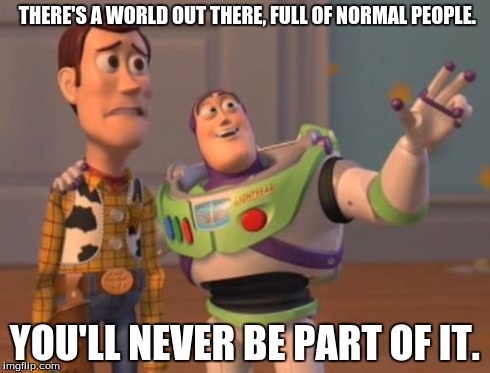
I don’t base any of my characters off of real people, because, frankly, everyone I know is either so normal that it isn’t worth it, or so out there that I wouldn’t know how.

The thing about normal is that once you’ve met one, you’ve met them all. I already know what normal people think about every subject, because they all think and do the same things (quite deliberately, too). Hence, the whole normal part. If I write a normal character, he’s going to be based on the conglomerate of normal behaviors, rather than any specific individual.

Then there are the weirdos, who have wild anecdotes and even wilder beliefs. These are the people who are fun to talk to, because I don’t know what they’ll say or do next. That unpredictable element also makes them impossible to write, because I don’t know what they’ll say or do next. Can’t write what I don’t know.

All of my fictional characters are just that: fictional. I draw heavily from my personal study of psychology, but I never have any specific people in mind.

.

.

.

hqfsa

About Me

Inner Voice

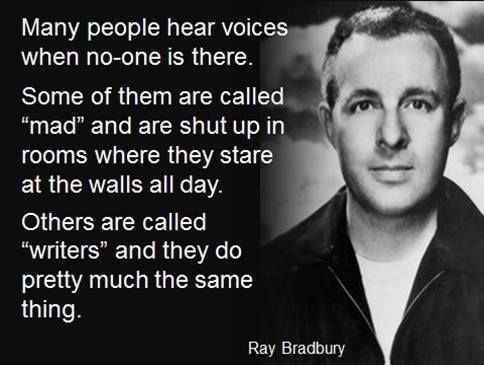
I have an extraordinarily loud inner voice, and I took it for granted that everyone had some sort of private dialogue with themselves, until I found out differently a few months ago. Read the title of this article, which says all you need to know. I still struggle with the idea, but it also explains why so many people have assumed that if I don’t say my thoughts out loud, my thoughts don’t exist.

I started off extremely shy, and once I was labeled as quiet, no one wanted to hear anything I had to say. However, that didn’t mean that I possessed an empty mind, so I’ve spent most of my life telling myself all of those thoughts that no one else ever bothered to listen to. In many ways, I was my only confidant during my formative years, and I suppose that my chatty brain is the natural consequence of that.

I often have a monologue going on in my brain. It doesn’t matter if I’m sewing or washing dishes, I’m always chattering away with myself in my head. I can even talk to my own fictional characters as if they were real.  It’s one of those things that I don’t tell most people about, since they aren’t very likely to understand — I’m sure that a psychiatrist would have a field day with me.

Ultimately, that’s why I write: the Voice has to go somewhere. That’s also why I feel compelled to self-publish, instead of keeping my stories hidden away on a flash drive somewhere. At the end of the day, I’m still human, and I still want to feel like someone hears me.


aaea2391c80f95e1506cecb103602cf6

About Me

Love Triangles

Hate ’em.

My first exposure to the idea of two guys chasing after one woman was the TV series Christy. My mom watched it, and some years later when the movie, Choices of the Heart, was released, I was excited to watch it with her. I was partial to the reverend David, and found it disappointing when (SPOILER) Christy married Dr. MacNeill instead. C’mon! I didn’t like him at all!

Later, I realized that most love triangles have a clear winner early on, and the second guy is mostly just emotional gratuity.

In real life, the closest I ever came to unwillingly becoming the subject of attention from multiple guys ended so horrifically that it was a full five years before I associated with any non-family males again, and earned me the branding of “cold hearted bitch.” It was scarring.

As a married thirty-something, love triangles don’t do it for me. All I needed was The One, and I enjoy stories about people finding their One too, so I can reminisce and appreciate how lucky I am with my husband. It’s easy to spoil happily-ever-afters by wondering what would have happened if you had married a different guy.

I don’t pick teams or giggle when my guy scores points over the other one. I don’t eagerly tune in day after day to see which man the main character will choose. Despite the popularity of love triangles, I just don’t like them. I see them as a good way to alienate others and get hurt. Not fun. Not romantic. No thank you.