About Writing

On writing communities

I joined an online community for writers.

I confess that on an emotional level, it takes me back to being a teenager on Elfwood, trying my best to chummy up to some clique, and wondering why they just didn’t like me no matter what. After all, I was WAY more talented than any of them.

Now I realize that it wasn’t about admiring talent. They copied each other, and I was stubbornly myself. Cliques don’t like individuals.

I like to imagine that those people who rejected me years ago are now trapped in lonely and pathetic lives. That’s what you get when you sell your soul! Bwahahahaha!

I can say this here, because we aren’t among them right now: I don’t like writers. I have never once gotten along with one. However, I like readers. I LOVE readers, really, because they love fictional worlds and stories as much as I do. I feel a kindred spirit with readers. Writers have fragile egos and are always on the defense — they feel threatened by talent and hard work. They don’t like me either.

I fully expect them to utilize the reviews and rating system to attempt to bully me into conformity. I will likely never be featured as a top writer. I will probably abandon my account with enough time. I suck at fitting in.

So why did I join a community for writers?

Because my oracle cards told me that I need to step outside of my comfort zone, and I can’t think of a more uncomfortable place for me.

That’s why I joined.

About Writing

On (not) reading as a writer

I became serious about writing when I could no longer find any books that I like.

I know that they always tell you that you have to read a lot to be a good writer, but the truth is, I don’t; not in the traditional sense, anyway. At 14-years-old I found myself slogging my way through the Wheel of Time series, and after four thousand pages I couldn’t take it anymore. I just didn’t like the story.

Something inside of me changed in that moment. I could no longer visit the library with an appetite for anything literary — I wanted something that I could never find: a story that spoke to my soul and resonated with my heart, a story that I could feel. Fiction  became dry and uninteresting. Unsatisfying.

I realized that those stories I kept hidden in notebooks could be more than a secret indulgence. They could fill the empty spot I felt so keenly in the literary world.

I still occasionally read novels — often as the mental equivalent of getting the oil changed — though I maintain rather picky standards about what I’ll put into my brain. More often than not, I fill my free moments with hobbies that have nothing to do with books at all.

I find that a good hour of sewing leaves me charged with more energy for writing than reading ever did.

About Writing

Bad Advice

c16252102720f898378c1d38543960a4


Now that I’ve inflicted this incredibly long image on you . . .

NEVER EVER FOLLOW WRITING ADVICE FROM THE INTERNET

Yes, I really did just post that image then tell you not to follow it. However, despite all of my rampant egotism, I am aware that my own philosophy is recursive, so go ahead and ignore me.

Anyway . . .

It’s your story, and chances are that if you’re writing romance, it’s your fantasy as well. Don’t turn it into a formula.

Personally, I can’t stand slow burn “we’re just friends” relationships — I have quit quite a few novels and TV series over it. In real life, my husband and I eloped quickly after meeting, skipped the typical dating thing all together, and have a better marriage than anyone I know. That’s what I know and what I like — slow burn always comes across as contrived and indecisive.

I also hate “on again, off again,” relationships, and quit reading/watching over them as well because it’s unnecessary drama. I like it when characters stay together against every odd.

Essentially, if I followed this list I would wind up with a story that I loathed.

It’s far better to write what you love, especially when it comes to love.

About Writing

Metaphor

cf5d8e1a382e67f111fd067dc234e7fa

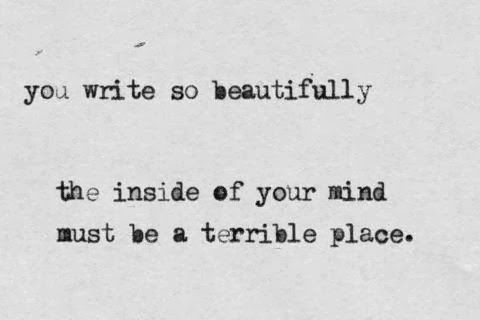
Everything I experience is converted into a metaphor for my writing.

My worst fears are that someone will take the metaphors too literally.

Or worse, see through them to the truth.

About Writing

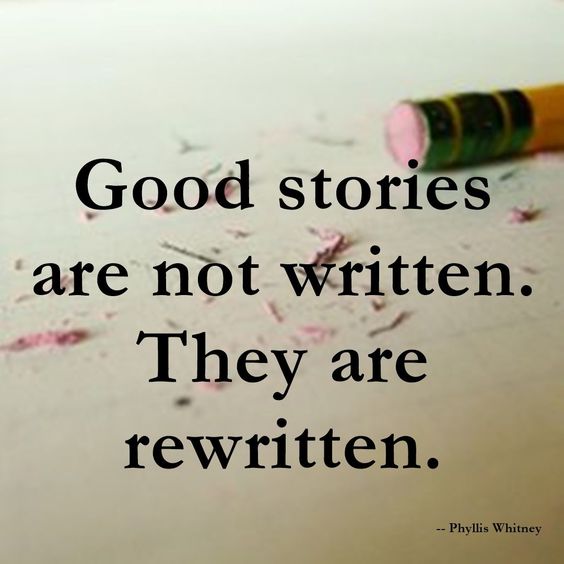
Good Stories

f24e20a9750162baae9aeeff02ed84b1

This advice changed the way I write.

The Hollywood depiction of writers is of them agonizing over a typewriter, coming up with the perfect way to phrase the last sentence before sending it off to be published immediately. They never have to rethink or rewrite anything.

I used to hold high standards for my first draft, so I did a lot of pre-writing and character sheets to ensure that everything would be solid by the time I started the story. The funny thing was, despite all the work I put into it before beginning, I never managed to finish any novels. I’d hit blocks and struggle with finding the motivation to write, then move on to the next idea that popped up. Then one day while I was talking to a start-up publisher, he commented, “There’s no such thing as good writing — only good editing.”

And the way I approached writing changed forever.

My first drafts are now a free flow of creativity. When I start that first sentence, I don’t know where the story is going to go — I write that down as it comes to me. I change my mind halfway through and jot down a note to edit the previous chapters for consistency. Then I change my mind again and scribble out that note. Sometimes, I don’t know what to do next and I write down random thoughts until the sentences start coming to me.

The second draft is spent cleaning up, rewriting, and fixing consistency. This is the part where I start to make it good.

Ever since I made that change to how I write, I have finished every novel I’ve started.

About Writing

Confidence

57043fca9559b37333ff86fbfdee43d4

I tell myself this all the time.

(Not to single out Twilight specifically, since other series like 50 Shades of Grey were also popular).

About Writing

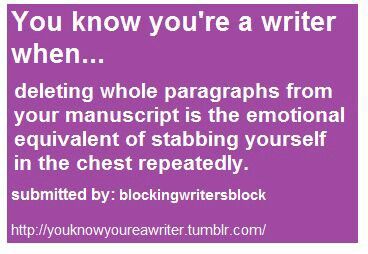
Emotional Equivalent

da6663f499c466aeb303d07b24be6677

I used to feel that way.

At this point, I suppose that I’ve been writing for long enough that I tend to feel a bit of relief when I chop up and rewrite entire chapters during the editing process. I don’t have the same emotional attachment to words that I used to have when I was younger. I don’t think about the time and energy that was initially invested in writing them anymore — it’s all part of the process.

Instead, I care more about telling the story the way it wants to be told.

But I sure remember the angst I used to feel.

About Writing

Concise

It often seems like every other writer needs to cut out paragraphs and scale back on superfluous prose during their editing process, and I have seen quite a few blog posts on the internet that make me wonder how someone can take so long to say so little. When I was in college, one of my classes required a 400-word essay, and all the other students complained about how hard it was to write something so short. Most people naturally write long.

Me? I’m the exact opposite. I adore being concise.

In fact, my first draft tends to be a little too bare-bones, and the second draft is all about putting in details to improve the pace — I don’t want to leave my readers feeling like they got swept up in a whirlwind of events flying by too quickly to process. My second draft tends to be twice as long as the first, yet still comparatively terse. After all, if *I* get bored of slogging through countless words, then I can’t imagine my readers enjoying it either.

P1000484
Macro tax