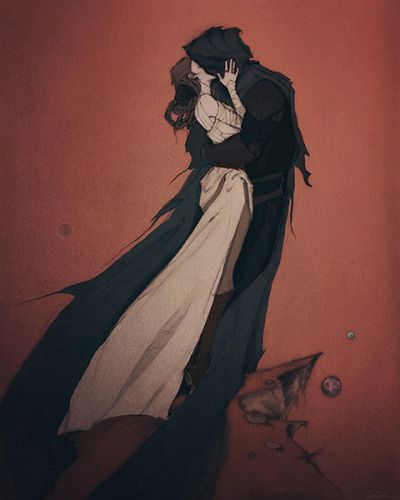
Ah, if only I had a reason to wear something like that . . .
An author's collection of thoughts and stories
I came across this song on YouTube and thought it was cute, so I checked out this band. Their latest album is really angry death metal, with songs titled wonderful things like, “Fuck Love” and “Everything’s Wrong”.
I couldn’t help but think with some amusement, “I guess they got a divorce after all.”
Note: I don’t actually know anything, so don’t quote me. I’m just being silly.
My malfunction:
There was a time when my life sucked. I’d complain about particulars, but I’m also intensely secretive, so you’ll just have to make do with that statement: it really sucked.
I didn’t have any money, but I had a laptop and spent most of my time hanging out at places that provided wifi, reading silly webcomics, browsing Imgur, and watching Hulu (back when they were still primarily free). It was my only distraction from how much everything sucked.
I looked forward to updates, and laughed at everything funny. It got me through the darkness, not unscathed, but still alive. Sometimes just surviving is a major feat in and of itself.
Writing is my talent and my passion. It’s what I have to offer to the world at large, outside of my ‘happily ever after’ that my husband and I have crafted together. It’s how I give meaning to lingering pain that would otherwise feel meaningless. I write because I am a writer.
I cannot, however, ask for much money from it. My soul won’t permit it.
I won’t be JK Rowling or Stephenie Meyer. No millions, no movie deals, no fame.
What I fantasize is giving someone else the distraction they need during a crappy time in their life, to help get them through it alive.
It’s not my place to ever know if I actually accomplish that goal or not, as long as I keep putting stories “out there” to land wherever they will. No ego stroking for me.
It’s the reason why I only write happy endings.
And that is my malfunction; the reason why I don’t advertise or solicit reviews. I firmly believe that I will be found by the ones who need to find me, and when they do I need to be within their grasp.
That’s how I will repay my debt to the Universe.
Writing communities always make me feel like I’m the crazy, avant-garde person that everyone dismisses because I’m just so out there.
Crazy is a given. But avant-garde? I don’t think so. I always thought I was more old-fashioned in my approach.
There’s a hyper-focus on world building, world building, world building(!!!1) with fantasy and sci-fi. This is obviously inspired by everyone fantasizing that they are writing the next Lord of the Rings.
Me? I thought Lord of the Rings was okay. Not inspiring, but not a waste of time. Certainly not something I want to emulate. Definitely not something I want to endlessly reread with different clothing.
The problem with novels based on world building is that they are dry. The plot is painfully generic, and the characters are one-dimensional props that bounce from explanation to explanation; about how dragons are blah blah blah, and the king’s daughter is blah blah blah, and magic is blah blah blah. Maybe the main character is given an interesting ability, but then their personality is so stereotypical that no one can be bothered to actually care. Insert weird names like fah’ri and el’wes in a effort to make it more unique, but not really…
I confess that I quit reading high fantasy when I was in middle school. Never could develop the stomach for it.
My style is character-driven storytelling. Instead of drawing maps, I read books on psychology. I think about readability and flow. The plot is a natural extension of the characters, driven by their goals and personalities. I build just enough world to give the story a solid foundation, but I don’t think about it excessively. I don’t come up with enough material for a compendium by any stretch of the imagination.
So, while the topic of writing is something that I have put a great deal of time and consideration into, my fundamental approach is different from everyone else in my chosen genres. I’m crazy and different, and no one seems to know how to respond to me. Ha ha.
Maybe I’m even avant-garde.

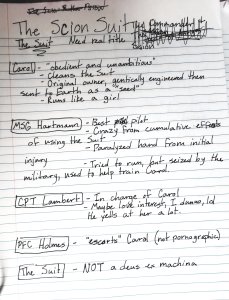
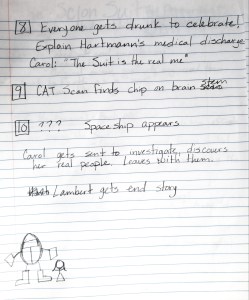
Carol jolted awake at the sound of urgent pounding on her door. Dizzily, she stumbled to the door and opened it to find Lambert, who grabbed her arm and pulled her roughly into the corridor. She had to trot to keep up with him as they sped through the base, avoiding the faces of the soldiers that peered at them, self-conscious of still wearing her pajamas. Lambert looked intently through every window they passed, but was otherwise too distracted to notice anything else.
When they reached the doors to the outside, Lambert barged through then took Carol by the shoulders and pushed her forward out from under the eaves. She saw it immediately.
A giant spaceship.
Hovering right above them.
When she realized her connection with its appearance her heart sunk, then suddenly leaped in ecstasy. After having spent so much time lovingly polishing it, she recognized that the ship was made from the same metal and paint as the Suit. The beacon had reached home after all.
Lambert was livid. “Did you have anything to do with this?” he snarled.
“No!” Carol blurted, then immediately felt like a small child for telling the lie. “I mean… it might have been me… on accident.”
“Do you…!” Lambert couldn’t finish. He was glaring at her, hard.
Carol couldn’t resist the urge to stare at the spaceship. She liked the way the light glinted off of it, and the angles in the design were beautiful in a way that nothing on Earth had ever appealed to her. It held as much sway for her as the Suit, and she itched to fly up and see what the interior was like. Unconsciously, she stepped forward and reached up to feel closer.
“Solitary confinement, commander!” Lambert barked, yanking her back.
“What?! No!” Carol pulled against him, but was physically no match. If she was in the Suit where she belonged, she could do what she wanted whether he allowed it or not. But as a human, she was powerless. She fought Lambert as he dragged her back through the base, resorting to tactics used by toddlers and letting her whole body go limp as a dead weight. He picked her up and threw her over his shoulder, where all she could do was pound on his muscular back that didn’t even give her the dignity of bending under her weight.
She wanted the spaceship, more than she had ever wanted anything. Everything inside of her was screaming that she needed to get on board, and all she could do was put up a futile fight.
Lambert tossed her onto her bed and threatened to tie her down if she didn’t behave, then exited her room and locked the door behind him. “Make sure she doesn’t get out,” he ordered Holmes, who was dumbfounded by what he had witnessed.
“What is going on… captain?” Holmes could barely remember protocol.
“That goddamn spaceship is making her crazy! No more questions, soldier!” Lambert stomped off, taking a moment to kick the wall and leave a dent with his steel-toed boot along the way.
While there was no doubt that the spaceship was of the same origin as the Suit, Lambert didn’t know if it had been inadvertently summoned by Carol accessing full command, or if she lied and had deliberately called out to it. He missed the old Carol who had skipped around as a permanent civilian; she had died during her first mission, and returned a different person. Another unrecognized casualty.
The military had hailed the spaceship but received no response. Because there was no sign of any activity onboard, they were waiting to decide what to do next, the tension palpable. The entire world had already turned its eyes on them, watching. Judging.
For captain Lambert, the event was personal.
The General arrived within the hour, and Lambert was part of the ensuing conference. He was not remotely surprised when the General announced, “Let’s send in the Suit.”
“General,” he began, his speech already rehearsed, “I would advise against it. The spaceship is undoubtedly here because of the Suit, and there will be unexpected consequences if we send it up to them. Furthermore, it is demonstrably provable that the Suit influences the mental state of those who pilot it, so we cannot trust that our pilot will remain loyal to us once up there. We should wait to see what the aliens do first.”
The General raised his eyebrows. “Wasn’t your last mission a resounding success?”
“Yes, sir. But…”
“We need to show the world that we are fearless.” The General pounded his fist for emphasis. “If the extraterrestrials wanted us dead, they could have done it in an instant. We aren’t going up there to fight, but to make first contact. It is possible that they are unable to receive our transmission, and have no idea of our desire to communicate.”
“I have a bad feeling about doing that, sir,” Lambert muttered.
The General paused thoughtfully. “Are there any other ideas?” When no one answered, he continued. “We need to take action, and that’s the best we’ve got. We’re sending up the Suit. I trust that your training with that woman has gone well?”
Lambert thought for a moment, then stood and saluted. “I must stand against this decision.”
“Are you defying orders, captain?” the General asked quietly.
“Yes, General. I will not send the Suit under any circumstance.” The words were hard to say, but Lambert strongly felt that he would much rather face the consequences of speaking them than the guilt that would follow if he didn’t. His inner voice insisted he talk about Carol, to tell them about the changes in her personality and the obvious allure that the spaceship held for her, but in that regard he held his tongue to protect her.
Their eyes met, and the General spoke, “In that case, you are relieved. Thank you for your service.”
His face stoic, Lambert finished his salute and marched out of the conference room. It wasn’t until he was in his office that he let his mask drop, kicking his desk repeatedly as he cursed, “Goddamn you, Carol!” She would never appreciate what he had tried to do for her.
Oddly, the one thing that he regretted the most was knowing that he would never see her again, or give her a proper goodbye.

When Carol reported to the bunker the next morning, Lambert wasn’t there – to make it worse, the two armed guards turned her away. She spent the day bumming around base, jittery at the thought of the Suit sitting all alone without her.
The day after was a replay of the same scene, and annoyed that she couldn’t properly sulk in front of an audience, Carol snapped at Holmes to get off her back and leave her alone. He repeated that he was assigned to escort her, which made her even more irritable. She spent the day hiding in her room.
By the end of the third day, her nerves boiled over; she couldn’t take it anymore. She stormed to Lambert’s office, half expecting to discover that he was vacationing in the Bahamas without giving her any notification, so it surprised her when she flung open the door and saw him sitting behind his desk.
“What’s going on?” she demanded, venting her pent-up frustration. “You said that I was fine, but we haven’t done any training in the Suit since I went on that mission. What the hell?”
“Sit down, commander,” he growled indistinctly, not bothering to look at her as he poured himself a glass out of a blue-tinted bottle. Carol gaped as she pulled out a chair.
“Are you drinking, captain?” she asked.
“Correction: I am getting drunk,” he replied.
“I don’t see how that could possibly be constructive. I’ve been reporting to the bunker every morning for days, and you’ve been letting me down. I thought that our training would go much more smoothly from now on, and that I would finally make you proud, and yet you just suddenly drop out like it doesn’t matter. So, seriously, what the hell?”
“That,” Lambert pointed at her. “It’s because of that. Irritability and aggression. We already lost MSG Hartmann because no one paid attention, and now you’re exhibiting personality changes as well. If I had the authority, I would decommission the Suit altogether.”
“My personality is not changing; you’ve just never seen me angry before,” Carol spat, then shied at sound of her own voice. She was jonesing for certain, but being inside the Suit made her feel like she was more herself. If she was changing, it was to her true nature.
“Commander…” Lambert took a moment to nurse his glass. When he spoke again, his voice sounded even less articulate than it had before, “Do you know how long we’ve had the Suit? The military found it when you were… still in diapers, I’d bet. Do you know why we didn’t start piloting it until the last few years?”
“No, sir,” she replied, crossing her arms and leaning back. She didn’t want to waste time on chitchat, but Lambert was too inebriated to notice or care.
“We had to study it. We had to reverse engineer ammo for it. Bullets don’t form out of thin air, you know.” He chuckled to himself. “The first man to climb inside was terrified that he was going to die, but his bravery was inspiring. You have any idea how often I think about him and wish I was more like that?”
“No, sir,” Carol grumbled.
“MSG Hartmann paid a price for using the Suit. I think that it’s too fundamentally alien to work with human brains, and we should lock it away for good. But you see, the General-” Lambert pointed up at the ceiling “-doesn’t want to do that. The fact is, commander, we’re losing. It’s a closely guarded secret, but our situation is a clusterfuck right now, and everyone is hoping that the Suit will carry us singlehandedly to victory.”
“Is that why you’re getting drunk?” Carol tried to keep her voice sharp, but she wasn’t feeling it anymore. Lambert seemed too pensive and pathetic to berate.
“Yes, ma’am, it is. It worries me that your psychological profile has changed so drastically. The Carol I started with couldn’t have killed a mouse without mourning it, but now look at you: I’ve seen grown men cry after their first kill, but your reaction was to have dinner. You were a completely different person.”
“Captain, I just…” Carol struggled to figure out what she wanted to say. “I need to pilot the Suit. I don’t think you understand what it’s like for me.”
“Maybe I understand too much.”
Lambert poured himself another glass, and Carol watched him drink in silence for a moment. A thought came to her out of nowhere, and compelled by curiosity, she asked, “Did anyone figure out those numbers I read to you on the first day?”
“They’re dates, commander,” Lambert snorted.
“Obviously. I just wondered if we learned anything about them.” Carol couldn’t explain why she felt an urgent need to know, other than it was somehow personally significant to her in some way.
“They’re interstellar dates. Now, get outta here, you’re interrupting my meditation time.” Whatever mood had possessed him before, was gone now. “Enjoy your vacation, ’cause eventually I’ll be forced to reunite you with your real body, whether I like it or not.”
Carol stood slowly, studying Lambert closely. “You remember that?” she asked quietly.
“I sure as hell do. Now, git!” He grabbed a book and threw it at her, missing by a wide margin but his point was made. Carol scampered out the door.
She wished she had kept her mouth shut.
I’ve always believed that a talented enough writer could turn the topic of drying paint into a fascinating read, but there’s something that I didn’t quite realize until my late 20s:
You have to be the sort of person that sees the beauty in drying paint in the first place.
This is on the “no duh” side of epiphanies, but frankly, it’s not how I was taught to live.
I was raised on the “go to college, get married, spend the rest of your life balancing work and family” formula. Occasionally someone would advise to stop and smell the roses, but you weren’t supposed to notice the veins of color in the petals, or compose metaphors to describe the scent. You definitely weren’t supposed to study the thorns in great detail either.
Did I lose you? Do you understand?
I rebelled when I was 20. I don’t mean that I went to wild parties or did anything stupid; I’ve always been far too introverted for rambunctious crowds, and too conscientious for short-sighted acts. I went to the park late at night to play on the swing set and feel the cool summer air play through my hair. I danced in rainstorms. I fell madly in love with the simple things, like listening to crickets or watching a candle flame dance. I engaged.
And no one understood. How could they? I was surrounded by people who spent their entire lives dissociated from their experiences, and they just didn’t know what to do with me. I was labeled ‘weird’ and left at that.
Being a talented writer isn’t just knowing the mechanical skills, it’s an entire way of living. It’s being unafraid to see the world like no one else does. It’s embracing both the pleasure and the pain. When you, as a person, live a life of passion, it will automatically permeate your writing.
That’s one of the reasons why I feel so driven to write: I want to share how I experience life in a way that others will understand. I want to offer more than what can be seen on the surface.
Metaphorically speaking, I want to express the beauty I see in drying paint.
At some point during the writing process, you have to start thinking about your readers.
I don’t mean you should sellout and introduce a teenage vampire who spends all day angsting about how much he hates himself, and all night getting spanked in the local underground BDSM scene, before being chosen to participate in a deadly game of wits and survival. Yuck. No.
When you chat with someone face-to-face, it’s considered polite to speak clearly and audibly, and to continually read the other person’s cues to make sure they aren’t growing bored by your rambling. When you’re done, you say goodbye instead of just walking away.
Writing should be approached with the same considerations. While it’s much harder to work without a present audience yawning and glancing at their cell phones, it’s good to empathize with imaginary readers and place yourself in their shoes, so to speak.
Continually ask yourself questions like:
“Is this sentence clear or do I need to reword it?”
“Is this part boring?”
“Are my transitions smooth or jarring?”
“Does this paragraph flow when I read it out loud, or is it choppy?”
“Is the end too abrupt?”
Etc, etc, etc.
Your readers are your best friends; they’re the ones who appreciate a part of you that even your parents don’t know about (at least for many of us writers, lol). Don’t take them for granted. Be a gracious host and make sure that they’re having a good time.
If you know someone you trust who fits your target audience, go ahead and use them as a beta reader. Watch them read. Pay attention to their facial expressions and body language. While they may say that something is good, a wrinkled brow and down turned mouth will tell you that there was something unsatisfying, but they might not be able to articulate it. Don’t take it personally, just think about how to make it better. I promise you that it’s a good feeling to come back with the improved version and watch someone gush over something they were previously “meh” about.
While it’s good practice to write the first draft for yourself, be in the habit of rewriting the last one for your readers. They have the power to set you down and dismiss you forever, so don’t lord your ego over them. Be nice and considerate, and show some appreciation.