
Personal Project
An author's collection of thoughts and stories


A stereotypical formulaic story:
An ambitious and spunky woman hits a low point in her career, so she leaves the big city to visit her small hometown, where she rekindles an old flame and learns a lesson about what’s really important in life. *cue heartfelt music*
Which basically means that once you’ve read one such story, you’ve read them all. *yawn* Yet a lot of writers keep sticking rigidly to the “basic plot” for whatever their chosen genre is, which ultimately makes them uninteresting to read.
I’ve decided to go ahead and break it down farther, to give you the analysis of the framework, so you know how to write a story without relying on imitating a plot that’s already been done.
I give you, the bare bones:
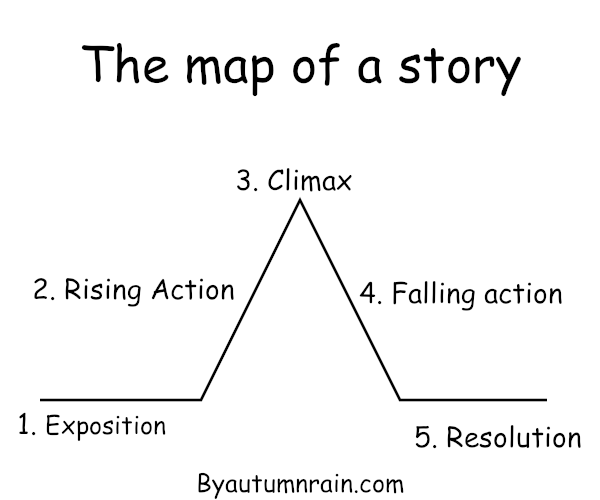
1.Exposition – Tell us who the story is about, the setting, and anything else that’s relevant to understand the rising action.
From our example above, this would be the description of ambitious and spunky woman, her chosen career, why she’s in a slump, why she chooses to return to her hometown.
To mix it up: An introverted yet successful cake decorator is given the challenge of a lifetime — making a cake to welcome the alien invasion. Describe how she’s successful, and why she was chosen.
2. Rising Action – This is usually the bulk of the story. The conflict has been introduced, and now it’s up to the characters to play it out.
From the example: The spunky woman meets her old flame, swoons over how gorgeous he is, then gets upset that he’s a jerk. Meanwhile, she has several deep conversations with her mom and/or best friend.
To mix it up: The cake decorator is teamed up with some important guy from the government, and together they work out the alien symbology to avoid accidentally offending the invaders. Meanwhile, they discover the aliens are allergic to buttercream, and need to come up with a substitute.
3. Climax – This is the culmination of events, and often the turning point in the story. It’s usually exciting.
From the example: Spunky woman and her old flame are stuck together somehow. They reveal their feelings and begin their relationship.
To mix it up: The cake decorator and government man realize that they were set up as scapegoats, and decide to hijack an alien cruiser to flee to the stars. Earth is doomed.
4. Falling action – This is where the characters work through the consequences of the climax.
From the example: The spunky woman is offered a new job, and she must choose between returning to the big city, or staying in her hometown with her old flame.
To mix it up: The cake decorator and government man discover an established colony of humans on Mars. Turns out, the aliens have been kidnapping people to populate it for years. They settle down together to live inside a dome city.
5. Resolution – The conflict is resolved, and the loose ends are tied up. Basically, it’s the author’s job to bid us a proper farewell so we feel satisfied that the story is over.
From the example: The spunky woman learns an important lesson about life and love, and decides to spend a little less time working, and a little more time living.
To mix it up: The cake decorator opens a new business on Mars, because frosting is her passion in life. Thanks to her knowledge that the aliens are allergic to buttercream, the colony can live in peace as long as they eat cake regularly. She is much happier than she ever was on Earth. She and government man have an unbreakable bond because of their shared experiences.
It’s essential that every story have all five parts. The climax doesn’t necessarily have to be big and dramatic, but there does need to be some pivotal event. Also, if you just end abruptly without a resolution, the story is going to feel unfinished.
If you use the story map as a guide for the events in your fiction, you can come up with new and exciting plots that don’t repeat the same old tropes over and over and over. Branch out, do something new, and still leave your readers feeling satisfied in the end.



An analytical discussion of my novel, Alice and the Warden. Aka, ego tripping. I will be discussing spoilers, so feel free to skip this post if you aren’t currently caught up.
So … I could never be a Hallmark movie writer. Truth is, while working on the Damon chapters, I could hear my mom’s voice lamenting, “Why can’t you write nice stories?”
*insert childhood issues here*
But anyway, we don’t need to get into the reasons why I’m drawn towards the darker side of reality. I just am, and that’s that.
Miranda is a foil** to Alice, and most of her decisions are opposite of Alice’s. Where the novel begins with Alice recovering from her life with Damon, Miranda in turn gets sucked into his world through the course of the story.
I don’t hate either Miranda or Damon — I’m actually fond enough that I’m writing “fanfiction” of them, that takes place after AatW ends. So hey, if you want more D/M, it’s coming.
When I began writing the Damon chapters, my goal was to illustrate how he draws people in, then manipulates and destroys them. I wanted to give a clear example of the sentence from chapter 3, “After four years, Alice had disappeared completely underneath Damon, to the point that when he asked her to confess to murder, she did it without hesitation.”
My secret worry is that others would read that sentence and immediately assume that Alice was a weak-willed doormat who passively allowed herself to be abused. In fact, Alice’s broken family left a giant vulnerability in her that Damon exploited for his own selfish gain, and she was very much the victim.
The exact tactics he used with Miranda were different, but the approach is generally the same. He found something to tie her to him, then oscillated between “perfectly wonderful” and “abusive psycho.” She can’t tell if she loves him or hates him, because he’s constantly throwing both at her. Since Miranda is a prideful sort of person, she isolates herself rather than risk the shame of revealing what she had gotten herself into, and Damon relies heavily on that fact. In essence, he deliberately gives his “girlfriends” Stockholm syndrome, and he’s smart enough to pull it off.
Internally, Damon wants to be better, but he doesn’t know how to deal with his own demons.
The Damon chapters were almost draining to write. They don’t have the cute cotton candy fluff of the first half of AatW, and they strike on my own insecurities far more than the Alice/Hackett chapters. Like I said before, I can just hear my mom’s voice chastising me for writing them.
But they’re an essential part of the story, because they give perspective on the depth contained in the first few chapters. Alice didn’t whimsically decide that she wanted to keep her baby — it was the first time her soul cried out for something after four years of psychological abuse and a broken childhood.
I have entirely too much to say about my own works.
LAWL.
**In literature, theatre/theater, etc., a character who helps emphasize the traits of the main character and who usually acts as an opponent or antagonist.
https://en.wiktionary.org/wiki/foil

Me: Damon and Miranda are the antagonists of my novel.
Also me: I wrote fanfiction about them!
…
Coming soon:


 By Autumn Rain