About Writing

Practical Writing Tips for Creative Success

I majored in Creative Writing during my stint in college. In one of my regular English classes, that focused on teaching grammar of all things (who does that?), we had a published author come as a guest speaker one day. After class, offhandedly, he commented, “Majoring in Creative Writing is the worst thing you can do as a writer.” He advised me to switch majors immediately.

I can’t remember his name or the title of the book he wrote. Shame, really, because that was probably the best advice I’ve ever gotten.

If you’re on this journey, don’t read books or websites that teach creative writing. Just don’t.

Learn grammar. Learn what prepositions and interjections are. Watch School House Rock. Internalize it. Use it all the time, even when texting. Embrace being seen as snooty. Words are your medium, and you need to understand how to use them correctly. Just don’t turn into a “grammar nazi” who compulsively hyper corrects everyone else — people hate that. Part of the rich complexity of English is that it can, and often does, accommodate oddities and mishmashing, so learn how to use that effectively.

Read non-fiction. I particularly like self-help books, as they tend to be a rich reservoir of foibles and psychology, wrapped up in layman’s descriptions that are easy to understand. And hey, if I happen to also benefit from it, all the better. These sorts of books will give you a better understanding of how to create realistic characters than worksheets ever will.

And of course, research your genre. Don’t write a Highlander romance based entirely off of all the other Highlander romance novels you’ve read; find a history book about Scotland first. This is especially important if you are writing in one of the realistic genres; its easy to alienate those who could be your most loyal fanbase if you completely misrepresent their field.

Finally, practice. Write all the time. Write about everything. Write and rewrite. Write. Write. Write. Compose stories in your head while you’re at the dentist or driving in your car. Don’t start judging anything until the 2nd or 3rd drafts; instead, enjoy the flow of creativity. Just frickin’ write!

You’ll learn far more than Creative Writing classes will teach you.

About Me

The Man Who Invented Christmas and Characterization

I have a thing for watching corny Christmas movies in December, which is how I came across The Man Who Invented Christmas. It’s about Charles Dickens during the time period in which he wrote A Christmas Carol.

Overall, it really wasn’t my cup of tea. I finished watching it anyway, despite interruptions breaking the movie up into multiple sittings, because I did like how it portrayed Dickens chatting with the fictional character of Scrooge whenever anyone else wasn’t around.

My favorite moment was when Dickens entered his study, stuffed full of fictional characters milling around, and one of them asked, “Who is that?”

Scrooge replied something like, “No one of any import — just the author.”

I’m going off of memory here, so forgive me if I got the line wrong. The spirit is there.

I busted out laughing, because that’s how I write.

My characters are as real to me as, well, real people. I talk to them and listen to the stories they tell me. Writers block happens when they refuse to answer my questions, and getting through it is a matter of finding out how to get them to open up again with better questions. Sometimes, I feel like I’m helplessly scribbling down as much as I can while they chatter away too fast for me to follow. Othertimes, they patiently work with me through the interruptions that come with being the mom. It’s often very sad when the story is done and we say our goodbyes.

I suppose that being crazy isn’t necessary for being a writer, but it certainly helps!

About Writing

Pinterest and formulas

I look at Pinterest when I’m too tired to function, and the site is always eager to suggest infographics and articles about how I should be writing; everything from tips to make scenes more emotional to character questionnaires.

If there’s one thing I hate, it’s being told that I have to follow a formula.

Ages ago, I didn’t want to go to college, but everyone told me I had to if I wanted to have a future. Two years in, I was so badly burnt out that I cried every morning when I got out of bed. Then one day it hit me: I didn’t have to be there.

I dropped out, got a full time job, and rented my own apartment. Complete strangers had a meltdown over my actions. Didn’t I care about my fuuuuture????!!!

Meh. I was happier. I met my husband during that time period.

And yeah, so life did get crappy when the job market crashed. Having a college degree wouldn’t have saved me from that, however, and experience isn’t a bad thing. I didn’t cease to exist, and I learned how to really appreciate life. I like who I am now, scars and everything.

Unfortunately, formulas seem to make a lot of people happy. You know, guaranteed results in three easy steps! If you follow the formulas perfectly enough, you’ll be rich and famous. And my knee-jerk reaction is: you can’t tell me what to do! I make my own paths.

When I create characters, I don’t fill out worksheets. I give them names, ask them, ‘what makes you tick?” then listen — that’s the important part. It’s chaotic and unpredictable. It doesn’t follow any rules. It’s fun.

I can’t guarantee results. Heck, other than really enjoying myself as a writer, I haven’t seen any myself! But you know what I’ve learned? It’s the journey that counts.

Muse

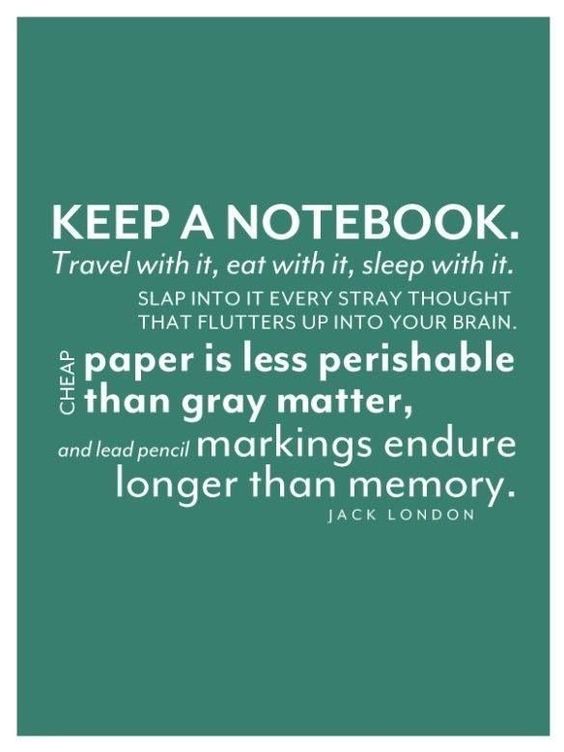
Keep a notebook

cec61b90bd9e0986e82bdfd6dc7553b5

It’s been one of *those* days, so I’m going to leave you with this.

About Writing

How Predictability Enhances Reader Engagement in Novels

The book, Lost in Math, talks about how some dudes, using the magical power of MATHS, scientifically prove that, on a scale of 1 being super predictable and 10 being extremely unpredictable, all popular music, from Beethoven to Lady Gaga, rated about a 4-6. Only, you know, they used sciencey terms to make it all official and whatnot.

The author goes on to say:

Intuitively this means that good music lives on the edge between predictability and unpredictability. When we turn on the radio, we want to be surprised — but not too much. Not so surprisingly, then, popular music follows quite simple recipes, and you can sing along when the chorus repeats.

This observation about music, I think, carries over to other areas of human life. In the arts, in writing, and in science too we like to be surprised, but not too much. …

Lost In Math, Sabine Hossenfelder, chapter 5

The author then goes on to explain the effect that this has had on the scientific community, but this isn’t a science or math blog, so we’ll stop there.

We’re going to apply this phenomenon to novels.

As readers, we don’t like stories about people who simply wake up, brush their teeth, go to work, eat dinner, then go to bed at night. Why? Because that’s how most of us live. Sometimes we mix it up with vacations, trips to the zoo, or whatever floats your boat, but day-to-day life is routine. We don’t have to pick up a book to experience it.

As readers, we also don’t like stories that are too bizarre. We don’t like having too many new concepts and terms thrown at us all at once, or reading a story that is completely unrelatable on any level. That’s why the Redwall series, for example, humanizes its animal characters — they wear clothes, cook food, fight with swords, and refrain from leaving droppings on counter tops — because that’s what the human audience relates to.

Therefore, writers need to learn how to balance between predictable and unpredictable if they desire a wider audience. Make it interesting, but relatable. Put a new spin on old ideas. Blend cliches with unique concepts. Trust me, most readers won’t constantly reference a companion encyclopedia to know what the heck you’re talking about; they’ll just quit reading.

Twilight was insanely popular despite its amateur writing, because it took the familiar ideas of romance and teenage angst, and paired it with the brand new idea of vampires that sparkled in the sunlight. Just one new angle on a mountain of cliches skyrocketed it into a #1 best seller. I mean, c’mon, who else would have ever thought of sparkly vampires?

So…

Surprise your readers!

But not too much.

About Writing

The Benefits of Using a Handwritten Binder for Writing

I like to work on one novel at a time, as I have found that not only is my focus much better that way, it serves as good motivation to actually finish the story before moving on to the next — otherwise I’d have a million works-in-progress and no endings.

Inspiration, on the other hand, doesn’t follow my schedule. It strikes whenever it pleases. That’s one of the reasons why I prefer keeping a handwritten binder rather than typing on a laptop. My binder is indispensable, always nearby, and never low on battery.

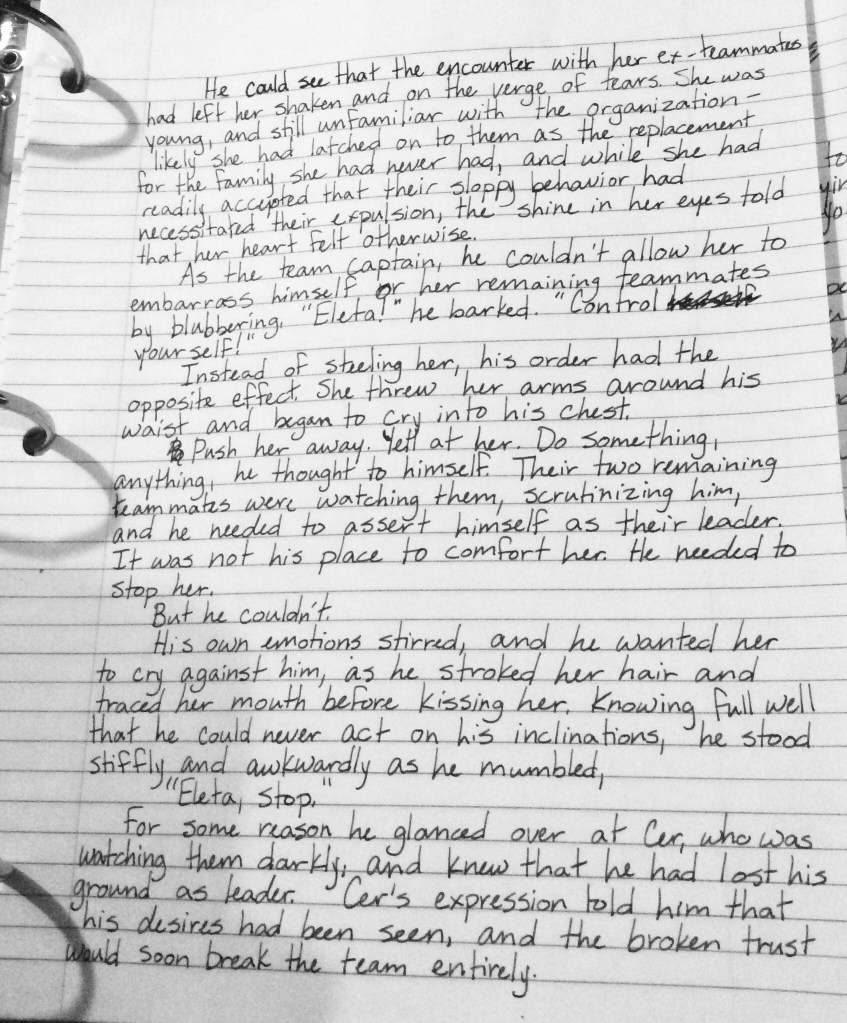
Whenever a new idea hits me, I write a page or two like this:

It’s not beautiful or elegant. In and of itself, it’s too vague to be particularly enjoyable for reading, but it contains everything I need to remember the idea.

Sometimes I don’t know any names, so I write down variables instead, such as “B” or “Z”. Those pages tend to look really weird.

Then it goes into the back of my binder, and waits for its turn. The proximity ensures that I often see it and thus never forget its existence.

When it’s time to start a new novel, I pick the idea that has the loudest voice.

Stories

The Midnight Window

I recently came across this short story that I originally wrote in 2008. I liked it enough to use it as editing practice, and brought it up-to-date to my current skill level.


He was watching them again.

He found his nose pressed against the cold glass window, his eyes locked on the room beyond, unconsciously counting the rising and falling breaths of each dark lump snuggled warmly in the bed, and he had no memory of how he had gotten there. They were bigger. They always seemed bigger each time he huddled against the side of the house, watching them sleep. He wondered how many years it had been, then found it absurd that he would even still care.

He used to also watch through the window on the other side of the house, gazing at the sleeping woman with some unknown regret pounding at his frozen heart. Used to, that is, until a man appeared next to her in bed, and he realized that his former position was no longer empty. After that, he lost all desire to venture beneath that particular window, and the pain that seared him never flared up again.

Now he spent his time with the small ones, peering at them through the blackness. Sometimes he would stay there all night, unable to tear himself away until the threat of dawn forced him into hiding. Those two sleeping mounds, buried under blankets, contained the last living fragment of him. When he saw them, he felt calm.

The littlest one woke up one night. Her head had lifted from the pillow and she looked toward him, riveting him in place despite his desire to flee. She didn’t seem afraid as she slowly slid out of bed and tiptoed up to the window. He could see her face clearly, and her long blonde hair that flowed down her back over her lacy nightgown. Her familiar blue eyes met his, as she put her hand against the glass, and he felt compelled to press his own hand against the other side. Then she whispered a single word,

“Papa.”

Something shot through his insides when he heard her speak, and he found himself floating as a silver mist, terrified that the wind would scatter him across the surrounding forest. It was some time before he found the strength to will himself back to solidity. He learned something crucial about his nature that night, and it gave him the resolve to stay away.

He didn’t know how much time passed before he went back, but the longing had become to much for him to deny. There was a third shape now, much smaller than the others, nestled between them with a tiny fist held up into the air. He knew what it was, and was surprised that he didn’t care. Perhaps he was now too far removed from his humanity to experience that emotion again.

This would be the last time that he would gaze at his children. They had moved forward with the life that he could never share, and it was time for him to let go. He was a vampire now, and didn’t belong in the world of the living. The final threads that kept him chained to the place were broken, and soon he would forget that they had ever existed.

About Writing

Why Plot Twists Need Logical Consistency

I suppose that one of the side effects of taking lots of creative writing classes in the early 2000’s is that I follow a lot of guidelines that have been tossed aside by my contemporaries. With years of contemplation and analysis, I have decided that they are very good ideas indeed, and I kind of wish that more writers thought the same way.

Plot twists that don’t make any sense.

The most egregious example of this is Disney’s Frozen, with the whole, “Hans is secretly evil” thing. His accounting for his actions is that he wanted to be king, but going through with marrying Anna would have given him exactly what he wanted, especially with Elsa running around crazy — come on, it’s not like marrying into an advantageous position never happened historically. Also, wanting to be king is ambitious, but not wrong in and of itself.

The whole, “I’m going to let you die while I laugh evilly” scene is nonsensical and jarring. After all, if the guy is that much of a sociopath, he’d maintain the act right through the very end, and never reveal his true thoughts under any circumstances.

The worst part is, there isn’t a single ounce of foreshadowing. I know that plenty of people have come up with “epileptic trees” style theories trying to prove there is, but I’ve seen that movie a million times thanks to my little girls, and there isn’t even a calculating look or anything. Rule of thumb: if foreshadowing isn’t immediately obvious the second time around, then it isn’t there.

It’s like the writers didn’t have the slightest clue how it should end, so they randomly threw that in as a drunken late night decision, and it killed the whole movie.

Plot twists must stay in character and make logical sense.

Even if you feel like you’re giving everything away by mentioning that Martha was irrationally jealous five chapters before she runs Jimmy over with a car, remember that the readers aren’t going to know what you’re building up to, but they will feel jilted if they think you’re deliberately jerking them around. Also remember that bragging, “I SAW IT COMING FIRST!” is just as much fun for the readers as being taken completely by surprise.

Or maybe the story will later reveal that Martha was possessed by a demon, and that’s why her actions were suddenly out of character. After all, these are only guidelines.

About Writing

Rules, shmules

I hate those “writing things to avoid” sorts of lists, as I feel that they rather miss the spirit of creativity. After all, slavish devotion to a set of rules will result in limited writing.

Take, for example, the advice to never start with the description of weather. If you say it fast and don’t think too hard, it seems like sound advice. After all, something like, “The sun was shining brightly as Timmy walked down the street” is pretty boring.

But sometimes the weather matters.

The sun was shining brightly, the birds were singing cheerfully, and a cool breeze was playing through the leaves, making it the perfect day to work, Timmy thought as he pulled out his hacksaw and began cutting up the corpse in front of him.

The description of weather is used to deliberately create a juxtaposition with Timmy’s grim work. That’s interesting.

So, if you’re starting with describing the weather just because you don’t know where else to start, then you should probably spend more time brainstorming. However, don’t be afraid of describing the weather if it serves a purpose to enhance the story, no matter what someone on the internet might have said. Whoever wrote those rules was just after page views anyway.